The five times sit-to-stand test predicts achievable exercise intensity during stress echocardiography
Yasuhide Mochizuki, Yui Kuroki, Mina Shibakai, Ayaka Oda, Sakiko Gohbara, Yumi Yamamoto, Saaya Ichikawa-Ogura, Rumi Hachiya, Eiji Toyosaki, Hiroto Fukuoka, Toshiro Shinke

TL;DR
The 5-STS test helps predict how much exercise a patient can handle during a heart stress test, improving test accuracy for people with physical limitations.
Contribution
The 5-STS test is shown to be a simple and effective predictor of achievable exercise intensity during stress echocardiography.
Findings
A 5-STS cut-off of 11.7 s predicted achieving a 25 W load with high sensitivity and specificity in the derivation cohort.
In the validation cohort, a 12.0 s cut-off demonstrated 98% sensitivity and 88% specificity for predicting achievable load.
Sarcopenia-related indices like 5-STS predicted exercise intensity independently of age and sex.
Abstract
Exercise stress echocardiography (ESE) is becoming increasingly important in assessing heart failure and valvular diseases; however, determining optimal exercise intensity remains challenging, particularly in patients with physical disorders. A total of 94 patients scheduled for ESE were enrolled in the study. Physical capability was assessed using the five times sit-to-stand test (5-STS), Clinical Frailty Scale, acronyms of the five components, namely strength, assistance with walking, rising from a chair, climbing stairs, and falls (SARC-F) questionnaire, grip strength test, and bioelectrical impedance analysis. In the derivation cohort (n = 43), we determined the 5-STS cut-off value to achieving a 25 W load. The effectiveness of this cut-off value was prospectively evaluated in a validation cohort (n = 51). In the derivation cohort, the 5-STS predicted achieving a 25 W load using a…
Genes, proteins, chemicals, diseases, species, mutations and cell lines named across the full text — each resolved to its canonical identifier and authoritative record.
Click any figure to enlarge with its caption.
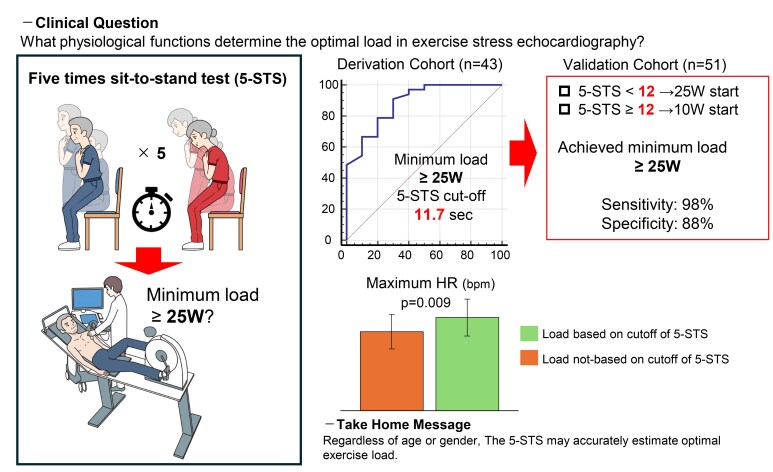 Figure 1
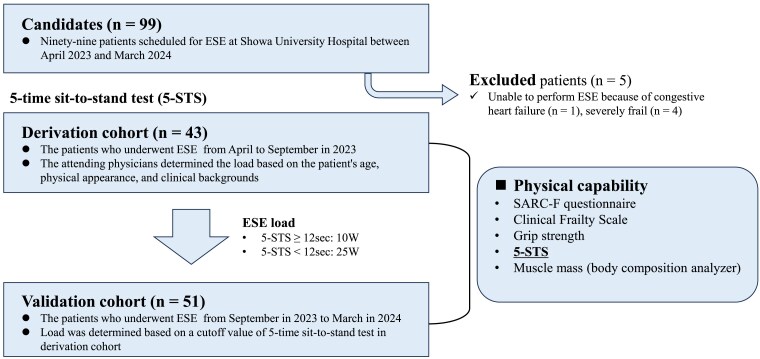 Figure 2
 Figure 3
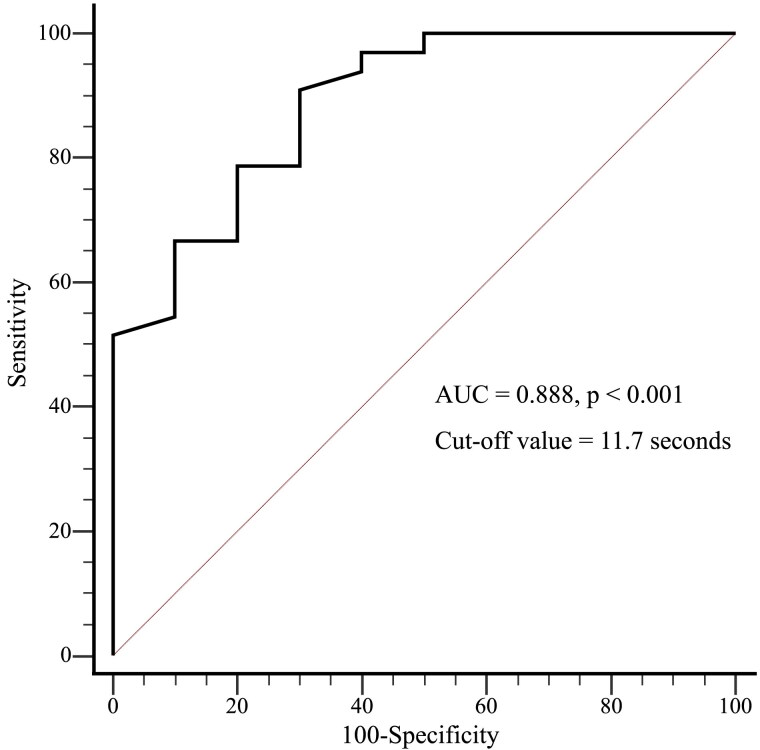 Figure 4
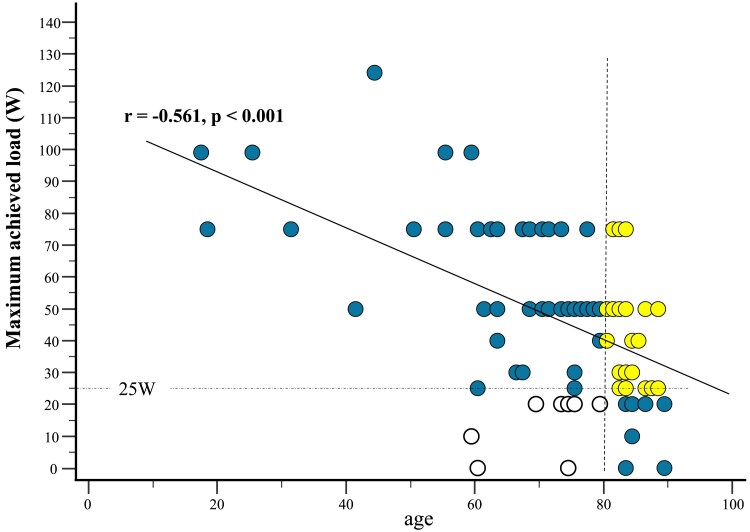 Figure 5
 Figure 6
Peer Reviews
No public reviews on file for this paper yet. If you reviewed it on a platform where reviews are public (OpenReview, ICLR, NeurIPS, ICML), you can paste yours below so the community can read it here.
Videos
No videos yet. Explain this paper in a talk, walkthrough, or lecture? Add one.
Taxonomy
TopicsCardiovascular Effects of Exercise · Cardiovascular and exercise physiology · Cardiac Imaging and Diagnostics