521 A Randomized Trial Comparing a Transparent Biosynthetic Wound Matrix to Silver-foam Dressing for Partial-thickness Burns
David Greenhalgh, David Hill, Ram Velamuri, Ian Driscoll, Angela Gibson, Kevin Foster, David Smith, Aleisha Chamberlain, Katie Bush, Miao Yu

TL;DR
A new transparent wound matrix was tested against a silver-foam dressing for treating partial-thickness burns, showing potential benefits in monitoring and reducing dressing changes.
Contribution
A novel transparent biosynthetic wound matrix was developed and evaluated for partial-thickness burns.
Findings
The biosynthetic matrix showed faster wound closure trends at weeks 2 and 3 compared to silver foam.
The matrix required significantly fewer dressing changes due to its adherence.
Both treatments were similarly safe, with no differences in adverse events or infection rates.
Abstract
A next-generation transparent biosynthetic wound matrix was developed for the treatment of partial-thickness burn injuries. It is composed of an outer slitted 2D silicone epidermal analogue, with customizable pores, which facilitates diffusion of gas and exudate from the wound bed. The silicone sheet is bonded to a nylon knitted fabric coated with porcine gelatin and aloe to induce adherence to the wound until healed. The purpose of this study was to compare the next-generation transparent biosynthetic wound matrix to a commonly used silver-containing foam dressing for the treatment of partial-thickness burns. The study was multicenter, randomized, and open-label. Patients with superficial to deep partial-thickness burns < 30% TBSA were included and treated within 72 hours post-injury. Primary outcomes included 100% re-epithelialization (closure) at 2 weeks and time to conversion to…
Genes, proteins, chemicals, diseases, species, mutations and cell lines named across the full text — each resolved to its canonical identifier and authoritative record.
Click any figure to enlarge with its caption.
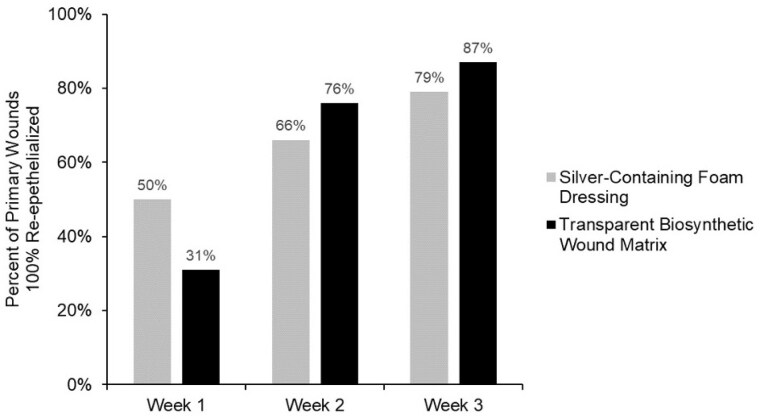 Figure 1
Peer Reviews
No public reviews on file for this paper yet. If you reviewed it on a platform where reviews are public (OpenReview, ICLR, NeurIPS, ICML), you can paste yours below so the community can read it here.
Videos
No videos yet. Explain this paper in a talk, walkthrough, or lecture? Add one.
Taxonomy
TopicsWound Healing and Treatments · Dermatologic Treatments and Research · Reconstructive Facial Surgery Techniques