77 Implementation of a Palliative Consultation Process at an Urban Burn Center: Lessons & Optimizations
Carey Lamphier, Lauren Nosanov, Yuk Ming Liu, Jasmin Mercedes, Laura Johnson

TL;DR
This study shows how implementing a Palliative Medicine consultation process at a busy Burn Center increased its use, but many eligible patients still don't receive it.
Contribution
The paper introduces a practical implementation of a PM consultation guideline and identifies factors influencing its adoption in a high-volume Burn Service.
Findings
PM consultation rates increased 1.5-fold after implementing the guideline.
Only 22.3% of eligible patients received PM consultations, indicating low compliance.
A modified Baux score >110 was the strongest predictor of PM consultation.
Abstract
Burn injuries are life altering events for both patients and families. Early Palliative Medicine (PM) involvement can assist with goals of care planning, symptom management, and emotional and spiritual support, augmenting the holistic multidisciplinary care provided by the Burn team. Identification of need was identified as a quality improvement opportunity given historically low rates of PM consultation. Implementation of a PM consultation guideline occurred at a high volume, urban Burn referral center, using criteria previously suggested in the literature. All patients admitted to the Burn service after June 2023 were included in a prospectively collected registry which included patient demographics, injury specific characteristics, and clinical outcomes. Injury mechanisms were characterized as burn or non-burn and guideline criteria met for each patient were tracked. Descriptive…
Click any figure to enlarge with its caption.
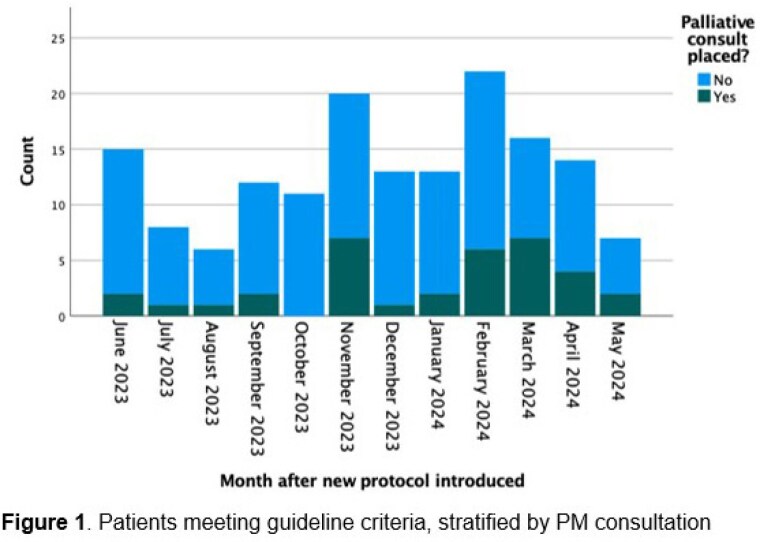 Figure 1
Peer Reviews
No public reviews on file for this paper yet. If you reviewed it on a platform where reviews are public (OpenReview, ICLR, NeurIPS, ICML), you can paste yours below so the community can read it here.
Videos
No videos yet. Explain this paper in a talk, walkthrough, or lecture? Add one.
Taxonomy
TopicsPalliative Care and End-of-Life Issues