585 Minimizing Unnecessary Procedures: Revisiting Fiberoptic Laryngoscopy Protocols for Pediatric Burn Patients in the Emergency Department
Dmitry Kotovich, Stav Sarna Cahan, Lea Ohana Sarna Cahan, Miriam Ben Hamo, Saar Hashavya, Menahem Gross

TL;DR
This study suggests that fiber optic laryngoscopy should not be routinely used for pediatric facial burn patients but only when clinical signs of inhalation injury are present.
Contribution
The study provides evidence that routine fiber optic laryngoscopy in pediatric facial burn cases is unnecessary and should be used selectively.
Findings
FOL had low sensitivity (29%) but high specificity (95%) for detecting inhalation injury compared to clinical findings.
Only 7.3% of patients had FOL findings indicating inhalation injury, with half of them not showing clinical signs.
Routine FOL use in pediatric facial burn patients is not recommended due to low sensitivity and patient discomfort.
Abstract
Facial burn injuries in pediatric patients can significantly threaten airway patency, requiring immediate evaluation. Current assessment algorithms mainly rely on clinical judgment, with limited data supporting the use of Fiber Optic Laryngoscopy (FOL) as a supplementary test. This study aims to assess whether FOL is necessary in the routine evaluation of pediatric facial burn patients and recommends its use only when clinical signs of inhalation injury are present. This retrospective analysis covered data from all patients aged 0-18 admitted to a Level 1 trauma and burn center with facial burns, who underwent FOL by an ENT physician between January 2010 to December 2022. Data collected included demographics, mechanism of injury, clinical findings, FOL findings, intubation performed, pediatric intensive care unit (PICU) admission and mortality rate. Statistical analysis was performed…
Click any figure to enlarge with its caption.
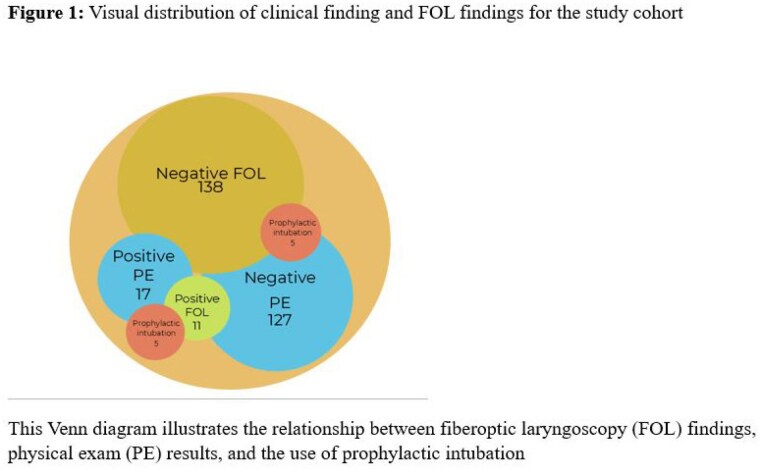 Figure 1
Peer Reviews
No public reviews on file for this paper yet. If you reviewed it on a platform where reviews are public (OpenReview, ICLR, NeurIPS, ICML), you can paste yours below so the community can read it here.
Videos
No videos yet. Explain this paper in a talk, walkthrough, or lecture? Add one.
Taxonomy
TopicsAirway Management and Intubation Techniques · Restraint-Related Deaths · Tracheal and airway disorders