984 Social Stories on the Burn Unit: Improving Communication with Neurodiverse Patients
Elizabeth Bowers, Arleta Brehm, Michael Feldman, Tiffany Lord, Sterling Hundley

TL;DR
This paper describes the development of social stories to improve communication with neurodiverse patients in a burn unit, addressing a gap in healthcare training and resources.
Contribution
The paper introduces burn-specific social stories as a novel communication tool for neurodiverse patients in a hospital setting.
Findings
Burn center staff reported a lack of training and resources for communicating with neurodiverse patients.
Social stories were developed and are being used to improve understanding and behavior in medical settings.
An art class is being considered to expand the social story collection.
Abstract
Medical personnel frequently report that they possess limited training, skills, and resources to effectively interact with neurodiverse patients. Neurodiverse individuals report poorer quality of healthcare and worse overall health than neurotypical counterparts. One method for improved communication with neurodiverse patients is social stories. They introduce readers to unfamiliar situations utilizing clear, brief language accompanied by a simple picture or symbol. They provide the reader with a linear set of events, expected behaviors, and outcomes. Our burn center is a 16-bed unit that serves adult and pediatric patients, with an average of 550 admissions a year. Several cases have made it clear that we need an improved approach to communication with the neurodiverse population. Interviews were conducted with burn center staff regarding their comfort level in communicating and…
Click any figure to enlarge with its caption.
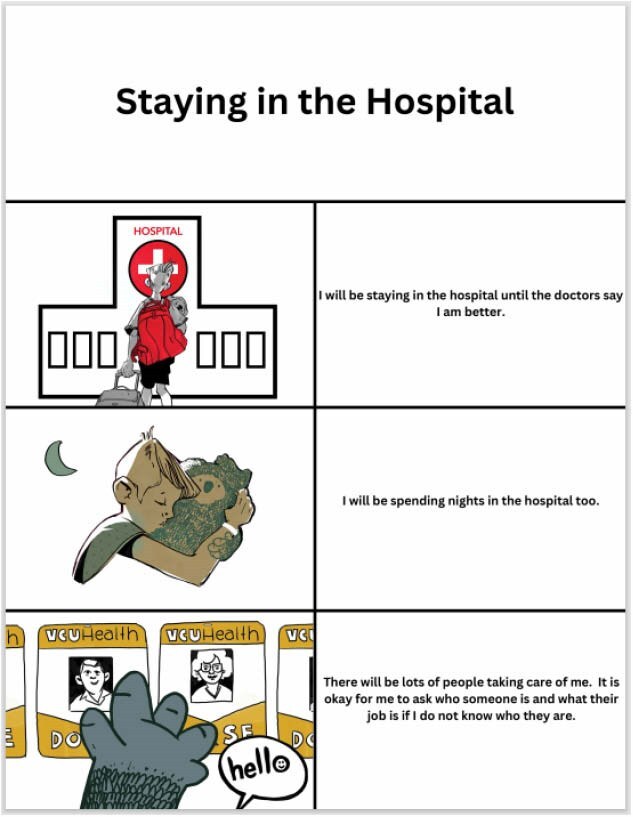 Figure 1
Peer Reviews
No public reviews on file for this paper yet. If you reviewed it on a platform where reviews are public (OpenReview, ICLR, NeurIPS, ICML), you can paste yours below so the community can read it here.
Videos
No videos yet. Explain this paper in a talk, walkthrough, or lecture? Add one.
Taxonomy
TopicsStroke Rehabilitation and Recovery · Art Therapy and Mental Health