623 Hardwiring Best Practice to Prevent CLABSIs in the Burn ICU
Joseph Knapp, Tracy Larson

TL;DR
A Burn ICU implemented best practices to reduce central line use and prevent infections, achieving significant improvements in patient care and outcomes.
Contribution
A multifaceted, evidence-based approach successfully reduced central venous catheter utilization and CLABSI rates in a Burn ICU.
Findings
The central line utilization ratio (SUR) was reduced to an average of 0.875, below the target of 1.0.
Central venous catheter (CVL) days decreased by 12.8% during the intervention period.
Seven consecutive months of SUR below 1.0 were achieved, indicating sustained improvement.
Abstract
Our Burn ICU’s current Standard Utilization Ratio (SUR) of central venous catheters is 1.084on average from 10/22 thru 7/2023 which is above comparable groups. This could lead to increased morbidity, resource utilization and financial strain. Reducing our SUR is crucial to provide higher quality care and improve patient outcomes. We incurred 4 CLABSIs during FY23, 3 of which were burn patients Our goal is to reduce our central line utilization ratio from 1.091 to =< 1.0 by the end of the end 2/2024 Furthermore, we wanted to reduce our CVL days by >=10%. To be achieved through evidence-based practice interventions and pragmatic efforts of a multidisciplinary team. Throughout this quality improvement process enhanced presence and discussion of CVLs is warranted given the sense of urgency to reduce future CLABSIs from our unique patient population to include all patients admitted to…
Click any figure to enlarge with its caption.
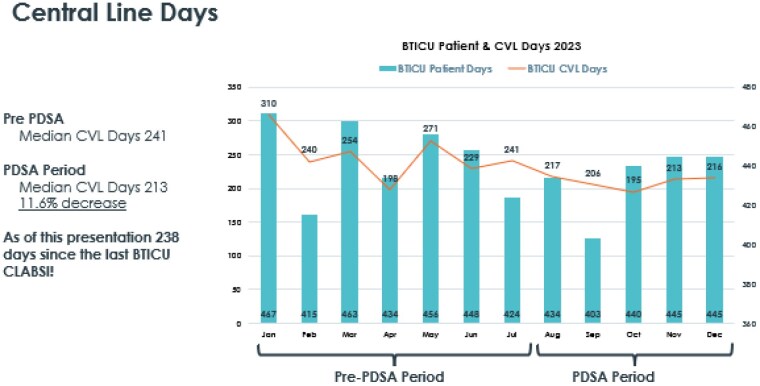 Figure 1
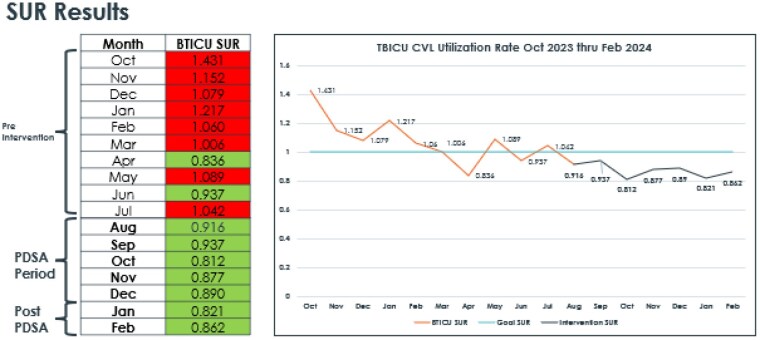 Figure 2
Peer Reviews
No public reviews on file for this paper yet. If you reviewed it on a platform where reviews are public (OpenReview, ICLR, NeurIPS, ICML), you can paste yours below so the community can read it here.
Videos
No videos yet. Explain this paper in a talk, walkthrough, or lecture? Add one.
Taxonomy
TopicsBurn Injury Management and Outcomes · Dermatologic Treatments and Research