637 Skin Deep? The Unseen Wounds of Burn Care Professionals
Ashley Honea, W Michelle Spencer, Claudia Islas, Karen Richey, Kevin Foster

TL;DR
Burn care professionals are at high risk for developing secondary traumatic stress due to caring for trauma-exposed patients.
Contribution
This study reports the prevalence of secondary traumatic stress among burn healthcare staff using a validated scale.
Findings
38% of burn staff scored in the mild or moderate range for secondary traumatic stress.
43% of participants scored in the high or severe range for secondary traumatic stress.
The study was conducted during a peak burn season with tragic patient cases, potentially influencing results.
Abstract
Secondary Traumatic Stress (STS) is a consequence of caring for another individual who has themselves been exposed to a traumatic incident. The nature of burn injuries put burn healthcare staff at risk for developing STS as a result of caring for these trauma-exposed patients. STS symptoms mirror Post Traumatic Stress Disorder, manifesting in intrusion, avoidance, and arousal symptoms. STS research has initially focused on mental health professionals and has expanded to include other high-risk occupations. The purpose of this study was to determine the prevalence of STS among burn healthcare staff. The Secondary Traumatic Stress Scale (STSS) is a 17-item validated instrument used to evaluate the frequency of STS symptoms. The 5-point Likert scale is comprised of 3 subscales measuring intrusion, avoidance and arousal. The total score ranges from 17-85, scores are categorized as: no STS…
Click any figure to enlarge with its caption.
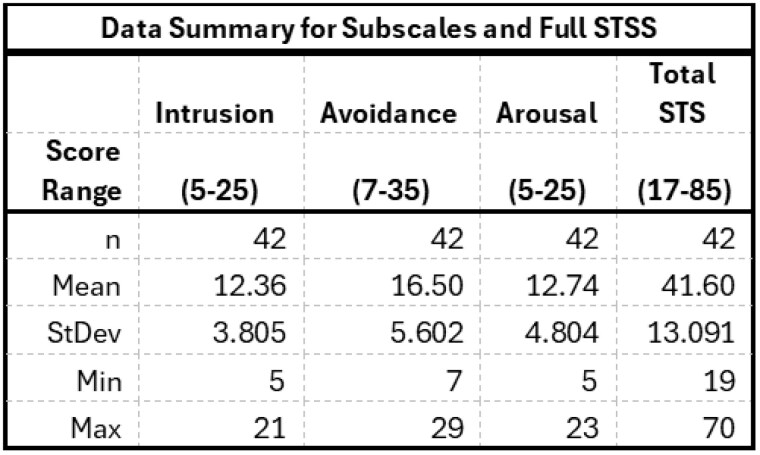 Figure 1
Peer Reviews
No public reviews on file for this paper yet. If you reviewed it on a platform where reviews are public (OpenReview, ICLR, NeurIPS, ICML), you can paste yours below so the community can read it here.
Videos
No videos yet. Explain this paper in a talk, walkthrough, or lecture? Add one.
Taxonomy
TopicsBurn Injury Management and Outcomes