931 Prescription Analysis of Antihistamines’ Use in Patients with Moderate to Severe Burns
Abbas Karim, Nizam Karim, Suhaib Shah, Rashid Syed, Zain Akbar, Farhad Marzook, Juquan Song, George Golovko, Steven Wolf, Amina El Ayadi

TL;DR
This study examines how antihistamines are prescribed for itch management in patients with moderate to severe burns, finding that hydroxyzine is commonly used but treatment delays and frequent switching suggest room for improvement.
Contribution
The study provides a large-scale analysis of antihistamine prescription patterns for post-burn pruritus across varying burn severities.
Findings
Over 70% of patients with burns ≥20% TBSA received antihistamines for pruritus management.
Hydroxyzine is the most commonly prescribed antihistamine, followed by diphenhydramine.
Treatment delays and frequent switching suggest suboptimal initial therapies and a need for improved protocols.
Abstract
Post-burn pruritus (PBP) significantly affects patients with moderate to severe burns (≥20% TBSA), causing discomfort and hindering recovery. Antihistamines, which block H1 receptors, are commonly prescribed for PBP, but large-scale studies on their usage patterns are limited. This study evaluates antihistamine prescription trends and provider practices for PBP across varying burn severities. We performed a treatment pathways analysis using TriNetX, a global, federated, deidentified database. A cohort of patients with burns ≥20% TBSA from the past 20 years (2004–2024) who developed pruritus was identified and stratified into four cohorts: 20-40%, 40-60%, 60-80%, and >80% TBSA. The analysis evaluated trends in antihistamine prescriptions, including the proportion treated with antihistamines, types prescribed, and median times to treatment initiation, duration, and therapy switching.…
Genes, proteins, chemicals, diseases, species, mutations and cell lines named across the full text — each resolved to its canonical identifier and authoritative record.
Click any figure to enlarge with its caption.
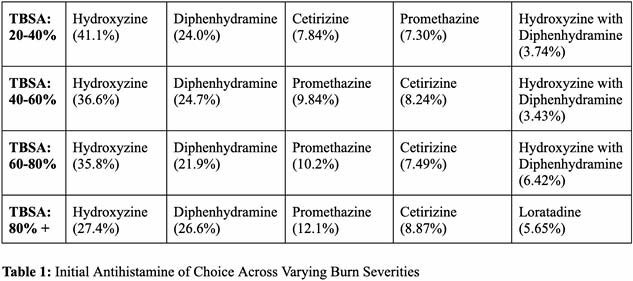 Figure 1
Peer Reviews
No public reviews on file for this paper yet. If you reviewed it on a platform where reviews are public (OpenReview, ICLR, NeurIPS, ICML), you can paste yours below so the community can read it here.
Videos
No videos yet. Explain this paper in a talk, walkthrough, or lecture? Add one.
Taxonomy
TopicsWound Healing and Treatments · Pressure Ulcer Prevention and Management · Dermatology and Skin Diseases