691 Effectiveness of an Early Mobility Timeline for Patients with Lower Extremity Split Thickness Skin Grafts
Connie Yeung

TL;DR
This study shows that early mobility for burn patients with lower extremity skin grafts can be safely implemented and reduces hospital stay.
Contribution
The study introduces an early mobility timeline for lower extremity skin graft patients and demonstrates its safety and effectiveness in reducing hospital length of stay.
Findings
96% of patients with early mobility did not experience graft loss, and minimal graft loss healed without further surgery.
Hospital length of stay decreased by an average of 1 day with early mobility compared to delayed mobility.
Early mobility was safely implemented on post-op day 3 with external compression.
Abstract
The long-standing mobility guideline for patients with lower extremity (LE) split-thickness skin grafts (STSG) in our burn unit is as follows: post-op day (POD) #1-4 bed rest, POD#5 edge of bed sitting, POD#6 transfers, POD#7 ambulation. Prolonged bed rest, however, can result in detrimental physiological effects, and practice guidelines for early ambulation have recommended mobility earlier than POD#5 for burn patients with LE STSG. Therefore, an early mobility timeline was developed to mobilize patients with LE STSG on POD#3. We hypothesize that early mobility will not result in graft loss when external compression is utilized, and hospital length of stay (LOS) will decrease. The developed early mobility timeline is as follows: POD#3: transfer out of bed to a chair with LE ace wraps; use splints when STSG crosses a joint POD#4: remove splints, ambulate in-room distances POD#5:…
Click any figure to enlarge with its caption.
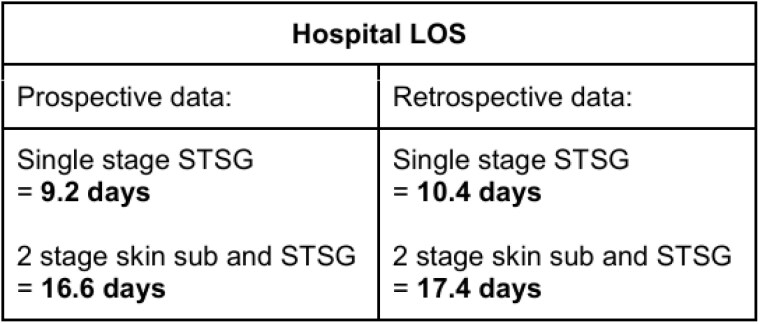 Figure 1
Peer Reviews
No public reviews on file for this paper yet. If you reviewed it on a platform where reviews are public (OpenReview, ICLR, NeurIPS, ICML), you can paste yours below so the community can read it here.
Videos
No videos yet. Explain this paper in a talk, walkthrough, or lecture? Add one.
Taxonomy
TopicsReconstructive Surgery and Microvascular Techniques