898 Analysis of Healthcare Disparities in Burn Patients
Rahel Eshete, Richard Korentager, Dhaval Bhavsar

TL;DR
The study found no significant differences in mortality rates among burn patients of different races, but noted variations in length of stay and comorbidities.
Contribution
This study contributes empirical evidence on healthcare disparities in burn patients, focusing on institutional outcomes and care uniformity across racial groups.
Findings
No significant difference in mortality rates was found between racial groups.
Caucasian patients had longer length of stay and higher comorbidities.
Uninsured status did not adversely affect outcomes for Hispanic/Latino patients.
Abstract
Prior research has indicated that race, gender, and socioeconomic status all influence the cost of care, outcomes, and mortality rates in burn patients. We wanted to see if there was any disparity in outcomes of our burn patients in relation to ethnicity and race. After IRB approval, we conducted retrospective review of burn registry data of 3646 patients from 2010 - 2020. We collected information on demographics, burn characteristics, co-morbidities, length of stay (LOS), number of surgeries, mortality, and complications. For the purposes of this study, the race category was divided into four groups: Caucasians, African American, Hispanic/Latino, and all others that include American Indian or Alaskan Natives, Asian, and Native Hawaiian or other Pacific Islander. The Hispanic/Latino group is categorized only if the chart selected that category for race and ethnicity. We were able to…
Click any figure to enlarge with its caption.
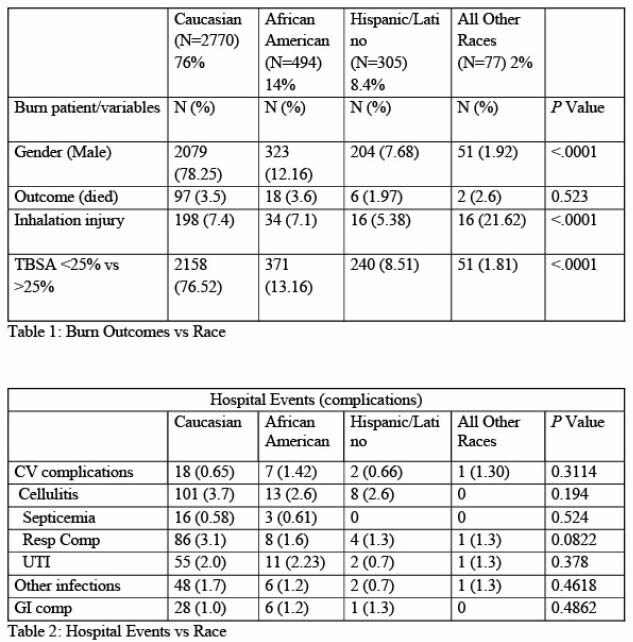 Figure 1
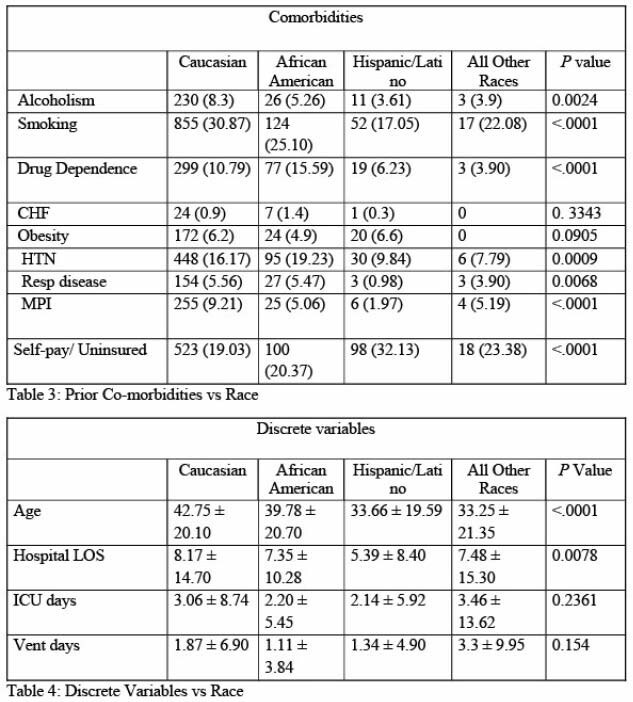 Figure 2
Peer Reviews
No public reviews on file for this paper yet. If you reviewed it on a platform where reviews are public (OpenReview, ICLR, NeurIPS, ICML), you can paste yours below so the community can read it here.
Videos
No videos yet. Explain this paper in a talk, walkthrough, or lecture? Add one.
Taxonomy
TopicsHealthcare Systems and Public Health