Aerobic exercise and brain structure among military service members and Veterans with varying histories of mild traumatic brain injury: A LIMBIC-CENC exploratory investigation
Samuel R. Walton, John J. Fraser, Jessie R. Oldham, Mark L. Ettenhofer, Patrick Armistead-Jehle, Hannah M. Lindsey, Naomi J. Goodrich-Hunsaker, Emily L. Dennis, Elisabeth A. Wilde, Sarah M. Jurick, Michael J. Hall, Randel L. Swanson, Andrew J. MacGregor, David F. Tate

TL;DR
This study explores how aerobic exercise and a history of mild traumatic brain injuries affect brain structure in military service members and veterans.
Contribution
The study provides new insights into how aerobic exercise and mTBI history interact to influence brain gray matter volumes in military populations.
Findings
Inactive participants had worse brain volume outcomes compared to those who were insufficiently active.
Highly active individuals with no mTBI history had worse brain volume outcomes compared to less active individuals.
Highly active individuals with multiple mTBIs had better brain volume outcomes compared to those with fewer mTBIs.
Abstract
To explore associations of recent moderate-to-vigorous aerobic exercise (MVAE) participation and lifetime mild traumatic brain injury (mTBI) history with measures of brain gray matter volumes among military service members and Veterans (SMVs). Participants (n = 1,340; aged 41.3 ± 10.3 years; 13% female) were SMV’s who participated in the Long-term Impact of Military-relevant Brain Injury Consortium-Chronic Effects of Neurotrauma Consortium Prospective Longitudinal Study (LIMBIC-CENC PLS). MVAE participation was self-reported via the Behavioral Risk Factor Surveillance System and categorized according to current MVAE recommendations (Inactive, Insufficiently Active, Active, and Highly Active). Lifetime mTBI history was queried via validated structured interview and categorized as 0 mTBI, 1-2 mTBIs, 3 + mTBIs. Structural MRI (T1- and T2-weighted images) were used to measure gray matter…
Genes, proteins, chemicals, diseases, species, mutations and cell lines named across the full text — each resolved to its canonical identifier and authoritative record.
Click any figure to enlarge with its caption.
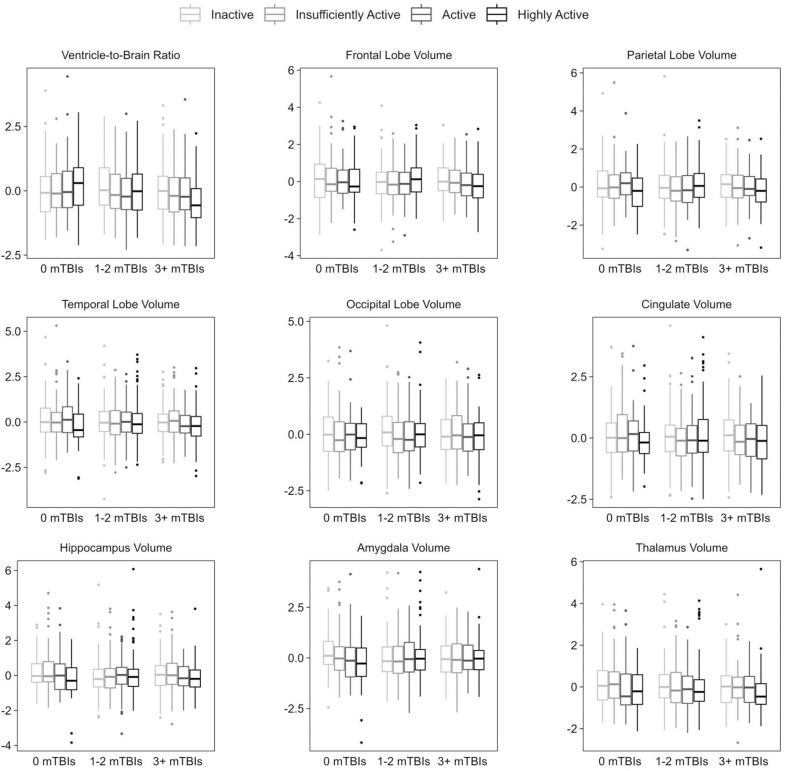 Figure 1
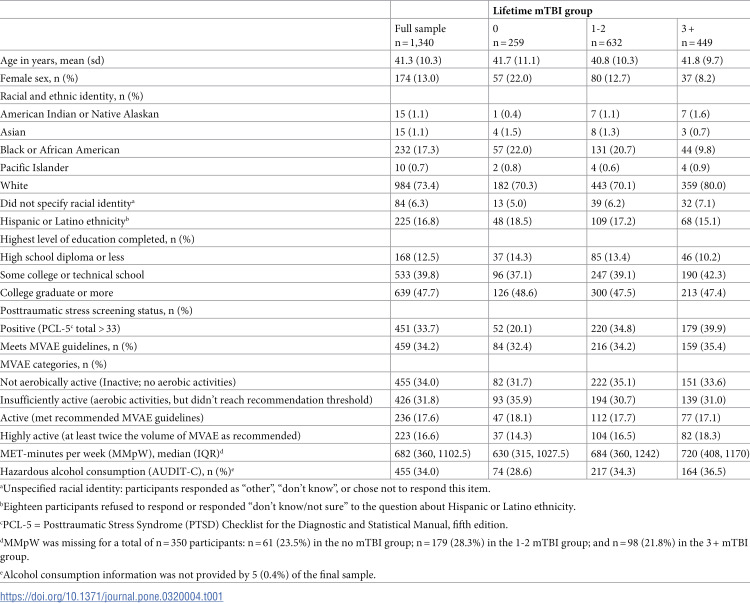 Figure 2
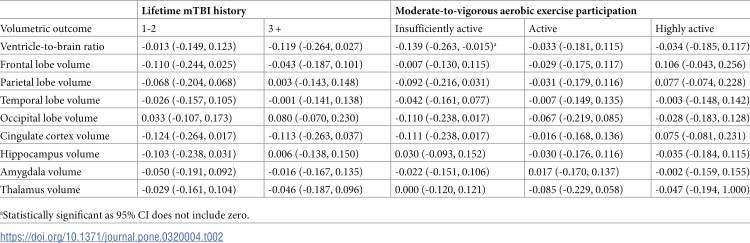 Figure 3
Peer Reviews
No public reviews on file for this paper yet. If you reviewed it on a platform where reviews are public (OpenReview, ICLR, NeurIPS, ICML), you can paste yours below so the community can read it here.
Videos
No videos yet. Explain this paper in a talk, walkthrough, or lecture? Add one.
Taxonomy
TopicsTraumatic Brain Injury Research · Cardiac Arrest and Resuscitation · Traumatic Brain Injury and Neurovascular Disturbances