Sex-specific Associations of Gene Expression with Alzheimer’s Disease Neuropathology and Ante-mortem Cognitive Performance
Logan Dumitrescu, Mabel Seto, Michelle Clifton, Melisa Lara Gomez, Gillian Coughlan, Katherine Gifford, Angela Jefferson, Philip De Jager, David Bennett, Yanling Wang, Lisa Barnes, Julie Schneider, Timothy Hohman, Rachel Buckley

TL;DR
This study explores how gene expression relates to Alzheimer’s disease in men and women, finding sex-specific patterns that could help improve precision medicine for the disease.
Contribution
The study identifies sex-specific gene associations with Alzheimer’s disease neuropathology and cognition, including significant X-linked genes and biological pathways.
Findings
10% of significant gene associations with Alzheimer’s disease were sex-specific, with 73% found in females.
Four X-linked genes showed significant sex differences in their associations with AD endophenotypes.
Female-specific pathways like neuroinflammation and neuronal development were linked to Alzheimer’s disease.
Abstract
The biological mechanisms underlying the increased prevalence of Alzheimer’s disease (AD) in women remain undefined. While previous case/control studies have identified sex-biased molecular pathways, the sex-specific relationships between gene expression and AD endophenotypes, particularly involving sex chromosomes, are underexplored. With bulk transcriptomic data across 3 brain regions from 767 decedents, we investigated sex-specific associations between gene expression and post-mortem β-amyloid and tau, as well as antemortem longitudinal cognition. Among 23,118 significant gene associations, 10% were sex-specific, with 73% of these identified in females and primarily associated with tau tangles and longitudinal cognition (90%). Notably, four X-linked genes, MCF2, HDAC8, FTX, and SLC10A3, demonstrated significant sex differences in their associations with AD endophenotypes (i.e.,…
Genes, proteins, chemicals, diseases, species, mutations and cell lines named across the full text — each resolved to its canonical identifier and authoritative record.
Click any figure to enlarge with its caption.
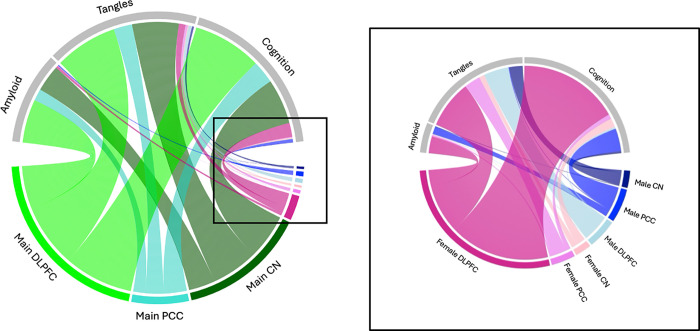 Figure 1
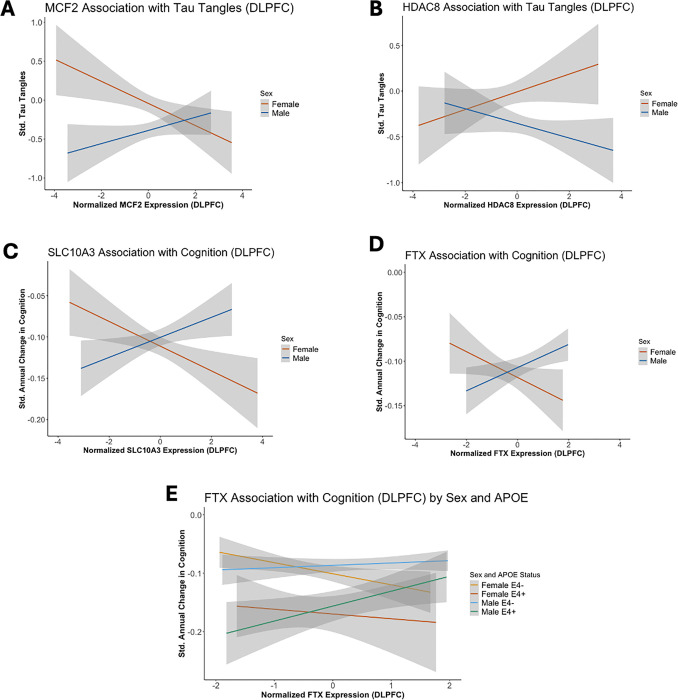 Figure 2
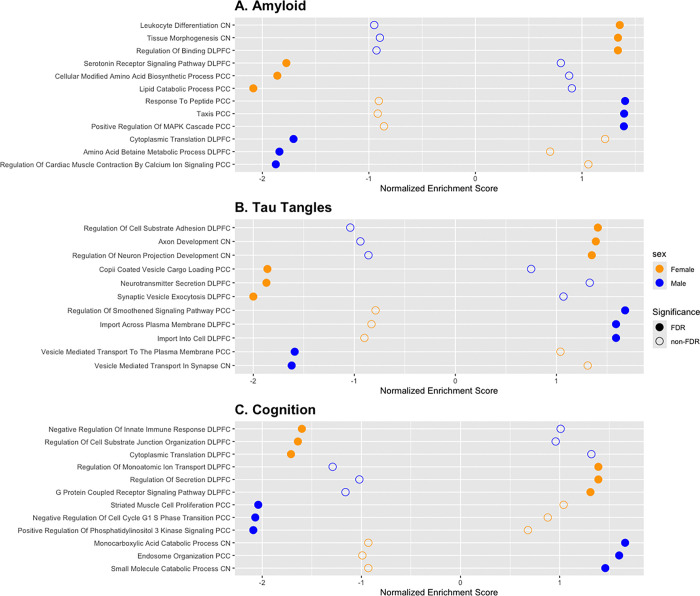 Figure 3
Peer Reviews
No public reviews on file for this paper yet. If you reviewed it on a platform where reviews are public (OpenReview, ICLR, NeurIPS, ICML), you can paste yours below so the community can read it here.
Videos
No videos yet. Explain this paper in a talk, walkthrough, or lecture? Add one.
Taxonomy
TopicsBioinformatics and Genomic Networks · Genetic Associations and Epidemiology · Epigenetics and DNA Methylation