Anticipated Imitation Is Not Affected by the Number of Imitators
Bence Neszmélyi, Roland Pfister

TL;DR
The study found that expecting to be imitated by one or two people has the same effect on action planning, suggesting that the brain uses simplified representations for anticipated imitation.
Contribution
The paper shows that anticipated imitation is not influenced by the number of imitators, unlike motor priming from observing multiple agents.
Findings
Anticipated imitation effects were similar for one or two imitators.
The brain uses sparse representations for anticipated imitation.
This contrasts with motor priming effects from observing multiple agents.
Abstract
Abstract: Anticipating to be imitated by another agent primes corresponding action plans in action models. Here we assessed whether being imitated by more than one coactor boosts anticipated imitation. This prediction was based on corresponding findings from motor priming by perceiving rather than anticipating movements of multiple agents. In contrast to this previous work, the effects of anticipated imitation were similar for imitation by a single agent and joint imitation by two agents. Anticipated imitation, therefore, appears to be based on sparse representations of only selected features rather than including a full representation of all possible consequences of one’s own movements.
Genes, proteins, chemicals, diseases, species, mutations and cell lines named across the full text — each resolved to its canonical identifier and authoritative record.
Click any figure to enlarge with its caption.
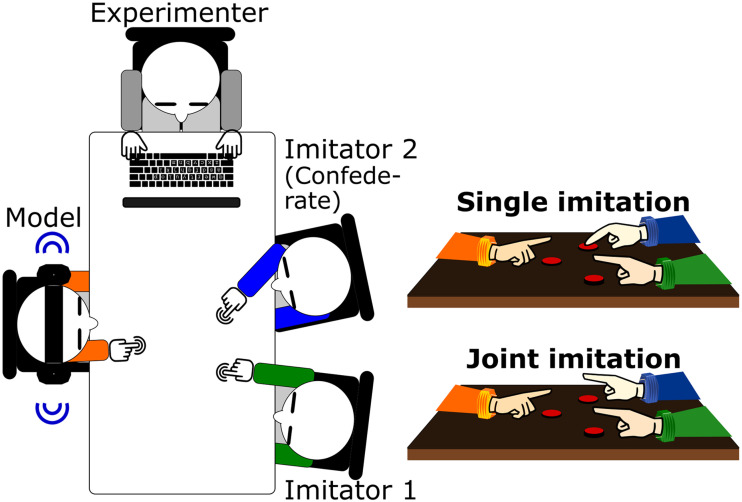 Figure 1
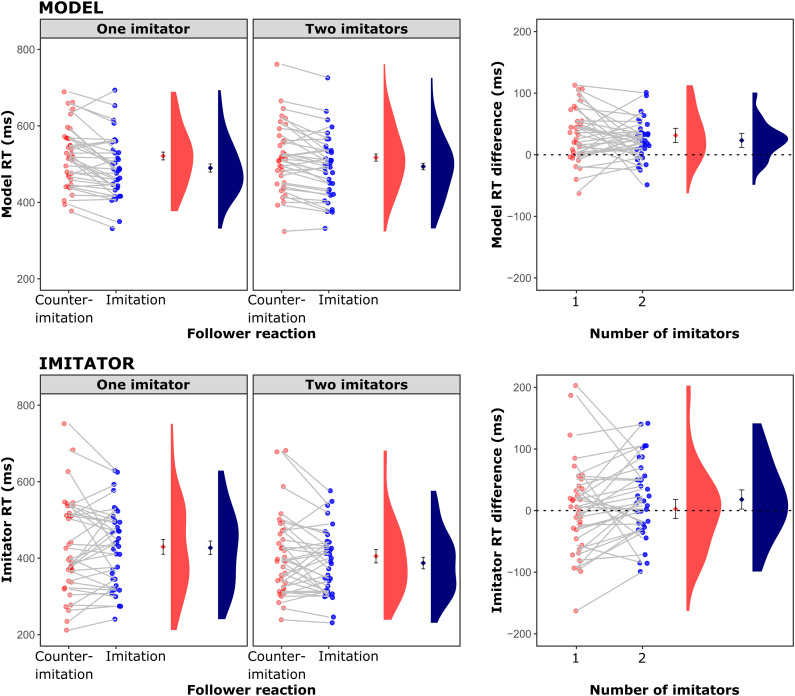 Figure 2
 Figure 3
Peer Reviews
No public reviews on file for this paper yet. If you reviewed it on a platform where reviews are public (OpenReview, ICLR, NeurIPS, ICML), you can paste yours below so the community can read it here.
Videos
No videos yet. Explain this paper in a talk, walkthrough, or lecture? Add one.
Taxonomy
TopicsAction Observation and Synchronization · Motor Control and Adaptation · Face Recognition and Perception