Enhancing access to nephrology care: telenephrology dashboard optimization via human-centered design
Melissa Swee, Bharat Kumar, M. Lee Sanders, Angie Thumann, Kantima Phisitkul, Benjamin R. Griffin, Masaaki Yamada, Meenakshi Sambharia, Mary Vaughan-Sarrazin, Heather S. Reisinger, Bradley S. Dixon, Diana I. Jalal

TL;DR
This paper describes the development of a telenephrology dashboard optimized through human-centered design to improve kidney health monitoring and remote consultations for patients.
Contribution
A novel telenephrology dashboard optimized via human-centered design to enhance remote nephrology care delivery.
Findings
Three critical needs identified: improved data clarity, accuracy, and balance between standardization and customization.
Five dashboard prototypes were iteratively refined into a final version with five core features.
Dashboard includes predictive kidney disease progression models and customizable views.
Abstract
Ensuring that patients, especially those in underserved areas, have access to specialized nephrology care is essential to addressing the increasing burden of chronic kidney disease. To address this, we developed the Telenephrology Dashboard for the 150,000 Veterans served by the Iowa City Veterans Affairs Health Care System (ICVAHCS). Our goal was to optimize the dashboard as a comprehensive and practical tool for end-users in order to monitor kidney health and facilitate remote nephrology consultations. The optimization process adhered to the Human-Centered Design (HCD) framework, encompassing five stages: Empathize, Define, Ideate, Prototype and Test. Research team members spent 10 h observing nephrologists during remote consultations and supplemented these observations with semi-structured interviews with clinicians to gain insights into existing workflows and challenges. A rapid…
Genes, proteins, chemicals, diseases, species, mutations and cell lines named across the full text — each resolved to its canonical identifier and authoritative record.
Click any figure to enlarge with its caption.
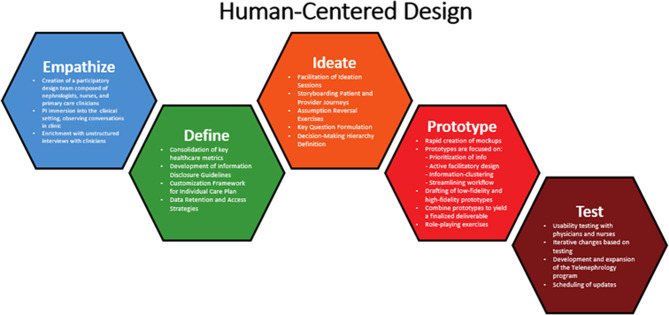 Figure 1
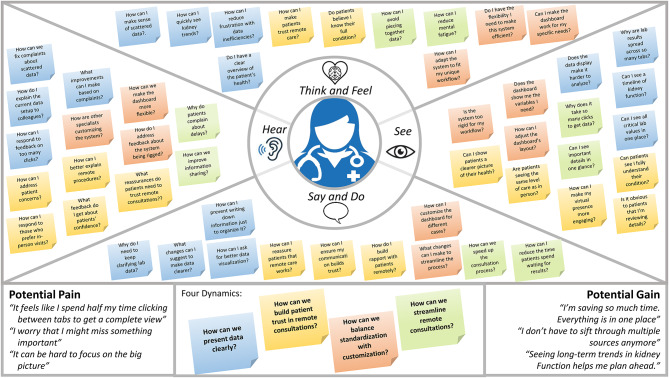 Figure 2
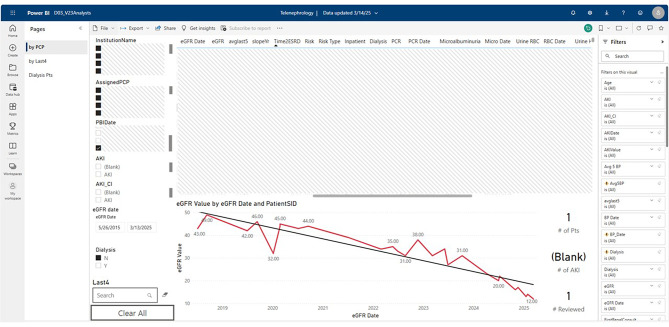 Figure 3
Peer Reviews
No public reviews on file for this paper yet. If you reviewed it on a platform where reviews are public (OpenReview, ICLR, NeurIPS, ICML), you can paste yours below so the community can read it here.
Videos
No videos yet. Explain this paper in a talk, walkthrough, or lecture? Add one.
Taxonomy
TopicsTelemedicine and Telehealth Implementation · Mobile Health and mHealth Applications · Artificial Intelligence in Healthcare and Education