Altercentric Memory Error at 9 Months But Correct Object Memory by 18 Months Revealed in Infants’ Pupil
Anna‐Lena Tebbe, Katrin Rothmaler, Hannah Elena Zielke, Robert Hepach, Charlotte Grosse Wiesmann

TL;DR
Nine-month-old infants show memory errors based on others' perspectives, but this bias disappears by 18 months as they develop better object memory.
Contribution
The study reveals the emergence and disappearance of altercentric memory errors in infants using pupillometry.
Findings
Nine-month-olds expect an object to be where an agent falsely believes it is, not where it actually is.
Eighteen-month-olds remember the object's actual location, not the agent's false belief.
Memory errors at 9 months do not predict correct action anticipation in infants.
Abstract
It was recently proposed that infants have a memory bias for events witnessed together with others. This may allow infants to prioritize relevant information and to predict others' actions, despite limited processing capacities. However, when events occur in the absence of others, for example, an object changes location, this would create altercentric memory errors where infants misremember the object's location where others last saw it. Pupillometry presents a powerful tool to examine the temporal dynamics of such memory biases as they unfold. Here, we showed infants aged 9 (N = 97) and 18 months (N = 79) videos of an agent watching an object move to one of two hiding locations. The object then moved from location A to B, which the agent either missed (leading to her false belief) or witnessed (true belief). The object subsequently reappeared either at its actual or, surprisingly, its…
Genes, proteins, chemicals, diseases, species, mutations and cell lines named across the full text — each resolved to its canonical identifier and authoritative record.
Click any figure to enlarge with its caption.
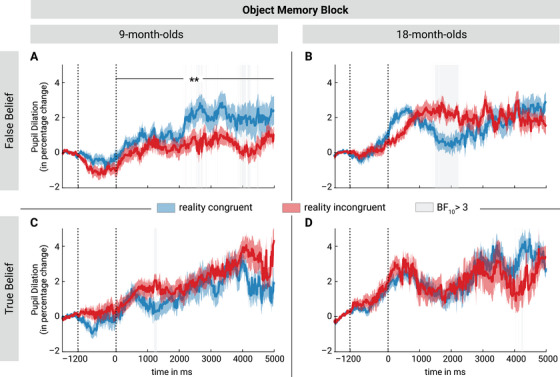 Figure 1
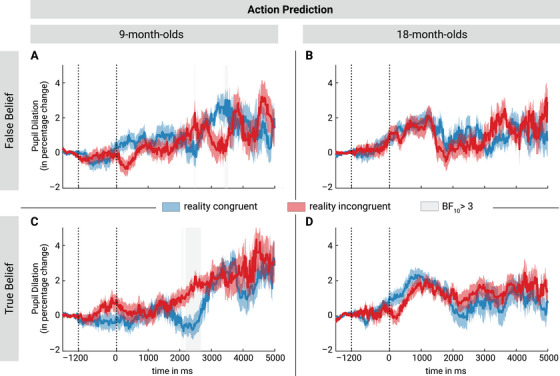 Figure 2
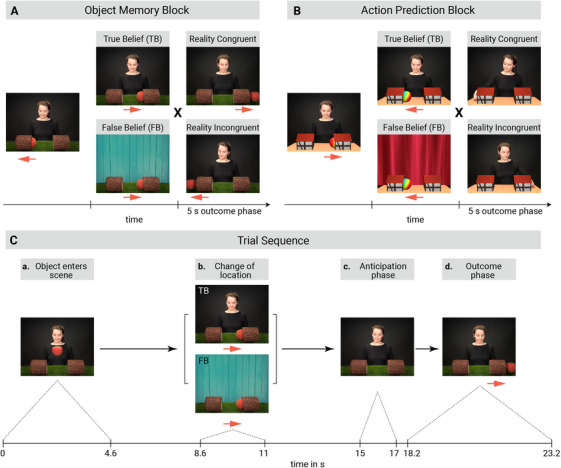 Figure 3
Peer Reviews
No public reviews on file for this paper yet. If you reviewed it on a platform where reviews are public (OpenReview, ICLR, NeurIPS, ICML), you can paste yours below so the community can read it here.
Videos
No videos yet. Explain this paper in a talk, walkthrough, or lecture? Add one.
Taxonomy
TopicsChild and Animal Learning Development · Memory and Neural Mechanisms · Language Development and Disorders