Diagnosing Median Arcuate Ligament Syndrome in a Patient With a History of Duodenal Lymphoma: A Case Report
Laura Miranda Burgos, Alphonsa Thomas, Jordy B Godinez

TL;DR
A 60-year-old man with a history of duodenal lymphoma and diabetes was diagnosed with MALS after years of unexplained stomach pain and found relief through surgery.
Contribution
This case highlights MALS as a potential cause of chronic abdominal pain in patients with complex medical histories.
Findings
CT angiogram confirmed MALS with celiac artery stenosis due to diaphragmatic crus compression.
Laparoscopic median arcuate ligament release provided significant symptom relief.
MALS should be considered in patients with unexplained chronic postprandial epigastric pain.
Abstract
Median arcuate ligament syndrome (MALS) is a rare vascular disorder that leads to a constellation of nonspecific gastrointestinal symptoms. We present a case of a 60-year-old male with a history of duodenal lymphoma in remission, insulin-dependent diabetes mellitus, and longstanding gastrointestinal symptoms, who developed worsening postprandial epigastric pain over eight months. Despite extensive evaluations including esophagogastroduodenoscopy (EGD), gastric emptying studies, and a hepatobiliary iminodiacetic acid (HIDA) scan, no definitive cause was identified. A computed tomography (CT) angiogram revealed anterior superior indentation of the proximal celiac artery by the diaphragmatic crus and post-stenotic dilation, consistent with MALS. The patient underwent laparoscopic median arcuate ligament release, resulting in significant symptom relief. This case underscores the importance…
Genes, proteins, chemicals, diseases, species, mutations and cell lines named across the full text — each resolved to its canonical identifier and authoritative record.
Click any figure to enlarge with its caption.
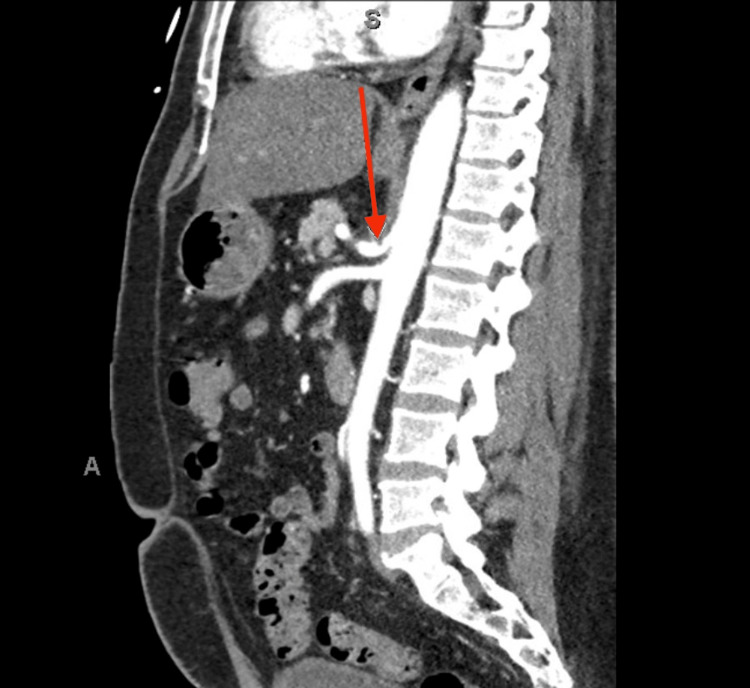 Figure 1
Peer Reviews
No public reviews on file for this paper yet. If you reviewed it on a platform where reviews are public (OpenReview, ICLR, NeurIPS, ICML), you can paste yours below so the community can read it here.
Videos
No videos yet. Explain this paper in a talk, walkthrough, or lecture? Add one.
Taxonomy
TopicsAbdominal vascular conditions and treatments · Gastroesophageal reflux and treatments · Esophageal and GI Pathology
Introduction
Median arcuate ligament syndrome (MALS), also known as celiac artery compression syndrome, is a rare condition characterized by the compression of the celiac artery by the median arcuate ligament, a fibrous band of the diaphragm [1]. It typically presents with nonspecific gastrointestinal symptoms, including postprandial abdominal pain, weight loss, and nausea, mimicking other gastrointestinal and vascular disorders [2,3]. Diagnosis requires high clinical suspicion and confirmatory imaging, such as computed tomography (CT) angiography, magnetic resonance (MR) angiography, or Doppler ultrasonography [4,5]. This case highlights the presentation, diagnostic workup, and management of MALS, emphasizing the importance of considering this diagnosis in patients with a complex medical history and chronic abdominal pain in order to improve their quality of life.
Case presentation
A 60-year-old male with a history of duodenal lymphoma in remission, insulin-dependent diabetes mellitus, and longstanding gastrointestinal symptoms presented with an eight-month history of worsening postprandial, dull-like, epigastric pain associated with nausea and intermittent vomiting that provided relief. He reported chronic watery diarrhea for over five years, more frequent when not using narcotic pain medications. He denied dysphagia, regurgitation of undigested food, or hematemesis. Physical examination revealed mild epigastric tenderness without peritoneal signs. Laboratory testing was non-contributory. Esophagogastroduodenoscopy (EGD) showed no active gastroduodenal pathology. Gastric emptying studies ruled out gastroparesis and a hepatobiliary iminodiacetic acid (HIDA) scan with cholecystokinin (CCK) demonstrated a normal gallbladder ejection fraction of 93%, excluding biliary dyskinesia. A computed tomography (CT) angiogram revealed anterior superior indentation of the proximal celiac artery by the diaphragmatic crus and post-stenotic dilation, consistent with MALS (Figure 1). No other significant abnormalities were noted.
Computed tomography (CT) angiogram findingsThe CT angiogram revealed anterior superior indentation of the proximal celiac artery by the diaphragmatic crus with a J-shaped configuration and post-stenotic dilation (red arrow), consistent with MALS.MALS: median arcuate ligament syndrome
The patient was referred to general surgery and scheduled for laparoscopic-assisted median arcuate ligament release, which ultimately provided symptomatic relief.
Discussion
MALS is a rare condition caused by extrinsic compression of the celiac artery, leading to ischemia and neural irritation of the celiac plexus [6]. Symptoms often include postprandial epigastric pain, nausea, and unintentional weight loss due to food aversion, mimicking functional gastrointestinal disorders [2,3]. Diagnosing MALS requires a high index of suspicion, especially in patients with chronic abdominal pain unresponsive to conventional treatments or in those with complex medical histories, such as this case involving a history of duodenal lymphoma. Computed tomography (CT) angiography and magnetic resonance (MR) angiography can reveal characteristic findings, such as narrowing of the celiac artery with post-stenotic dilation, often more pronounced during expiration [4,5]. Additionally, Doppler ultrasonography can assess blood flow and detect compression of the celiac artery. However, these imaging modalities may not always be definitive; thus, clinical evaluation and imaging are often necessary for diagnosis [7].
Primary duodenal lymphomas are extremely rare, with a total of 1060 cases identified between 1998 and 2015 [8]. They can lead to chronic gastrointestinal symptoms, including pain, diarrhea, and malabsorption, which may persist even after remission due to treatment-related complications such as post-inflammatory changes, fibrosis, or altered gut motility [9,10]. Additionally, lymphoma-related mesenteric or retroperitoneal lymphadenopathy can contribute to vascular compression syndromes, further complicating the diagnostic picture [11]. In our patient, the longstanding gastrointestinal symptoms, including unintentional weight loss and episodic pain, initially raised concerns for either a recurrence of lymphoma or post-treatment complications, leading to an extensive workup. However, the absence of active disease on endoscopy and imaging, coupled with the characteristic findings on CT angiography, confirmed MALS as the underlying cause of his symptoms.
Management of MALS involves surgical decompression through the laparoscopic or surgical release of the median arcuate ligament, aiming to relieve vascular and neural compression of the celiac artery [3,12]. Postoperative outcomes are generally favorable, with symptom relief reported in most cases [13,14]. In patients with complex medical histories, such as a history of duodenal lymphoma in remission, the presentation of MALS can be particularly challenging. The overlap of symptoms between MALS and other gastrointestinal disorders necessitates a comprehensive evaluation to avoid misdiagnosis [15]. Additionally, the presence of comorbid conditions may influence the choice of a surgical approach and postoperative management. For instance, patients with a history of malignancy may have altered anatomy or an increased risk of complications, which should be considered when planning surgical intervention [16]. Early recognition and intervention are essential to reduce morbidity and improve quality of life [14].
Conclusions
This case highlights the importance of considering MALS as a differential diagnosis in patients with chronic, unexplained gastrointestinal symptoms, particularly when conventional evaluations fail to identify a clear cause. Given its rarity and overlapping presentation with other gastrointestinal disorders, MALS requires a high index of suspicion and a thorough diagnostic workup, including CT angiography, to confirm the diagnosis. In patients with complex medical histories, such as prior malignancy, careful assessment is crucial to avoid misdiagnosis and unnecessary delays in treatment. Laparoscopic median arcuate ligament release remains the mainstay of therapy, offering significant symptomatic relief and improved quality of life. Early recognition and intervention are essential in optimizing outcomes for patients with this rare vascular disorder.
The reference list from the paper itself. Each links out to its DOI / PubMed record.
- 1Median arcuate ligament syndrome-review of this rare disease JAMA Surg Kim EN Lamb K Relles D Moudgill N Di Muzio PJ Eisenberg JA 47147715120162693439410.1001/jamasurg.2016.0002 · doi ↗ · pubmed ↗
- 2Median arcuate ligament syndrome J Vasc Surg Goodall R Langridge B Onida S Ellis M Lane T Davies AH 217021767120203188231410.1016/j.jvs.2019.11.012 · doi ↗ · pubmed ↗
- 3A diagnostic workup and laparoscopic approach for median arcuate ligament syndrome ANZ J Surg Diab J Diab V Berney CR 174217479220223510401410.1111/ans.17514 PMC 9545262 · doi ↗ · pubmed ↗
- 4Median arcuate ligament syndrome: evaluation with CT angiography Radiographics Horton KM Talamini MA Fishman EK 117711822520051616010410.1148/rg.255055001 · doi ↗ · pubmed ↗
- 5Compression of the celiac trunk caused by median arcuate ligament in children and adolescent subjects: evaluation with contrast-enhanced MR angiography and comparison with Doppler US evaluation J Vasc Interv Radiol Aschenbach R Basche S Vogl TJ 5565612220112131626310.1016/j.jvir.2010.11.007 · doi ↗ · pubmed ↗
- 6Median arcuate ligament syndrome: vascular surgical therapy and follow-up of 18 patients Langenbecks Arch Surg Grotemeyer D Duran M Iskandar F Blondin D Nguyen K Sandmann W 1085109239420091950689910.1007/s 00423-009-0509-5 · doi ↗ · pubmed ↗
- 7Median arcuate ligament syndrome in athletes Surg Endosc Harr JN Haskins IN Brody F 4763120172717794910.1007/s 00464-016-4948-0 · doi ↗ · pubmed ↗
- 8Clinicopathological features, treatment strategy, and prognosis of primary non-Hodgkin’s lymphoma of the duodenum: a SEER database analysis Can J Gastroenterol Hepatol Zheng G Wang Y Zhao Y Zheng Z 9327868202020203239945910.1155/2020/9327868 PMC 7201497 · doi ↗ · pubmed ↗