Genome Sequence of Arthrobacter Phage Sourignavong
Ian T. Rife, Nana Sannomiya, Katie N. Thai, Cori B. Williams, Raelynn A. Amasol-Tanoura, Jennifer H. Arca, Gillian A. Bradley, Avery C. Catlin, Saige A. Edwards, Sophia F. Faria, Maximilliano Fuentes-Ayala, Lola M. Gantenbein, Alexis M. Haiges, Hailey E. Hart, Ayden K. Herrera

TL;DR
This paper presents the genome sequence of a soil-isolated phage named Sourignavong, which infects Arthrobacter bacteria.
Contribution
The study provides a new phage genome sequence and identifies two endolysin genes.
Findings
The phage Sourignavong has a 15,625 bp genome with 27 predicted protein coding genes.
Two of the genes are predicted to encode endolysin enzymes.
Sourignavong is classified into the actinobacteriophage cluster AN.
Abstract
We report the genome sequence of phage Sourignavong isolated from soil in Oklahoma City, Oklahoma using Arthrobacter sp. ATCC 21022. The 15,625 bp genome contains 27 predicted protein coding genes, including two predicted endolysin enzyme genes. Sourignavong is assigned to actinobacteriophage cluster AN.
Genes, proteins, chemicals, diseases, species, mutations and cell lines named across the full text — each resolved to its canonical identifier and authoritative record.
Click any figure to enlarge with its caption.
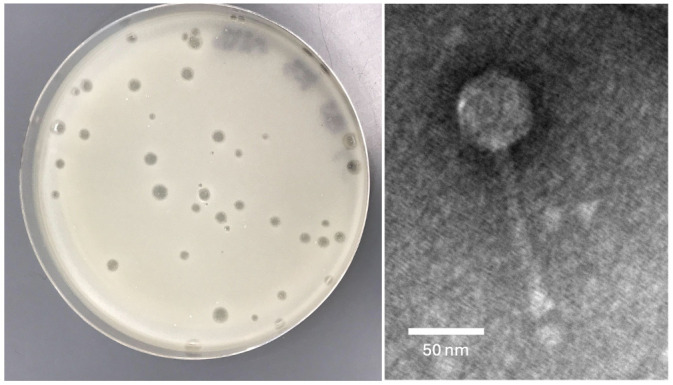 Figure 1
Peer Reviews
No public reviews on file for this paper yet. If you reviewed it on a platform where reviews are public (OpenReview, ICLR, NeurIPS, ICML), you can paste yours below so the community can read it here.
Videos
No videos yet. Explain this paper in a talk, walkthrough, or lecture? Add one.
Taxonomy
TopicsFractal and DNA sequence analysis · Machine Learning in Bioinformatics
Description
Uncovering the diversity of phages is an important endeavor in the development of phage as therapeutics for bacterial infections, particularly those that are resistant to antibiotics (Hatfull 2022). Here, we present phage Sourignavong that infects Arthrobacter sp. ATCC 21022.
Sourignavong was discovered in Oklahoma City, OK from moist soil surrounding a decaying tree stump (GPS: 35.515833 N, 97.530556 W), using standard procedures (Zorawik et al., 2024). Briefly, the soil sample was suspended in PYCa medium (peptone, yeast extract, calcium), then spun and the supernatant filtered (0.22 um pore size), before the filtrate was inoculated with Arthrobacter sp. and incubated with shaking at 30˚C for 72 hours. The culture was then refiltered and the filtrate plated on top agar with Arthrobacter sp. After incubation at 30˚C, Sourignavong formed clear plaques 0.8 – 4.0 millimeter in diameter (n=38; Fig.1) and was subsequently purified through three rounds of plating. Negative stain (1% uranyl acetate) transmission electron microscopy revealed a siphovirus morphology with a capsid size of 55 nm and a tail length of 135 nm (n=1; Fig. 1).
DNA was extracted from a liquid lysate using a Promega Wizard DNA Clean-up kit and prepared for sequencing using the NEB Ultra II Library Kit (Zorawik et al., 2024). The Sourignavong genome was sequenced by Illumina sequencing technology (MiSeq, v3 reagents), resulting in 27,191 150-base reads. Raw reads were assembled in Newbler v2 (Roche), resulting in a single genomic contig with 224-fold coverage. The genome was circular, with a total genome length of 15,625 bps, and a GC content of 60.30%.
The auto annotation of the Sourignavong genome was completed using Glimmer v3.02b (Delcher et al., 2007) and GeneMark v3.25 (Besemer and Borodovsky, 2005). Start sites were manually verified using the Phage Evidence Collection and Annotation Network (PECAAN) v.20240320 (https://discover.kbrinsgd.org), Starterator v562 (http://phages.wustl.edu/starterator), and Phamerator v560 (Cresawn et al., 2011). Potential functions for predicted protein coding genes were designated based on top hits from HHpred (PDB_mmCIF70, SCOPe70, Pfam-A, and NCBI_Conserved_Domains databases) (Zimmermann et al., 2018) as well as BLAST searches against two databases (NCBI, Actinobacteriophage Proteins) (Altschul et al., 1990; Camacho et al., 2009; Russell and Hatfull, 2017). ARAGORN v1.2.38 (Laslett and Canback, 2004) was used to identify potential tRNAs. Default parameters were used for all software.
Through this annotation process, Sourignavong has 27 predicted genes, of which 15 were assigned putative functions, with no tRNAs. Based on gene content similarity (GCS) to phages in the Actinobacteriophage database (Russell and Hatfull, 2017), Sourignavong is assigned to phage cluster AN (Pope et al. 2017; Russel and Hatfull, 2017). As with previously characterized cluster AN phages, the majority of Sourignavong’s small genome encodes structure, assembly, and lysis genes, including a fused protease-capsid gene and two consecutive endolysin genes (Klyczek et al. 2017). No immunity repressor or integrase functions could be identified, suggesting Sourignavong is unlikely to establish lysogeny.
Nucleotide sequence accession numbers
Sourignavong is available at GenBank with Accession No. PP978872 and Sequence Read Archive (SRA) SRX24892107 .
The reference list from the paper itself. Each links out to its DOI / PubMed record.
- 1Altschul Stephen F. Gish Warren Miller Webb Myers Eugene W. Lipman David J. 1990101 Basic local alignment search tool Journal of Molecular Biology 21530022-283640341010.1016/s 0022-2836(05)80360-22231712 · doi ↗ · pubmed ↗
- 2Besemer J. Borodovsky M. 200571 Gene Mark: web software for gene finding in prokaryotes, eukaryotes and viruses Nucleic Acids Research 33Web Server 0305-1048 W 451W 45410.1093/nar/gki 48715980510 PMC 1160247 · doi ↗ · pubmed ↗
- 3Camacho Christiam Coulouris George Avagyan Vahram Ma Ning Papadopoulos Jason Bealer Kevin Madden Thomas L 2009121 BLAST+: architecture and applications BMC Bioinformatics 1011471-210510.1186/1471-2105-10-421PMC 280385720003500 · doi ↗ · pubmed ↗
- 4Cresawn Steven G Bogel Matt Day Nathan Jacobs-Sera Deborah Hendrix Roger W Hatfull Graham F 20111012 Phamerator: a bioinformatic tool for comparative bacteriophage genomics BMC Bioinformatics 1211471-210510.1186/1471-2105-12-395PMC 323361221991981 · doi ↗ · pubmed ↗
- 5Delcher Arthur L. Bratke Kirsten A. Powers Edwin C. Salzberg Steven L. 2007119 Identifying bacterial genes and endosymbiont DNA with Glimmer Bioinformatics 2361367-481167367910.1093/bioinformatics/btm 00917237039 PMC 2387122 · doi ↗ · pubmed ↗
- 6Hatfull Graham F. 202277 Mycobacteriophages: From Petri dish to patient PLOS Pathogens 1871553-7374 e 1010602 e 101060210.1371/journal.ppat.101060235797343 PMC 9262239 · doi ↗ · pubmed ↗
- 7Klyczek Karen K. Bonilla J. Alfred Jacobs-Sera Deborah Adair Tamarah L. Afram Patricia Allen Katherine G. Archambault Megan L. Aziz Rahat M. Bagnasco Filippa G. Ball Sarah L. Barrett Natalie A. Benjamin Robert C. Blasi Christopher J. Borst Katherine Braun Mary A. Broomell Haley Brown Conner B. Brynell Zachary S. Bue Ashley B. Burke Sydney O. Casazza William Cautela Julia A. Chen Kevin Chimalakonda Nitish S. Chudoff Dylan Connor Jade A. Cross Trevor S. Curtis Kyra N. Dahlke Jessica A. Deaton Bethany M. Degroote Sarah J. De Nigr · doi ↗ · pubmed ↗
- 8Laslett D. 200412 ARAGORN, a program to detect t RNA genes and tm RNA genes in nucleotide sequences Nucleic Acids Research 3211362-4962111610.1093/nar/gkh 15214704338 PMC 373265 · doi ↗ · pubmed ↗