Transcripts from the src-1(cj293) mutant can encode a SRC-1 molecule lacking the SH2 domain in Caenorhabditis elegans
Snehal S Mahadik, Erik A. Lundquist

TL;DR
This study shows that a specific mutation in C. elegans produces a version of the SRC-1 protein missing a key domain, leading to overactivity in neurons.
Contribution
The study confirms that the src-1(cj293) mutation generates a transcript lacking the SH2 domain, supporting its role as a constitutively active allele.
Findings
RNA seq data shows the src-1(cj293) mutation leads to a splice between exon 3 and exon 6.
The resulting transcript can encode a SRC-1 molecule missing the SH2 domain.
This mutation causes overactive SRC-1 in VD neuron growth cones during outgrowth.
Abstract
Previous studies suggest that the src-1 ( cj293 ) mutation is an activated src-1 allele in C. elegans with the potential to encode a molecule lacking the SH2 domain. src-1 ( cj293 ) is a deletion with breakpoints in introns 3 and 5, deleting exons 4 and 5, which encode the SH2 domain. If exon 3 is spliced to exon 6, the reading frame is maintained. Here, RNA seq of src-1 ( cj293 ) mutants showed that the exon 3 to exon 6 splice does not occur in src-1 (+) but is robustly present in src-1 ( cj293 ) . Thus, src-1 ( cj293 ) produces a transcript that can encode a SRC-1 molecular lacking the SH2 domain, which leads to overactive SRC-1 in growth cones of VD neurons during their outgrowth ( i.e. src-1 ( cj293 ) might be a constitutively-active mutation).
Genes, proteins, chemicals, diseases, species, mutations and cell lines named across the full text — each resolved to its canonical identifier and authoritative record.
Click any figure to enlarge with its caption.
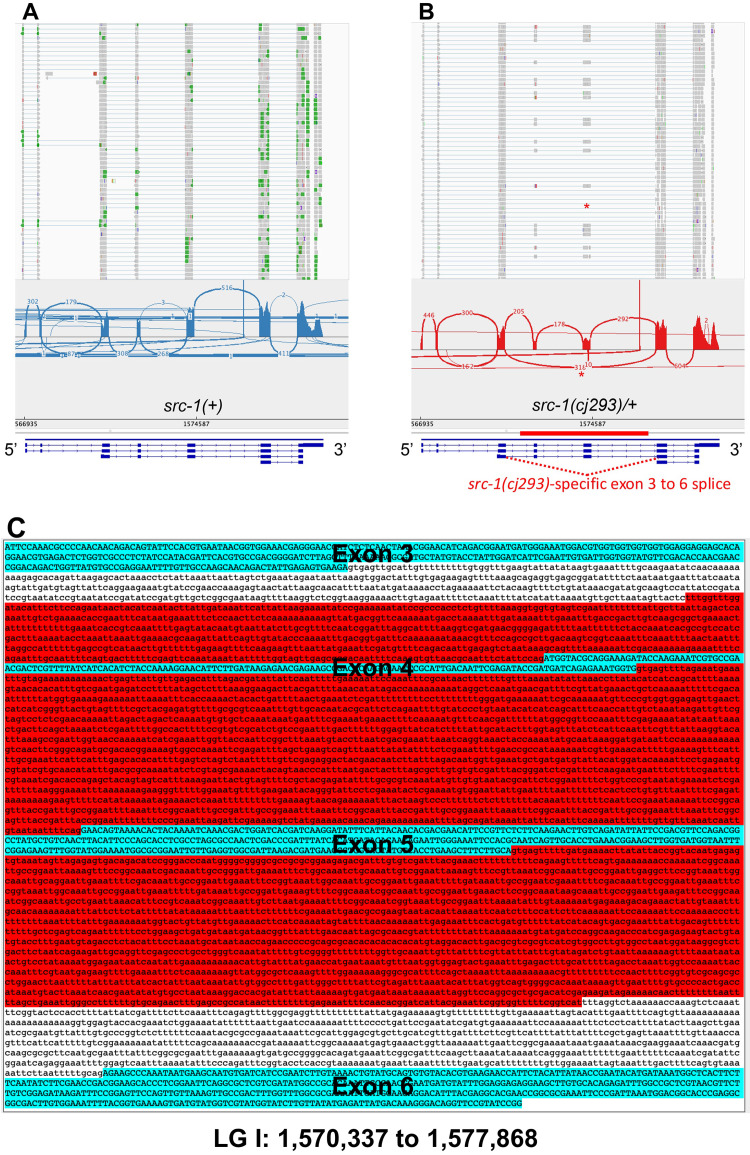 Figure 1
- —National Institute of Neurological Disorders and Stroke (United States)https://ror.org/01s5ya894
- —National Institute of Neurological Disorders and Stroke (United States)https://ror.org/01s5ya894
- —National Institute of General Medical Sciences (United States)https://ror.org/04q48ey07
Peer Reviews
No public reviews on file for this paper yet. If you reviewed it on a platform where reviews are public (OpenReview, ICLR, NeurIPS, ICML), you can paste yours below so the community can read it here.
Videos
No videos yet. Explain this paper in a talk, walkthrough, or lecture? Add one.
Taxonomy
TopicsGenetics, Aging, and Longevity in Model Organisms · RNA Research and Splicing · Heat shock proteins research
Description
The SRC-1 /Src tyrosine kinase in * Caenorhabditis elegans * is required for embryonic development, cell migration, and axon guidance (Bei
- et al.* 2002; Itoh
- et al.* 2005; Lee
- et al.* 2005; Sugioka and Sawa 2010; Masuda
- et al.* 2012; Zhu
- et al.* 2020; Mahadik
- et al.* 2024). In developing VD axon growth cones, SRC-1 acts with the UNC-6 /Netrin receptor UNC-5 to inhibit growth cone protrusion (Mahadik
- et al.* 2024). A precise deletion mutant of
src-1 * had VD growth cones that displayed excessive protrusion resulting in axon guidance defects, similar to * unc-5 * loss-of-function (Mahadik
- et al.* 2024). The
src-1 ( cj293 ) * in-frame deletion removes exons that encode the SH2 domain and an N-terminal portion of the kinase domain (Mahadik
- et al.* 2024).
src-1 ( cj293 ) * is predicted to encode a molecule lacking the SH2 domain and part of the kinase domain (Mahadik
- et al.* 2024). Similar to the
src-1 (lq185) * precise deletion allele, * src-1 ( cj293 ) * mutants display defects in embryonic development (Bei
- et al.* 2002; Mahadik
- et al.* 2024). However,
src-1 ( cj293 ) * mutants displayed VD growth cones with reduced protrusion compared to wild-type , similar to * src-1 (+) * overexpression (Mahadik
- et al.* 2024). This suggests that
src-1 ( cj293 ) * might encode a constitutively-active SRC-1 molecule.
The breakpoints of the * src-1 ( cj293 ) * mutation are in introns 3 and 5, removing exons 4 and 5 ( Figure 1A and B). If exon 3 is spliced to exon 6 (3-6), the reading frame is maintained, resulting in coding potential for a molecule lacking the SH2 domain and part of the kinase domain (Mahadik
- et al.* 2024). RNA seq was conducted in heterozygous
src-1 ( cj293 )/+ * animals. Reads were aligned to the * C. elegans * genome, and Sashimi plots were generated to illustrate splicing events. In animals with a * wild-type src-1 (+) * gene, the 3-6 splice did not occur ( Figure 1A ). However, in * src-1 ( cj293 )/+ * animals, the 3-6 splice was common (318 times) ( Figure 1B ). The 3-6 splice products produced in * src-1 ( cj293 ) * have the potential to produce a SRC-1 molecule missing the SH2 domain and part of the kinase domain. The catalytic residue of the kinase is not in the deleted region. Kinase function is likely active in * src-1 ( cj293 ) * , as mutation of the catalytic residue (D381A) in * src-1 (syb7248) * resulted in a dominant phenotype resembling * src-1 * precise deletion, with excessively-protrusive growth cones VD growth cones (Mahadik
- et al.* 2024).
Autoinhibition of Src kinase activity is mediated by the SH2 domain, which binds to phosphorylated tyrosine 527, resulting in a closed, inactive conformation (reviewed in (Wagner
- et al.* 2013)). This tyrosine is conserved in
C. elegans * SRC-1 (tyrosine 531), thus it might also be subject to autoinhibition by the SH2 domain. A SRC-1 molecule missing the SH2 domain may result in overactive kinase activity, consistent with the * src-1 ( cj293 ) * overactive phenotype in the growth cone. It is also possible that * src-1 ( cj293 ) * overactivity is due to other interactions that require the SH2 domain and/or the N-terminal portion of the kinase domain. * src-1 ( cj293 ) * was not dominant for axon guidance defects, which would be expected of an activated molecule. Possibly, one copy of the activated allele is not sufficient to produce a phenotype in heterozygotes with * src-1 (+) * . In any case, these results are consistent with * src-1 ( cj293 ) * producing an activated SRC-1 molecule lacking the SH2 domain and N-terminal portion of the kinase domain, which phenotypically, results in SRC-1 overactivity.
Methods
RNA was isolated from mixed-stage animals as previously described (Tamayo et al. 2013; Paolillo et al. 2024). Poly-A selection and RNA seq library construction was conducted using the NEBnext stranded RNA seq kit. RNA seq libraries were made using the NEBNext stranded mRNA library kit. Sequencing was conducted on a Nextseq 2000 instrument with 150-bp paired-end sequencing. FASTQ files were processed using fastp (0.23.2) (Chen et al. 2018). Reads were aligned to the * C. elegans * reference genome [release WBcel235, version WBPS14 (WS271)] using HISAT2 (version 2.2.1) (Kim et al. 2015). BAM files from HISAT2 alignment were analyzed in the Integrated Genome Viewer (Robinson et al. 2011; Thorvaldsdottir et al. 2012), including Sashimi plots (Katz et al . 2010; Katz et al. 2015). Wormbase was used for * C. elegans * informatics (Sternberg et al., 2024)
Reagents
Raw FASTQ reads for * src-1 (+) * and * src-1 ( cj293 ) * were deposited in the Sequence Read Archive ( PRJNA1093133 and PRJNA1219192 , respectively). The * src-1 (+) * strain was LE5443 ( * unc-6 (lq154) X; juIs76 II * ). The balanced * src-1 ( cj293 )/+ * strain was HR1275 ( * src-1 ( cj293 ) dpy-5 ( e61 )/ hT2 I; +/ hT2 III * ).
The reference list from the paper itself. Each links out to its DOI / PubMed record.
- 1Bei Yanxia Hogan Jennifer Berkowitz Laura A. Soto Martha Rocheleau Christian E. Pang Ka Ming Collins John Mello Craig C. 200271 SRC-1 and Wnt Signaling Act Together to Specify Endoderm and to Control Cleavage Orientation in Early C. elegans Embryos Developmental Cell 311534-580711312510.1016/s 1534-5807(02)00185-512110172 · doi ↗ · pubmed ↗
- 2Chen Shifu Zhou Yanqing Chen Yaru Gu Jia 201891 fastp: an ultra-fast all-in-one FASTQ preprocessor Bioinformatics 34171367-4803 i 884i 89010.1093/bioinformatics/bty 56030423086 PMC 6129281 · doi ↗ · pubmed ↗
- 3Itoh Bunsho Hirose Takashi Takata Nozomu Nishiwaki Kiyoji Koga Makoto Ohshima Yasumi Okada Masato 2005121 SRC-1, a non-receptor type of protein tyrosine kinase, controls the direction of cell and growth cone migration in C. elegans Development 132231477-91295161517210.1242/dev.0210316251208 · doi ↗ · pubmed ↗
- 4Katz Yarden Wang Eric T Airoldi Edoardo M Burge Christopher B 2010117 Analysis and design of RNA sequencing experiments for identifying isoform regulation Nature Methods 7121548-70911009101510.1038/nmeth.152821057496 PMC 3037023 · doi ↗ · pubmed ↗
- 5Katz Yarden Wang Eric T. Silterra Jacob Schwartz Schraga Wong Bang Thorvaldsdóttir Helga Robinson James T. Mesirov Jill P. Airoldi Edoardo M. Burge Christopher B. 2015122 Quantitative visualization of alternative exon expression from RNA-seq data Bioinformatics 31141367-48112400240210.1093/bioinformatics/btv 03425617416 PMC 4542614 · doi ↗ · pubmed ↗
- 6Kim Daehwan Langmead Ben Salzberg Steven L 201539 HISAT: a fast spliced aligner with low memory requirements Nature Methods 1241548-709135736010.1038/nmeth.331725751142 PMC 4655817 · doi ↗ · pubmed ↗
- 7Lee Jeeyong Li Weiquan Guan Kun-Liang 200581 SRC-1 Mediates UNC-5 Signaling in Caenorhabditis elegans Molecular and Cellular Biology 25151098-55496485649510.1128/mcb.25.15.6485-6495.200516024786 PMC 1190325 · doi ↗ · pubmed ↗
- 8Mahadik Snehal S. Burt Emily K. Lundquist Erik A. 2024521 SRC-1 controls growth cone polarity and protrusion with the UNC-6/Netrin receptor UNC-5 in Caenorhabditis elegans PLOS ONE 1951932-6203 e 0295701 e 029570110.1371/journal.pone.029570138771761 PMC 11108135 · doi ↗ · pubmed ↗