Patterns of SARS-CoV-2 seropositivity among essential workers in long term care and retirement homes in Ontario, Canada: A descriptive cross-sectional study
Christine Fahim, Siyi Wang, Nimitha Paul, Karen Colwill, Roya Dayam, Jamie M. Boyd, Huiting Ma, Vincenza Gruppuso, Ana Mrazovac, Jessica Firman, Anjali Patel, Vanessa Bach, Keelia Quinn de Launay, Alyson Takaoka, Vanja Grubac, Anne-Claude Gingras, Sharon E. Straus

TL;DR
This study found higher SARS-CoV-2 seroprevalence among racialized and lower-income essential workers in long-term care and retirement homes in Ontario.
Contribution
The study identifies socioeconomic and racial disparities in SARS-CoV-2 seropositivity among essential workers in care facilities.
Findings
Seroprevalence increased from 24% in 2021 to 44% in 2022 among staff in long-term care and retirement homes.
Black, East and Southeast Asian, and other racialized staff had nearly double the seroprevalence compared to White staff.
Staff in higher-income neighborhoods had lower seroprevalence, and those with home-provided sick leave had reduced risk.
Abstract
Understanding patterns of SARS-CoV-2 seroprevalence among Long-Term Care Home and Retirement Home (LTCH/RH) staff is critical to designing effective public health interventions. We estimated SARS-CoV-2 seroprevalence among LTCH/RH staff in Ontario, Canada between May 2021-October 2022 using a cross-sectional analysis. Eligible participants completed a demographic questionnaire and provided a dried blood spot sample. Positive seroprevalence was defined as the proportion of individuals in a population who were positive for a SARS-CoV-2 infection, determined using anti-nucleocapsid total IgG antibodies analyzed with a validated chemiluminescent ELISA. We report age-adjusted prevalence ratios [PR; confidence interval, CI] by participant socio-demographic, household, neighbourhood, and occupational characteristics and stratified the analyses over two time periods (period 1: 2021-05-17 to…
Genes, proteins, chemicals, diseases, species, mutations and cell lines named across the full text — each resolved to its canonical identifier and authoritative record.
Click any figure to enlarge with its caption.
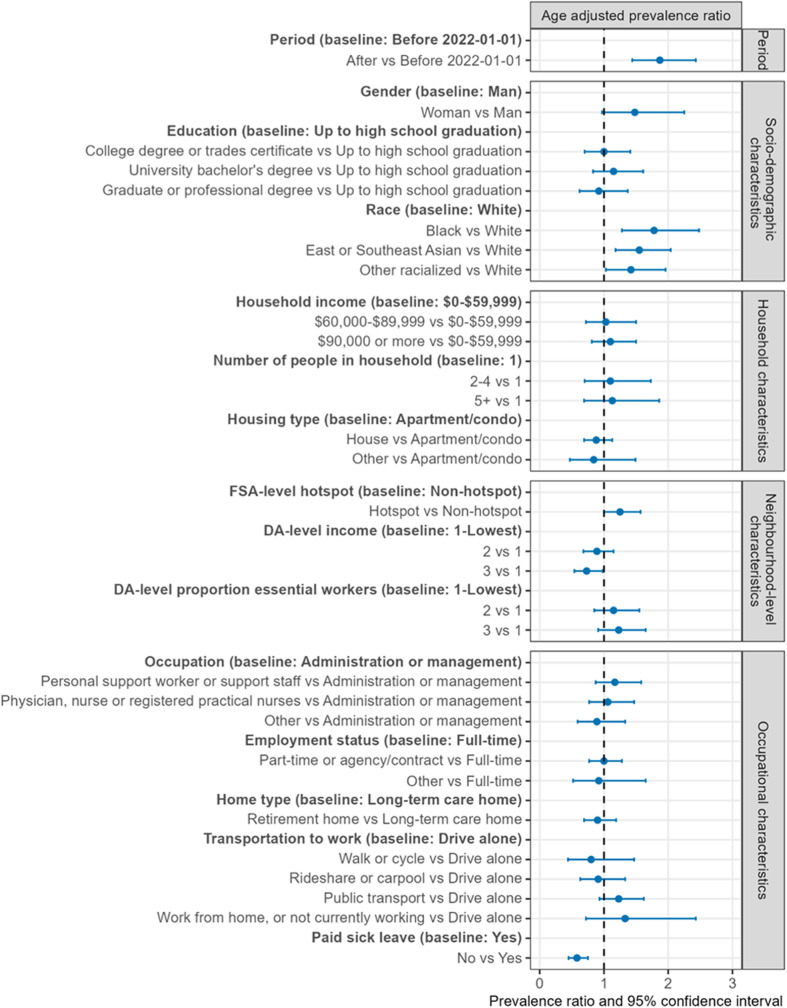 Figure 1
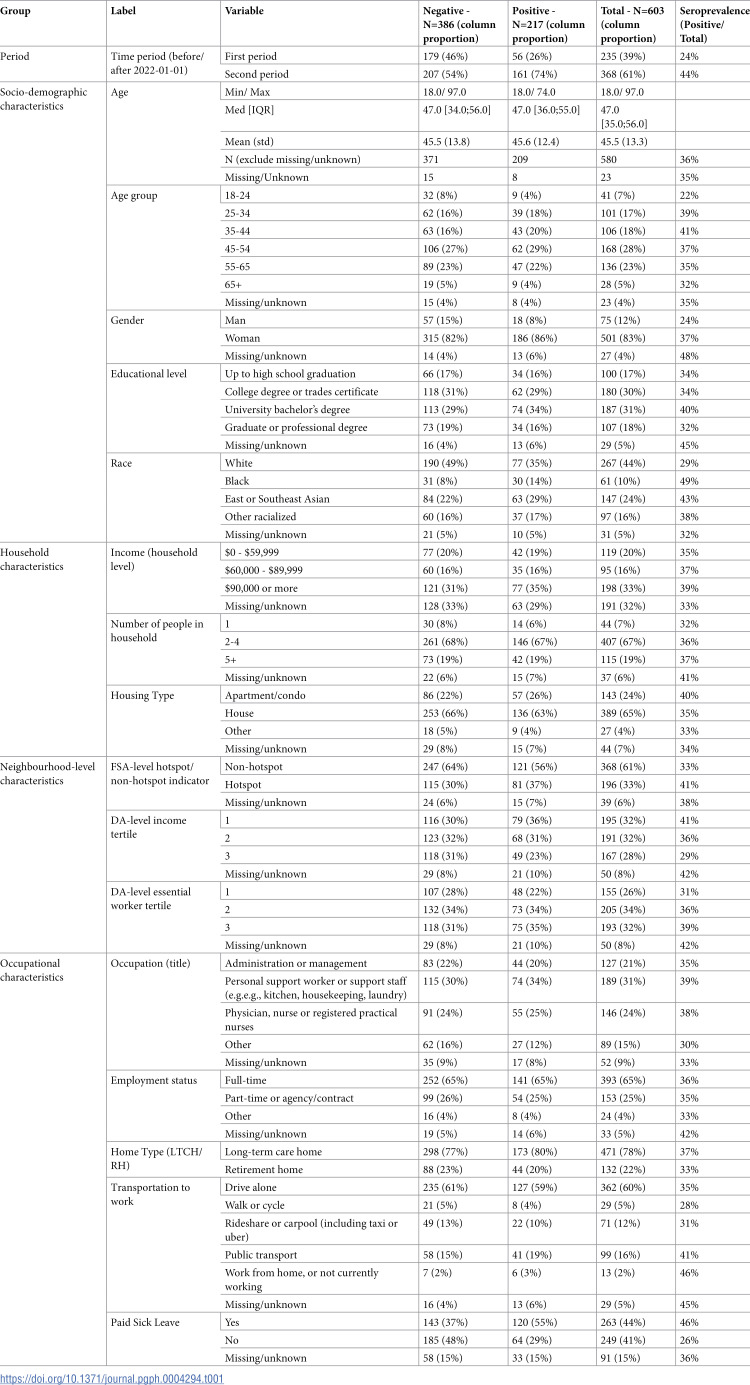 Figure 2
Peer Reviews
No public reviews on file for this paper yet. If you reviewed it on a platform where reviews are public (OpenReview, ICLR, NeurIPS, ICML), you can paste yours below so the community can read it here.
Videos
No videos yet. Explain this paper in a talk, walkthrough, or lecture? Add one.
Taxonomy
TopicsSARS-CoV-2 and COVID-19 Research · COVID-19 Clinical Research Studies · COVID-19 epidemiological studies