MEDIATING EFFECT OF OCCUPATIONAL STRESS BETWEEN SKELETAL MUSCLE DISORDERS AND DEPRESSIVE SYMPTOMS IN FIREFIGHTERS: A STRUCTURAL EQUATION MODELING APPROACH
Fengqiong Chen, Liang Wang, Jin Wang, Meiling Liu, Shiwei Cao, Yunxuan Huang, Huaxin Deng, Mengliang Ye

TL;DR
This study finds that skeletal muscle disorders in firefighters are linked to depressive symptoms, partly through increased occupational stress.
Contribution
The study identifies a partial mediating role of occupational stress in the relationship between skeletal muscle disorders and depressive symptoms in firefighters.
Findings
Skeletal muscle disorders directly predict depressive symptoms (β = 0.25, p < 0.001).
Occupational stress partially mediates the relationship between skeletal muscle disorders and depressive symptoms (indirect effect = 0.209).
Occupational stress is strongly associated with both skeletal muscle disorders and depressive symptoms.
Abstract
The purpose of this study was to explore the relationship between skeletal muscle disorders (SMD), occupational stress (OS) and depressive symptoms (DS) among firefighters. A cross-sectional survey was conducted among firefighters in Chongqing, China. Descriptive statistic and correlation analyses were performed by using SPSS 26.0. AMOS 24.0 was used to construct the structural equation modeling between SMD and DS. The mediating effect of OS was also evaluated. The results demonstrate that SMD can predict DS (β = 0.25, p < 0.001) and OS (β = 0.39, p < 0.001) positively, OS positively predicted DS (β = 0.39, p < 0.001) after controlling for SMD. Additionally, OS has a partial indirect effect between DS and SMD (indirect effects = 0.209, 95% CI: 0.093–0.372, p < 0.001). Occupational stress has a partial indirect effect between SMD and DS among firefighters. Skeletal muscle disorders…
Genes, proteins, chemicals, diseases, species, mutations and cell lines named across the full text — each resolved to its canonical identifier and authoritative record.
Click any figure to enlarge with its caption.
 Figure 1
 Figure 2
 Figure 3
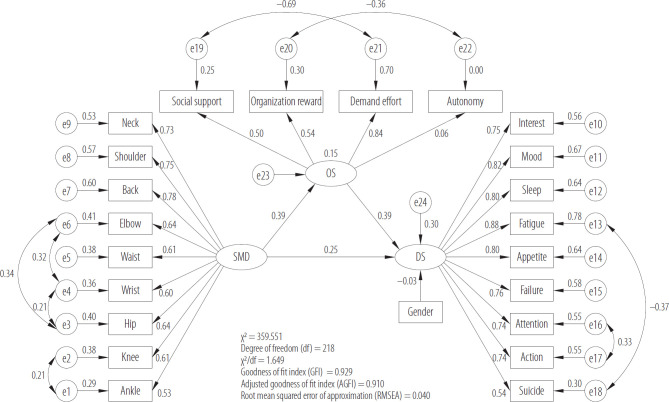 Figure 4
Peer Reviews
No public reviews on file for this paper yet. If you reviewed it on a platform where reviews are public (OpenReview, ICLR, NeurIPS, ICML), you can paste yours below so the community can read it here.
Videos
No videos yet. Explain this paper in a talk, walkthrough, or lecture? Add one.
Taxonomy
TopicsOccupational Health and Performance · Ergonomics and Musculoskeletal Disorders