Customizing Computerized Adaptive Test Stopping Rules for Clinical Settings Using the Negative Affect Subdomain of the NIH Toolbox Emotion Battery: Simulation Study
Saki Amagai, Aaron J Kaat, Rina S Fox, Emily H Ho, Sarah Pila, Michael A Kallen, Benjamin D Schalet, Cindy J Nowinski, Richard C Gershon

TL;DR
This study explores how changing stopping rules in computerized adaptive tests can reduce patient burden while maintaining reliability in measuring emotions like anger, fear, and sadness.
Contribution
The study introduces alternative stopping rules for computerized adaptive tests in clinical settings to balance test burden and reliability.
Findings
Alternative stopping rules slightly reduced test burden while increasing reliability for adult emotion assessments.
Fixed-length tests with 8 or fewer items increased assessments with reliability below 0.85.
Reduced maximum stopping rules best balanced precision and test length.
Abstract
Patient-reported outcome measures are crucial for informed medical decisions and evaluating treatments. However, they can be burdensome for patients and sometimes lack the reliability clinicians need for clear clinical interpretations. We aimed to assess the extent to which applying alternative stopping rules can increase reliability for clinical use while minimizing the burden of computerized adaptive tests (CATs). CAT simulations were conducted on 3 adult item banks in the NIH Toolbox for Assessment of Neurological and Behavioral Function Emotion Battery; the item banks were in the Negative Affect subdomain (ie, Anger Affect, Fear Affect, and Sadness) and contained at least 8 items. In the originally applied NIH Toolbox CAT stopping rules, the CAT was stopped if the score SE reached <0.3 before 12 items were administered. We first contrasted this with a SE-change rule in a planned…
Genes, proteins, chemicals, diseases, species, mutations and cell lines named across the full text — each resolved to its canonical identifier and authoritative record.
Click any figure to enlarge with its caption.
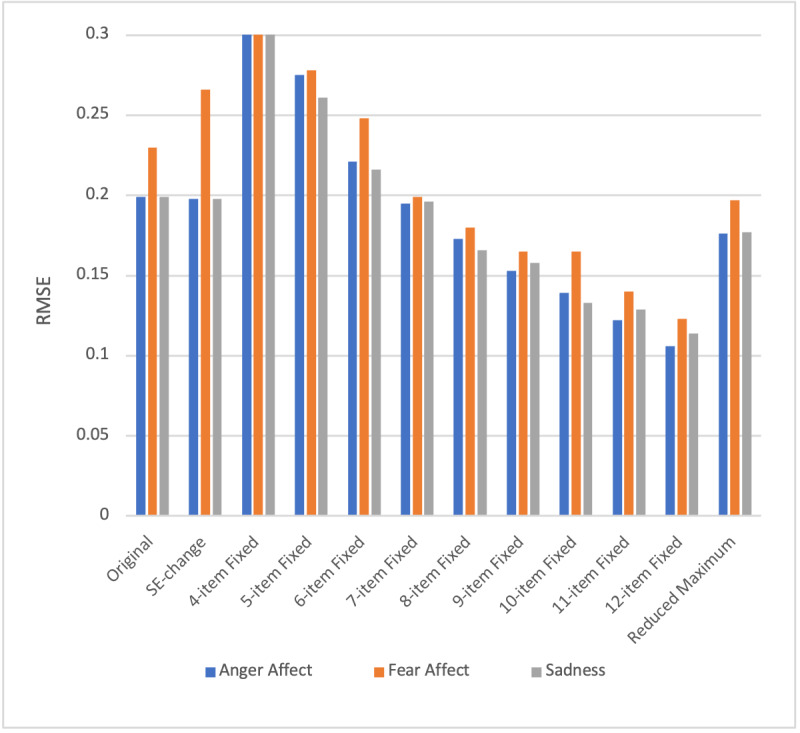 Figure 1
Peer Reviews
No public reviews on file for this paper yet. If you reviewed it on a platform where reviews are public (OpenReview, ICLR, NeurIPS, ICML), you can paste yours below so the community can read it here.
Videos
No videos yet. Explain this paper in a talk, walkthrough, or lecture? Add one.
Taxonomy
TopicsMental Health Research Topics · Anxiety, Depression, Psychometrics, Treatment, Cognitive Processes · Schizophrenia research and treatment