Identifying behaviour change techniques, technical features and implementation options for a virtual reality intervention to motivate adult smokers to quit: A focus group study with healthcare and virtual reality experts
Tosan Okpako, Corinna Leppin, Alessandro Chincotta, Dimitra Kale, Olga Perski, Jamie Brown

TL;DR
Experts in healthcare and virtual reality suggest ways to design a VR program to help adult smokers quit by using tailored content and behavior change techniques.
Contribution
The study identifies specific behavior change techniques and implementation strategies for a VR smoking cessation intervention based on expert input.
Findings
Experts suggested using behavior change techniques like 'prompt comparative imagining of future outcomes' and 'imaginary reward'.
Customizable avatars and tailored narratives were proposed to enhance user engagement in VR smoking cessation.
Safety and inclusivity considerations, such as seated experiences and screening for health risks, were emphasized for VR implementation.
Abstract
In this study, individuals working in healthcare or virtual reality (VR) were invited to contribute towards developing a VR intervention to encourage adults to quit smoking, by building upon user-generated ideas from a previous co-design study with adult smokers. Three online focus groups were with healthcare workers (n = 26), and one was with VR experts (n = 4). Transcripts were analysed using thematic analysis. In the first theme, experts agreed that previous co-design content showing the outcomes of quitting or not quitting could be helpful. Suggested behaviour change techniques included ‘prompt comparative imagining of future outcomes’, and ‘imaginary reward’. Experts suggested a format where users could customise an avatar and select what content they see, creating a tailored narrative. There was a subtheme about the potential unsuitability of co-design content based on extreme…
Genes, proteins, chemicals, diseases, species, mutations and cell lines named across the full text — each resolved to its canonical identifier and authoritative record.
Click any figure to enlarge with its caption.
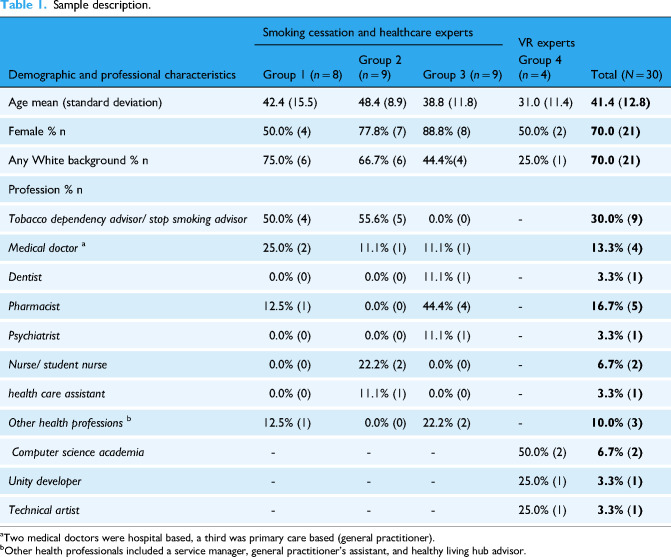 Figure 1
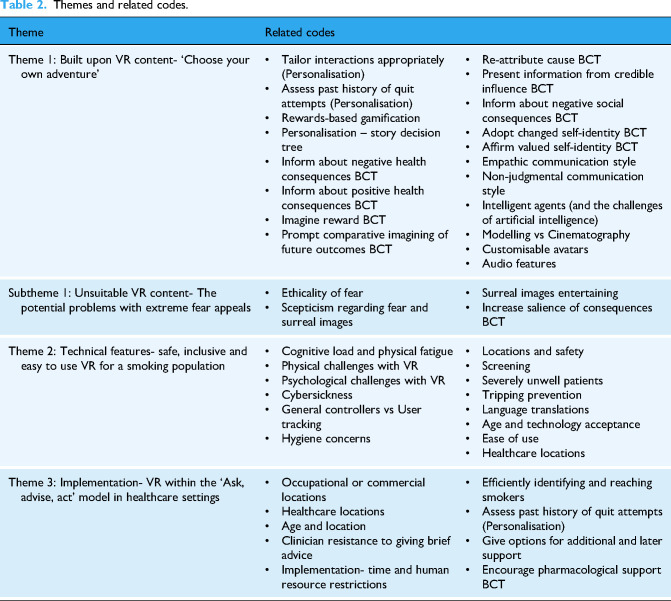 Figure 2
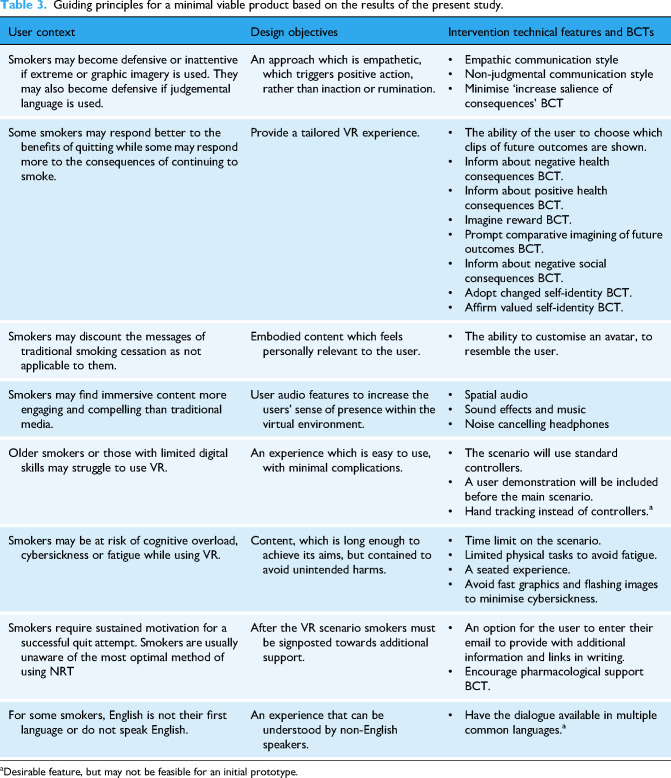 Figure 3
Peer Reviews
No public reviews on file for this paper yet. If you reviewed it on a platform where reviews are public (OpenReview, ICLR, NeurIPS, ICML), you can paste yours below so the community can read it here.
Videos
No videos yet. Explain this paper in a talk, walkthrough, or lecture? Add one.
Taxonomy
TopicsMobile Health and mHealth Applications · Behavioral Health and Interventions · Eating Disorders and Behaviors