Could a hand-held, visual electrophysiology device theoretically reduce diagnostic waiting times for complex eye conditions in the NHS? A Discrete Event Simulation (DES) modelling study
Steffen Bayer, Daniel Garillo, Marion Penn, Maria Chorozoglou, Sally Brailsford, Eloise Keeling, Fatima Shawkat, Perry Carter, Helena Lee, Jay E. Self

TL;DR
A portable eye test device could reduce waiting times for complex eye conditions in the NHS by screening patients before lab testing.
Contribution
This study uses discrete event simulation to evaluate a hand-held device's potential to reduce waiting times for eye diagnostics.
Findings
The RETeval® device could avoid lab-based testing for up to 45% of patients.
Waiting time reductions are resilient to changes in referral rates and device accuracy.
DES modeling is a useful tool for assessing diagnostic pathway changes.
Abstract
Visual Electro-Diagnostic Testing (EDTs) are a highly specialised service in the NHS. The high cost of tests and a paucity of trained visual electrophysiologists has resulted in very few services across the UK and, when combined with increasing patient backlogs, has caused significant travel burden and variable waiting times. Here, we study the potential for impact on patients and services by adding a screening step to traditional referral pathways using an Electroretinogram (ERG) test from a relatively inexpensive, portable, hand-held EDT device; the RETeval® (LKC technologies, Gaithersburg, MD, USA). We model a large regional-referral EDT service using Discrete Event Simulation (DES) modelling based on retrospective patient data and published best evidence for the device. We evaluate the potential impact that adding the screening step in referral pathways could have on patient…
Genes, proteins, chemicals, diseases, species, mutations and cell lines named across the full text — each resolved to its canonical identifier and authoritative record.
Click any figure to enlarge with its caption.
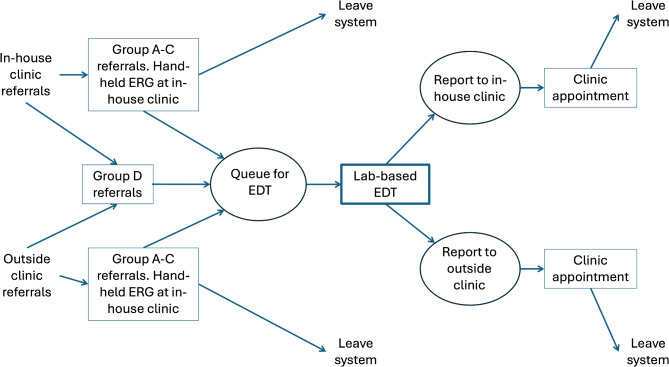 Figure 1
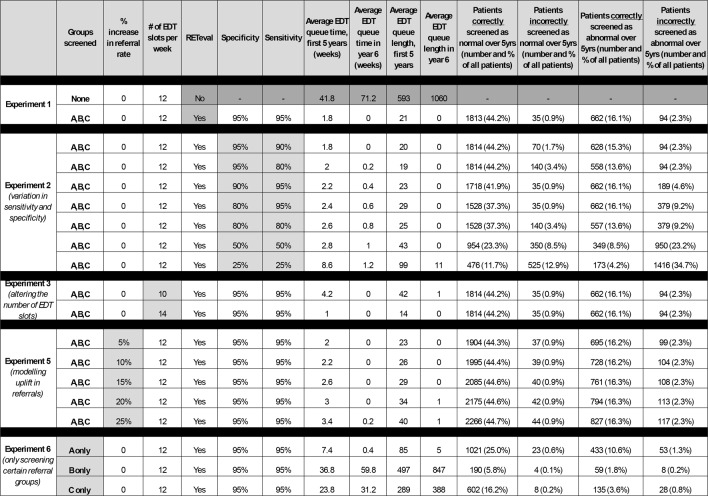 Figure 2
Peer Reviews
No public reviews on file for this paper yet. If you reviewed it on a platform where reviews are public (OpenReview, ICLR, NeurIPS, ICML), you can paste yours below so the community can read it here.
Videos
No videos yet. Explain this paper in a talk, walkthrough, or lecture? Add one.
Taxonomy
TopicsHealthcare Operations and Scheduling Optimization · Healthcare Technology and Patient Monitoring · Hemodynamic Monitoring and Therapy