Foot Drop, Wrist Drop, and Digital Ischemia As Initial Manifestations in Sjögren’s Disease
Rafeef R Alsheikhmubarak, Asmaa Hegazy, Fahad Aleidan, Saitah F Alshammari

TL;DR
A woman with rheumatoid arthritis developed unusual symptoms like foot drop and digital ischemia, which were later linked to Sjögren’s syndrome.
Contribution
This case highlights atypical early manifestations of Sjögren’s syndrome, including motor deficits and digital ischemia.
Findings
The patient exhibited bilateral wrist and foot drop as initial symptoms of Sjögren’s syndrome.
Digital ischemia was observed as a rare early sign in this case.
Treatment with steroids and immunosuppressants led to significant symptom improvement.
Abstract
A 50-year-old Saudi woman, with a history of rheumatoid arthritis (RA), presented to the emergency room with a three-week history of progressive weakness. Her symptoms began with difficulty elevating her arms and standing up from a chair. Over the next two days, her weakness progressed, leading to bilateral wrist drop and foot drop, along with an inability to raise her hands or stand. She also reported sensory changes, including decreased sensation to touch and heat, most prominent in the lower limbs, and complaints of dry eyes and mouth. Additionally, the patient noted bluish discoloration of her right middle finger. Physical examination revealed bilateral wrist and foot drop, decreased distal strength, absent reflexes, and a black discoloration on the distal interphalangeal (DIP) joint of her right middle finger. The patient had a history of inflammatory polyarthritis diagnosed as RA…
Genes, proteins, chemicals, diseases, species, mutations and cell lines named across the full text — each resolved to its canonical identifier and authoritative record.
Click any figure to enlarge with its caption.
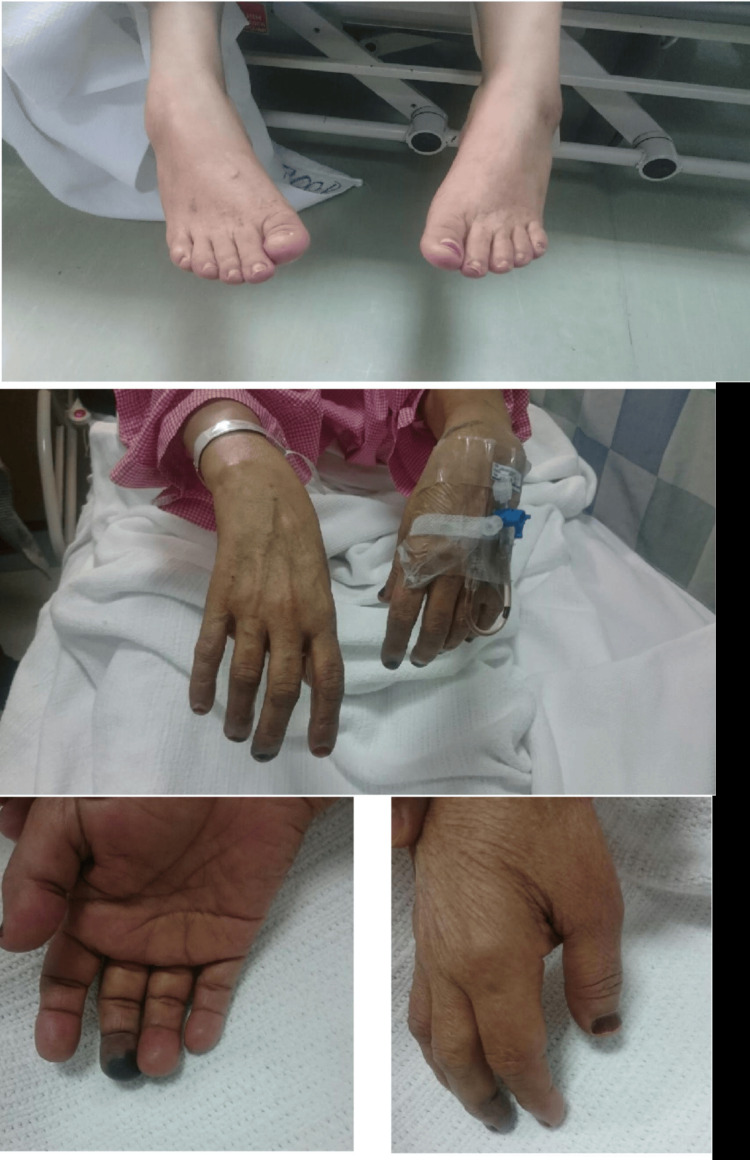 Figure 1
| Test | Result | Normal level |
|---|---|---|
| Hemoglobin, g/dL | 13.5 | 12-16 |
| White blood cells, L-1 | 7x10⁹ | 4.5 to 11.0 |
| Platelet, L-1 | 401x109 | 150-450 |
| Prothrombin time (PT), seconds | 15.3 | 11-13 |
| Partial thromboplastin time (PTT), seconds | 37.4 | 25-35 |
| International normalized ratio (INR), seconds | 1.16 | <1 |
| Urea, mmol | 6 | 1.8-7.1 |
| Creatinine, µmol/L | 74 | 53-97.2 |
| Sodium, mEq/L | 133 | 135-145 |
| Potassium, mEq/L | 3.8 | 3.5-5.2 |
| Albumin, mg/dL | 23 | 11-48 |
| 24-hour urine protein, mg\day | 768 | <150 |
| Aspartate aminotransferase (AST), U\L | 64 | 10-36 |
| Alkaline phosphatase (ALP), U\L | 258 | 44-147 |
| Alanine aminotransferase (ALT), U\L | 46 | 7-56 |
| Antinuclear antibody (ANA) | 1/1280 | Negative |
| Rheumatoid factor (RF) | 35 | Negative |
| Anti-cyclic citrullinated peptide (CCP) | Negative | Negative |
| Anti-Ds-DNA | Negative | Negative |
| Perinuclear anti-neutrophil cytoplasmic antibody (pANCA) | Negative | Negative |
| Cytoplasmic anti-neutrophil cytoplasmic antibody (cANCA) | Negative | Negative |
| Lupus anticoagulant | Negative | Negative |
| Anti-smith | Negative | Negative |
| Anti-JO-1 | Negative | Negative |
| Anti-ribonucleoprotein (RNP) | Negative | Negative |
| Anti-mitochondrial antibody (AMA) | Negative | Negative |
| Anti-smooth muscle antibody (ASMA) | Negative | Negative |
| Anti-Sjögren’s syndrome-related antigen A (SSA) | 149 | Negative |
| Anti-Sjögren’s syndrome-related antigen B (SSB) | 137 | Negative |
| C-reactive protein (CRP), mg/L | 44.6 | 8-10 |
| Erythrocyte sedimentation rate (ESR), mm\hr | 70 | <30 |
| IgG, mg\dL | 983 | 600-1600 |
| C3 | Normal | |
| C4 | Low |
Peer Reviews
No public reviews on file for this paper yet. If you reviewed it on a platform where reviews are public (OpenReview, ICLR, NeurIPS, ICML), you can paste yours below so the community can read it here.
Videos
No videos yet. Explain this paper in a talk, walkthrough, or lecture? Add one.
Taxonomy
TopicsSalivary Gland Disorders and Functions · Systemic Lupus Erythematosus Research · Olfactory and Sensory Function Studies
Introduction
Sjögren’s syndrome (SS) is a chronic autoimmune disorder primarily characterized by immune-mediated destruction of the exocrine glands, leading to hallmark symptoms of xerophthalmia (dry eyes) and xerostomia (dry mouth). However, beyond its classic glandular involvement, SS is increasingly recognized as a systemic disease with the potential to affect multiple organ systems, including the musculoskeletal, pulmonary, renal, and nervous systems. Neurological manifestations, while less common, can significantly impact disease progression and patient quality of life [1,2]. During the literature review, only a few cases were found to have neurological manifestations as presenting symptoms.
In this case report, we present a 50-year-old female with a known history of rheumatoid arthritis (RA) who was admitted to the emergency room with predominant neurological symptoms, including weakness, wrist drop, and foot drop. Given the rarity of such a presentation in SS and its potential to be misdiagnosed or overlooked, this case contributes to the growing body of evidence emphasizing the diverse and heterogeneous clinical spectrum of SS. By discussing the diagnostic challenges and relevant literature, we aim to highlight the importance of considering SS in the differential diagnosis of unexplained peripheral neuropathy, particularly in patients with a history of autoimmune disease.
Case presentation
A 50-year-old married Saudi housewife presented to the ER with a three-week history of progressive weakness. The problem started with a decreased ability to elevate her hands to comb her hair and difficulty in getting up from the chair. Two days prior to the presentation, the weakness worsened, and she was unable to raise her hands upward, which remained in a hanging position with a bilateral wrist drop. Additionally, she was unable to stand on her feet due to bilateral foot drop and was unable to move them upward.
Additionally, she reported decreased sensation to touch and heat in all four limbs, more pronounced in the lower limbs, as well as dry eyes and mouth. She also noted bluish discoloration of her right middle finger, which was first noticed two weeks ago and was not painful. Moreover, the patient developed inflammatory polyarthritis two years ago and was diagnosed with RA at that time. Apart from that, she had no history of oral ulcers, patchy hair loss, Raynaud phenomenon, photosensitivity, malar rash, deep vein thrombosis (DVT), cerebrovascular accident (CVA), or abortions.
Upon physical examination, the patient was alert, oriented, well-nourished, and in no acute distress. Vital signs were stable. The skin was warm with no pallor, cyanosis, or jaundice. The patient showed bilateral foot and wrist drops (Figure 1). In addition, she had decreased power, more pronounced distally, and a global decrease in reflexes with a mute plantar reflex. She had decreased sensation to touch and temperature in a glove-and-stocking distribution. She also had black discoloration reaching the distal interphalangeal (DIP) joint of her right middle finger (Figure 1). The systematic examination was otherwise unremarkable.
Bilateral foot drop, bilateral wrist drop, and digital ischemia
Laboratory investigations were performed, with the results detailed in Table 1.
The patient was admitted and underwent a nerve conduction study (NCS), which showed severe motor and sensory polyneuropathy with no action potential. Her minor salivary gland (MSG) biopsy results showed 10 lymphocytic aggregates, each containing more than 50 lymphocytes. The Schirmer test was positive for the right eye (0/5) and left eye (1/5). Ultrasound of the hands showed synovitis of the wrist joints but no erosions and the DEXA scan revealed osteoporosis.
The diagnostic criteria for SS include the presence of serum autoantibodies and lymphocytic sialadenitis on labial salivary gland biopsy. Our patient met both criteria, with a positive biopsy and positive serum antibodies for anti-Ro (Sjögren’s syndrome-related antigen A (SSA)) and anti-La (Sjögren’s syndrome-related antigen B (SSB)), which are highly specific for SS and often found together, further supporting the diagnosis. Additionally, she tested positive for antinuclear antibody (ANA) and rheumatoid factor (RF), with low C4 and normal C3 (Table 1).
The patient received a steroid pulse for three days, followed by oral prednisone at 1 mg/kg. Cyclophosphamide was administered at 1 g for six months. For osteoporosis, the patient was prescribed teriparatide for 18 months, after which she was switched to denosumab every six months. Maintenance medications included methotrexate, folic acid, vitamin D, calcium carbonate, omeprazole, artificial tears, and physiotherapy. The patient responded excellently to the treatment.
Discussion
The pathophysiology of SS is not yet fully understood, but a complex interaction between susceptible individuals and environmental factors plays a significant role [1]. It is well established that SS can have a wide range of signs and symptoms, as it is a multisystemic disease [2]. Nearly 71% of SS patients will develop extraglandular manifestations [2].
A cohort study conducted in France aimed to estimate the prevalence of neurological manifestations among SS patients. The study included 392 patients diagnosed with SS, and the results showed that 16.1% had peripheral nervous system (PNS) involvement, and 3.6% had central nervous system (CNS) involvement [3]. In a systematic review, the prevalence of peripheral neuropathies among patients with SS was found to be 15%, with 83% of those affected being females. The most common type of peripheral neuropathy was distal axonal neuropathy, with a prevalence of 80%, followed by sensory ganglionopathy [4].
In a study conducted in Germany, 184 patients with polyneuropathies were investigated for SS, and 44 were diagnosed. Among those diagnosed, weakness was reported in only 11 (25%) cases [5].
Few case studies have reported weakness in association with SS [6,7]. However, in this case report, the patient experienced weakness along with bilateral foot and wrist drops.
While some cases have been reported of patients presenting with bilateral wrist drops, these instances have been attributed to other conditions. For example, one case reported a patient who presented with bilateral wrist drop, pain, and paresthesia in both hands. The patient was later diagnosed with Behçet's disease, which responded well to treatment with cyclophosphamide [8]. In another case, a patient with bilateral foot and wrist drops, weakness, and numbness was diagnosed with severe sensorimotor polyneuropathy secondary to SLE-associated vasculitis [9]. To conclude, as far as we know, there are no documented cases in the literature associating wrist or foot drops with SS.
Conclusions
This case report highlights a rare presentation of SS with bilateral wrist and foot drop, progressive weakness, and sensory disturbances. While peripheral neuropathy is a recognized complication of SS, such a presentation is rarely documented. This case underscores the importance of considering neurological complications in SS to ensure timely diagnosis and management. Furthermore, it contributes to the existing literature by broadening the spectrum of possible neurological manifestations. Recognition of such cases is crucial, as early diagnosis and appropriate immunosuppressive treatment can significantly impact patient outcomes.
The reference list from the paper itself. Each links out to its DOI / PubMed record.
- 1Sjögren's syndrome: a systemic autoimmune disease Clin Exp Med Negrini S Emmi G Greco M 925222022 https://pubmed.ncbi.nlm.nih.gov/34100160/3410016010.1007/s 10238-021-00728-6PMC 8863725 · doi ↗ · pubmed ↗
- 2Reviewing primary Sjögren's syndrome: beyond the dryness - from pathophysiology to diagnosis and treatment Int J Med Sci Both T Dalm VA van Hagen PM van Daele PL 191200142017 https://pmc.ncbi.nlm.nih.gov/articles/PMC 5370281/2836707910.7150/ijms.17718 PMC 5370281 · doi ↗ · pubmed ↗
- 3Epidemiology of neurological manifestations in Sjögren's syndrome: data from the French ASSESS Cohort RMD Open Carvajal Alegria G Guellec D Mariette X 022016 https://pubmed.ncbi.nlm.nih.gov/27110384/10.1136/rmdopen-2015-000179 PMC 483876327110384 · doi ↗ · pubmed ↗
- 4Primary Sjögren syndrome-related peripheral neuropathy: a systematic review and meta-analysis Eur J Neurol Liampas A Parperis K Erotocritou MF 2552653020233608691010.1111/ene.15555 PMC 10087501 · doi ↗ · pubmed ↗
- 5Neuro-Sjögren: peripheral neuropathy with limb weakness in Sjögren’s syndrome Front Immunol Seeliger T Prenzler NK Gingele S 16001020193135473710.3389/fimmu.2019.01600 PMC 6637792 · doi ↗ · pubmed ↗
- 6Sjögren's syndrome with rapidly progressive motor neuron disease: a case report J Int Med Res Yang H Jing X Yan J Ma D 3000605209744654820203323398910.1177/0300060520974465 PMC 7705389 · doi ↗ · pubmed ↗
- 7Hypokalemic paralysis due to primary Sjögren syndrome: case report and review of the literature Case Rep Rheumatol Garza-Alpirez A Arana-Guajardo AC Esquivel-Valerio JA Villarreal-Alarcón MA Galarza-Delgado DA 7509238201720172883586410.1155/2017/7509238 PMC 5556603 · doi ↗ · pubmed ↗
- 8Wrist drop as a manifestation of Behçet’s disease Eur J Case Rep Intern Med Daher A Haddad F 51242017 https://pubmed.ncbi.nlm.nih.gov/30755922/10.12890/2016_000512 PMC 634689530755922 · doi ↗ · pubmed ↗