Correction to “A Multifunctional Cobalt‐Containing Implant for Treating Biofilm Infections and Promoting Osteointegration in Infected Bone Defects Through Macrophage‐Mediated Immunomodulation”
Nongyang Yan, Hao Zhou, Jinpeng He, Tengfei Li, Qi Liu, Hao Ning, Zhixin Ma, Linfei Feng, Tao Jin, Youwen Deng, Zhengwei Wu, Shauna Celeste Kennard

Abstract
Genes, proteins, chemicals, diseases, species, mutations and cell lines named across the full text — each resolved to its canonical identifier and authoritative record.
Click any figure to enlarge with its caption.
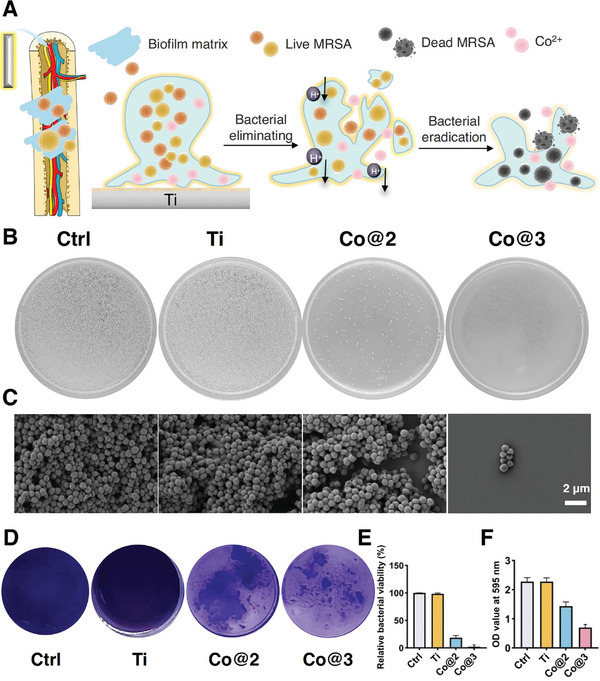 Figure 1
Peer Reviews
No public reviews on file for this paper yet. If you reviewed it on a platform where reviews are public (OpenReview, ICLR, NeurIPS, ICML), you can paste yours below so the community can read it here.
Videos
No videos yet. Explain this paper in a talk, walkthrough, or lecture? Add one.
Taxonomy
TopicsOrthopedic Infections and Treatments · Bone Tissue Engineering Materials
https://doi.org/10.1002/advs.202409200
In the original publication, the image representing the Co@3 group was mistakenly shown in Figure 4C with the correct image as follows:
Figure 4 Co‐Ti effectively eliminates MRSA biofilm. A) Schematic diagram of the antibiofilm mechanism of Co‐Ti, illustrating the transition from biofilm matrix disruption to bacterial elimination and eradication. B) MRSA colonies visualized on agar plates after treatment with different samples: Control, Ti, Co@2, and [email protected]) SEM images of MRSA biofilms following incubation with different samples, demonstrating morphological changes and bacterial removal. Scale bar = 2 µm. D) Crystal violet staining of biofilm biomass after treatment with Control, Ti, Co@2, and Co@3, showing reduced biofilm formation in Co@3‐treated samples. E) Relative bacterial viability of MRSA after treatment with various samples, quantified as a percentage. F) Quantification of biofilm biomass at OD 595 nm after treatment with different samples, with results shown as mean ± SD (n = 3).
We apologize for this error.