Correction: Baghdadi et al. Contribution of Manure-Spreading Operations to Bioaerosols and Antibiotic Resistance Genes’ Emission. Microorganisms 2023, 11, 1797
Mahsa Baghdadi, Patrick Brassard, Stéphane Godbout, Valérie Létourneau, Nathalie Turgeon, Florent Rossi, Émie Lachance, Marc Veillette, Marie-Lou Gaucher, Caroline Duchaine

Abstract
Genes, proteins, chemicals, diseases, species, mutations and cell lines named across the full text — each resolved to its canonical identifier and authoritative record.
Click any figure to enlarge with its caption.
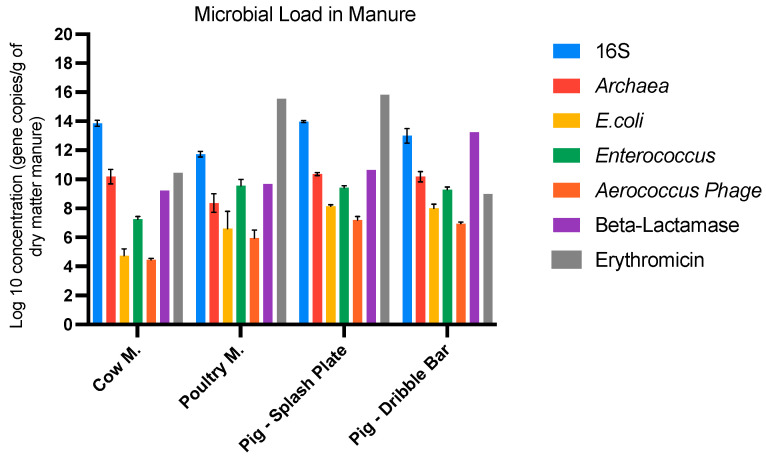 Figure 1
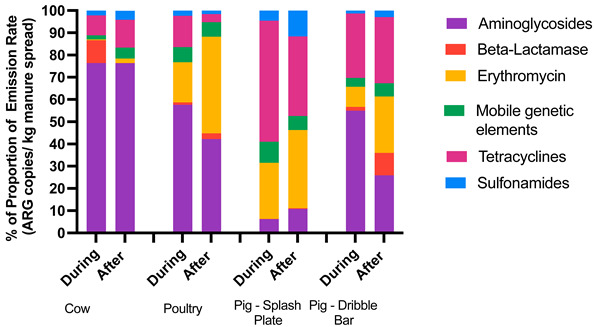 Figure 2
Peer Reviews
No public reviews on file for this paper yet. If you reviewed it on a platform where reviews are public (OpenReview, ICLR, NeurIPS, ICML), you can paste yours below so the community can read it here.
Videos
No videos yet. Explain this paper in a talk, walkthrough, or lecture? Add one.
Taxonomy
TopicsIndoor Air Quality and Microbial Exposure · Advanced Chemical Sensor Technologies · Odor and Emission Control Technologies
In the original publication [1], there was a mistake in Table 1 legend as published. The mistake involved missing “Average concentrations” in the legend. The miscalculation involved applying the equation (−0.3082 × 10^8^) + 12.223 to data where some values were zero, leading to incorrect results. The corrected Table 1 appears below.
In the original publication, there was a mistake in the Figure 1 caption as published. The mistake involved a typo in “ARGs”, which was edited to ARG. The corrected Figure 1 appears below
In the Figure 3A legends, Sulfanamide is a typo and needs to be changed to sulfonamides. The corrected Figure 3A appears below.
The miscalculation involved applying the equation (−0.3082 × 10^8^) + 12.223 to data where some values were zero, leading to incorrect results. This error resulted in errors in the descriptions of Table 1 and Figure 1 and the related text. A correction has been made to the results Section 3.1. The corrected section appears below.
“Manure is known as the main source of emitted bioaerosols. In the present study, the average concentration of total bacteria was found to be the highest in cow manure and pig slurry (7.61 × 10^13^, 9.29 × 10^13^, and 1.91 × 10^13^ 16S rRNA gene copies/g of dry matter, respectively) and the lowest in poultry manure (Table 1A). A similar observation can be made for Archaea, which was 2 log lower in the latter. Conversely, Enterococcus, E. coli, and the Aerococcus phage were the lowest in cow manure (1.91 × 10^7^, 7.65 × 10^4^, and 1.45 × 10^4^ 16S rRNA gene copies/g of dry matter, respectively), whereas the other types of manure displayed very similar concentrations (Table 1A).
Beta-lactamase and tetracyclines, as well as sulfonamides, resistance genes were the most abundant ARGs in pig slurry with the dribble bar (1.70 × 10^13^, 1.42 × 10^12^, and 2.75 × 10^11^ gene copies/g of dry matter, respectively) (Table 1B). Erythromycin and tetracycline resistance genes were the most reported ARGs in pig slurry with the splash plate (6.72 × 10^15^, 2.31 × 10^12^, gene copies/g of dry matter, respectively). Erythromycin resistance genes had the highest concentration in poultry manure (3.52 × 10^15^ gene copies/g of dry matter). According to these results, on average, erythromycin and beta-lactamase resistance genes were the most abundant in manure for most of the experiments (10^15^ and 10^12^ gene copies/g of dry matter) (Figure 1).”
The authors state that the scientific conclusions are unaffected. This correction was approved by the Academic Editor. The original publication has also been updated.
The reference list from the paper itself. Each links out to its DOI / PubMed record.
- 1Baghdadi M. Brassard P. Godbout S. Létourneau V. Turgeon N. Rossi F. LachanceÉ. Veillette M. Gaucher M.-L. Duchaine C. Contribution of Manure-Spreading Operations to Bioaerosols and Antibiotic Resistance Genes’ Emission Microorganisms 202311179710.3390/microorganisms 1107179737512969 PMC 10386661 · doi ↗ · pubmed ↗