Editorial of Conjugated Polymers: Preparation, Properties and Applications
Paolo Coghi, Carmine Coluccini

Abstract
Genes, proteins, chemicals, diseases, species, mutations and cell lines named across the full text — each resolved to its canonical identifier and authoritative record.
Click any figure to enlarge with its caption.
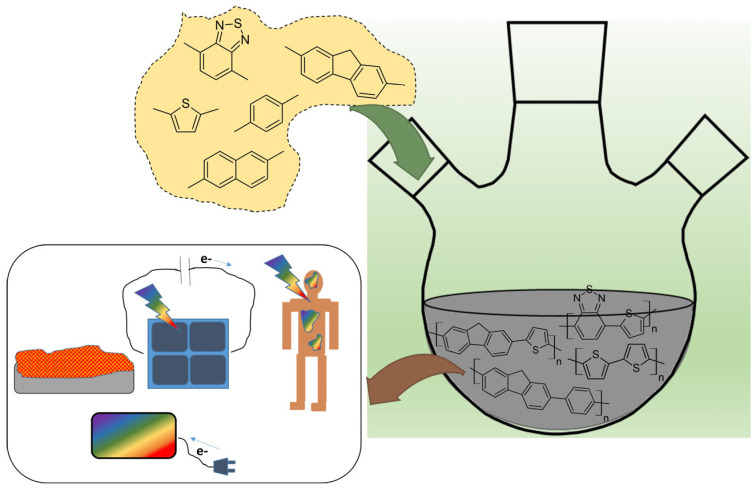 Figure 1
Peer Reviews
No public reviews on file for this paper yet. If you reviewed it on a platform where reviews are public (OpenReview, ICLR, NeurIPS, ICML), you can paste yours below so the community can read it here.
Videos
No videos yet. Explain this paper in a talk, walkthrough, or lecture? Add one.
Taxonomy
TopicsConducting polymers and applications · Covalent Organic Framework Applications · Luminescence and Fluorescent Materials
Conjugated polymers (CPs) continue to revolutionize the landscape of materials science with their unique electrical, optical, and mechanical properties. Recent advancements in their synthesis, doping strategies, and structural modifications have opened new avenues in photovoltaics, optoelectronics, biomedical applications, and energy storage. The collection of recent studies highlights the remarkable versatility of CPs and their increasing significance in both fundamental research and practical applications (Figure 1).
One of the notable developments in CP research is the electropolymerization of inherently chiral polymer films, as demonstrated by Niebisch et al. [1]. This study showcases a novel diketopyrrolopyrrole-based polymer that exhibits chiroptical properties, expanding the potential for CPs in chiral sensing and optoelectronic applications. Meanwhile, the work of Yue et al. [2] emphasizes the critical role of dopant selection in fine-tuning the electrical transport properties of CPs. Their investigation into the effects of different chemical dopants on indacenodithiophene-co-benzothiadiazole polymers provides valuable insights into optimizing CPs for industrial-scale applications.
In the realm of nanoelectronics, Chen et al. [3] introduce high-performance one-dimensional transistors based on poly(p-phenylene ethynylene) molecular wires. Their findings indicate that gate-all-around molecular wire FETs could serve as a promising candidate to extend Moore’s law, bringing transistor technology closer to the sub-5 nm scale. Similarly, Lian et al. [4] explore the incorporation of benzimidazole structures into polyimides, significantly enhancing their thermal and dielectric properties for flexible electronic applications.
Biomedical applications of CPs have also seen remarkable advancements. Trindade [5] provides an extensive review of elastomeric Janus particles with controlled surface textures, highlighting their potential in bacterial adhesion studies and biomimetic materials. Krawczyk et al. [6] report the development of a polypyrrole-based drug delivery system tailored for neurological applications. Their study demonstrates the successful incorporation of chlorpromazine and heparin into CP matrices, paving the way for precise, controlled drug release mechanisms.
Photonic applications remain a major focus for CP research, as highlighted by Coghi et al. [7] in their review of light-sensitive conjugated polymers for photovoltaic and light-emitting devices. The ability of CPs to efficiently absorb and convert light energy is also demonstrated in the work of Zulkifli et al. [8], where a novel polycyclopentadithiophene-based polymer exhibits promising photocatalytic activity for organic transformations. Additionally, Nurazizah et al. [9] provide a systematic comparison of PEDOT:PSS and PEDOT:Carrageenan in dye-sensitized solar cells, revealing their respective roles as counter-electrodes and electrolytes, and suggesting pathways for improving their efficiency.
Advances in theoretical and computational chemistry have furthered our understanding of CP behavior at the molecular level. Rodríguez-Sánchez et al. [10] conduct a theoretical study on vinyl-sulfonate monomers and their impact as dopants in polyaniline dimers, shedding light on their electronic properties and reactivity. Lim et al. [11] provide a computational perspective on nitrogen-substituted polycyclic aromatic hydrocarbons, elucidating their π-electron delocalization patterns and potential electronic applications. Finally, Šloufová et al. [12] present a novel class of metallo-supramolecular polymers featuring 1-thioxophosphole units, revealing intriguing photoinduced Raman spectral changes that contribute to the growing field of responsive polymeric materials.
Taken together, these studies underscore the transformative potential of conjugated polymers across a broad spectrum of scientific and technological domains. As research continues to push the boundaries of CP design and application, it is evident that these materials will play an increasingly vital role in shaping the future of electronics, medicine, and sustainable energy solutions.
We extend our gratitude to all contributing authors and reviewers who have helped shape this Special Issue, and we look forward to further advancements in this rapidly evolving field.
The reference list from the paper itself. Each links out to its DOI / PubMed record.
- 1Niebisch F. Scherf U. Palma-Cando A. Electropolymerization of a New Diketopyrrollopyrrole Derivative into Inherent Chiral Polymer Films Nanomaterials 202414177610.3390/nano 1422177639591018 PMC 11597823 · doi ↗ · pubmed ↗
- 2Yue B. Zhang X. Lu K. Ma H. Chen C. Lin Y. Impact of Structural Alterations from Chemical Doping on the Electrical Transport Properties of Conjugated Polymers Polymers 202416246710.3390/polym 1617246739274100 PMC 11398188 · doi ↗ · pubmed ↗
- 3Chen Z. Tan X. Li Q. Wan J. Xu G. High-Performance One-Dimensional Sub-5 nm Transistors Based on Poly(p-phenylene ethynylene) Molecular Wires Molecules 202429320710.3390/molecules 2913320738999159 PMC 11243332 · doi ↗ · pubmed ↗
- 4Lian M. Zhao F. Liu J. Tong F. Meng L. Yang Y. Zheng F. The Pivotal Role of Benzimidazole in Improving the Thermal and Dielectric Performance of Upilex-Type Polyimide Polymers 202315234310.3390/polym 1510234337242916 PMC 10223674 · doi ↗ · pubmed ↗
- 5Trindade A.C. Controlled Surface Textures of Elastomeric Polyurethane Janus Particles: A Comprehensive Review Polymers 202416183510.3390/polym 1613183539000690 PMC 11244459 · doi ↗ · pubmed ↗
- 6Krawczyk S. Golba S. Neves C. Tedim J. Chlorpromazine–Polypyrrole Drug Delivery System Tailored for Neurological Application Molecules 202429153110.3390/molecules 2907153138611809 PMC 11013625 · doi ↗ · pubmed ↗
- 7Coghi P. Coluccini C. Literature Review on Conjugated Polymers as Light-Sensitive Materials for Photovoltaic and Light-Emitting Devices in Photonic Biomaterial Applications Polymers 202416140710.3390/polym 1610140738794599 PMC 11125275 · doi ↗ · pubmed ↗
- 8Zulkifli F.Z.A. Ito M. Uno T. Kubo M. Synthesis and Photocatalytic Activity of Novel Polycyclopentadithiophene Polymers 202315409110.3390/polym 1520409137896335 PMC 10610433 · doi ↗ · pubmed ↗