Association of Personal Care and Consumer Product Chemicals with Long-Term Amenorrhea: Insights into Serum Globulin and STAT3
Ziyi Li, Xue Song, Daniel Abdul Karim Turay, Yanling Chen, Guohong Zhao, Yingtong Jiang, Kun Zhou, Xiaoming Ji, Xiaoling Zhang, Minjian Chen

TL;DR
This study finds that exposure to certain chemicals in personal care products is linked to long-term amenorrhea, with serum globulin and STAT3 playing a mediating role.
Contribution
The study identifies specific PFAS chemicals and their associations with long-term amenorrhea, revealing serum globulin and STAT3 as potential mediators.
Findings
Women with long-term amenorrhea had higher exposure levels to specific PFAS chemicals like PFHxS and n_PFOA.
Serum globulin partially mediates the relationship between PFAS exposure and long-term amenorrhea.
PFHxS and n_PFOA may interact with STAT3, suggesting a biological pathway linking these chemicals to amenorrhea.
Abstract
Chemicals in personal care and consumer products are suspected to disrupt endocrine function and affect reproductive health. However, the link between mixed exposure and long-term amenorrhea is not well understood. This study analyzed data from 684 women (2013–2018 National Health and Nutrition Examination Survey) to assess exposure to eight polyfluorinated alkyl substances (PFASs), 15 phthalates (PAEs), six phenols, and four parabens. Various statistical models for robustness tests and mediation analysis were used to explore associations with long-term amenorrhea and the role of serum globulin. Biological mechanisms were identified through an integrated strategy involving target analysis of key chemicals and long-term amenorrhea intersections, pathway analysis, and target validation. Results showed that women with long-term amenorrhea had higher exposure levels of Perfluorodecanoic…
Genes, proteins, chemicals, diseases, species, mutations and cell lines named across the full text — each resolved to its canonical identifier and authoritative record.
Click any figure to enlarge with its caption.
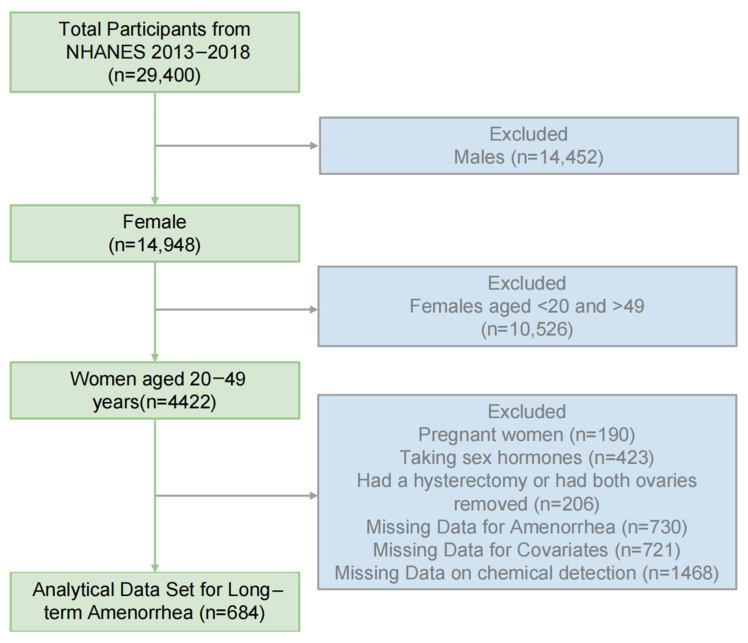 Figure 1
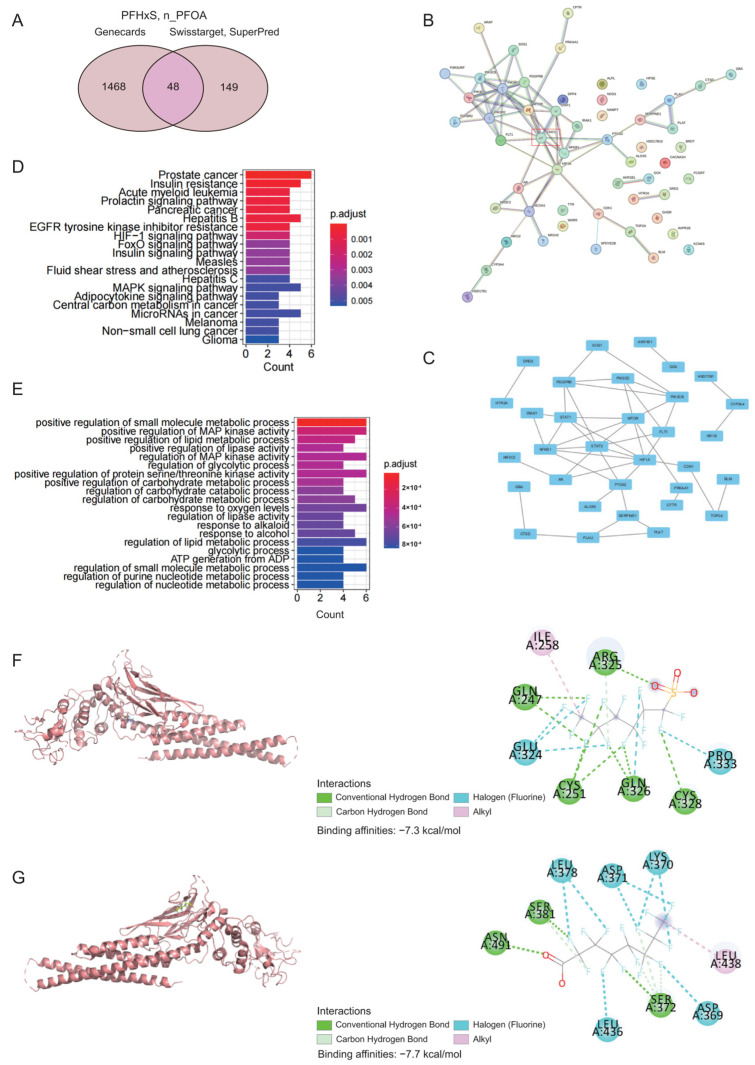 Figure 2
Peer Reviews
No public reviews on file for this paper yet. If you reviewed it on a platform where reviews are public (OpenReview, ICLR, NeurIPS, ICML), you can paste yours below so the community can read it here.
Videos
No videos yet. Explain this paper in a talk, walkthrough, or lecture? Add one.
Taxonomy
TopicsPer- and polyfluoroalkyl substances research · Effects and risks of endocrine disrupting chemicals · Birth, Development, and Health