Multi-Color Tunable Afterglow Materials Leveraging Energy Transfer Between Host and Guest
Xiao He, Bo Wang, Xiaoqiang Zhao, Fengqin Ke, Wenhui Feng, Liwen Wang, Jiameng Yang, Guangyu Wen, Denghui Ji

TL;DR
This paper introduces tunable afterglow materials that change color and duration based on energy transfer between host and guest molecules, enabling new applications in anti-counterfeiting.
Contribution
The study demonstrates dynamic color and time adjustment in RTP materials through host/guest energy transfer and structural variation.
Findings
Afterglow color shifts from yellow to green by altering the host's molecular structure.
Host energy levels and Förster energy transfer are critical for long-aging triplet excitons.
Multi-color materials enable advanced anti-counterfeiting applications.
Abstract
Host/guest doping is an effective approach to achieving room-temperature phosphorescence (RTP). However, the influence of the host matrix on doping systems is still unclear, and it is difficult to select the suitable host species for a certain guest emitter. This study prepared a series of host/guest RTP materials with dynamically adjustable time and color by doping a non-RTP guest material in various host materials that were easy to crystallize. The varying afterglow color originated from the difference in Förster energy transfer between the host and guest. Specifically, the change from yellow to green afterglow was realized by varying the host’s molecular structure. This study further revealed the importance of proper host energy levels, the ability to generate long-aging triplet excitons, and the Förster energy transfer from host to guest. Additionally, multiple information…
Genes, proteins, chemicals, diseases, species, mutations and cell lines named across the full text — each resolved to its canonical identifier and authoritative record.
Click any figure to enlarge with its caption.
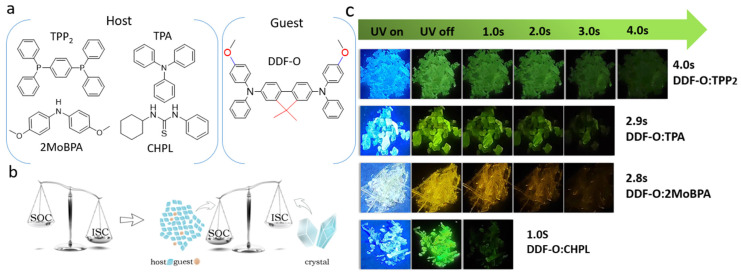 Figure 1
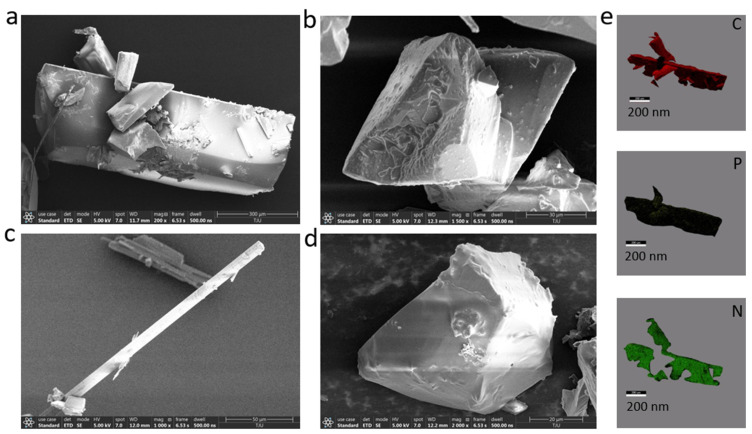 Figure 2
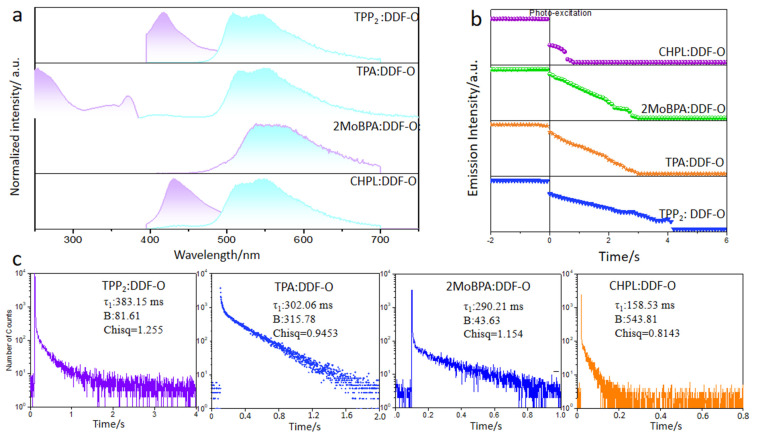 Figure 3
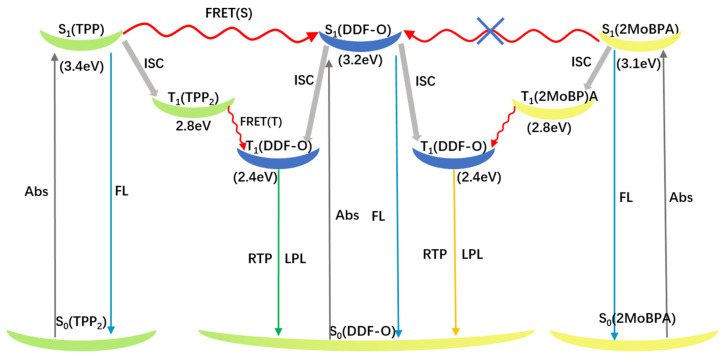 Figure 4
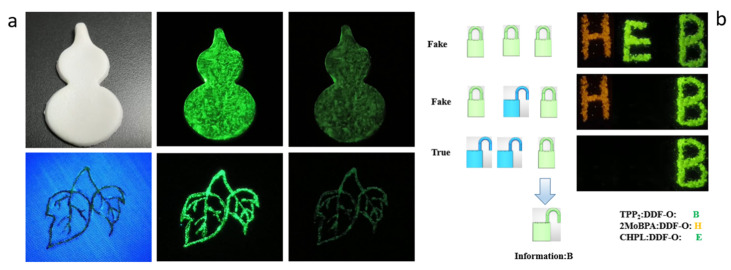 Figure 5
Peer Reviews
No public reviews on file for this paper yet. If you reviewed it on a platform where reviews are public (OpenReview, ICLR, NeurIPS, ICML), you can paste yours below so the community can read it here.
Videos
No videos yet. Explain this paper in a talk, walkthrough, or lecture? Add one.
Taxonomy
TopicsLuminescence and Fluorescent Materials · Organic Light-Emitting Diodes Research · Carbon and Quantum Dots Applications