The Mediating Role of Work–Life Balance Between Perceived Partner Support and Satisfaction with Food-Related Life in Dual-Earning Parents and Their Adolescents
Berta Schnettler, Andrés Concha-Salgado, Klaus G. Grunert, Ligia Orellana, Mahia Saracostti, Katherine Beroiza, Héctor Poblete, Germán Lobos, Cristian Adasme-Berríos, María Lapo, Leonor Riquelme-Segura, José A. Sepúlveda, Karol Reutter, Enid Thomas

TL;DR
This study explores how work-life balance connects partner support to satisfaction with food-related life in dual-earning parents and their adolescents.
Contribution
The study introduces a model showing how work-life balance mediates partner support effects on food-related life satisfaction in dual-earning families.
Findings
Mothers' food-related life satisfaction is indirectly influenced by partner support through work-life balance.
Fathers' food-related life satisfaction is directly and indirectly affected by partner support and work-life balance.
Adolescents' satisfaction is linked to mothers' partner support and fathers' work-life balance.
Abstract
Background: Partner support and work–life balance (WLB) are important for families’ well-being. Previous research has linked perceived family support, WLB, and satisfaction with food-related life (SWFoL); however, there is limited information regarding each parent’s support from their partner. Drawing on the conservation of resources theory, the work–home resources, and the actor–partner interdependence model (APIM), this study examined the direct and indirect effects of parents’ perceived partner support, WLB, and the SWFoL of dual-income parents and their adolescents, considering the moderating role of parents’ gender-transcendent attitudes. Methods: A total of 516 dual-earning parents with one adolescent child were recruited in Chile using non-probability sampling. The parents completed scales measuring perceived partner support, WLB, and gender role attitudes. The three family…
Genes, proteins, chemicals, diseases, species, mutations and cell lines named across the full text — each resolved to its canonical identifier and authoritative record.
Click any figure to enlarge with its caption.
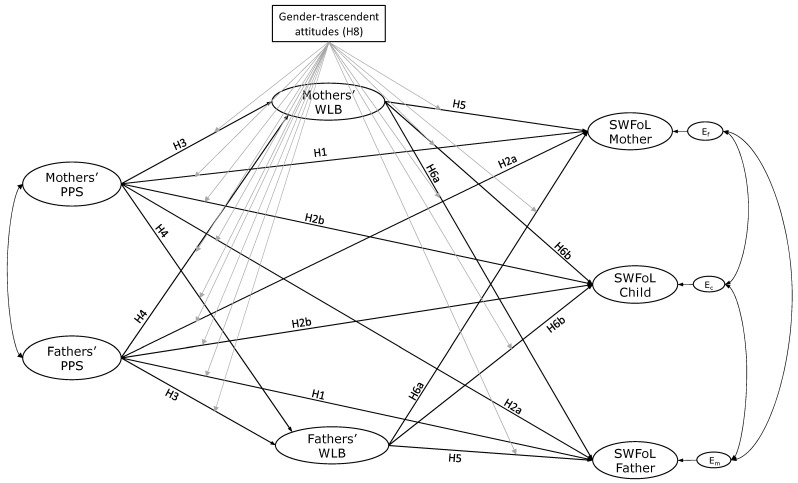 Figure 1
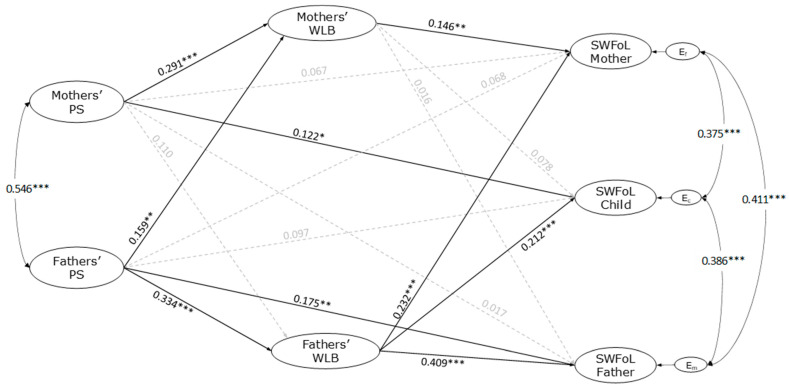 Figure 2
Peer Reviews
No public reviews on file for this paper yet. If you reviewed it on a platform where reviews are public (OpenReview, ICLR, NeurIPS, ICML), you can paste yours below so the community can read it here.
Videos
No videos yet. Explain this paper in a talk, walkthrough, or lecture? Add one.
Taxonomy
TopicsWork-Family Balance Challenges · Attachment and Relationship Dynamics · Intergenerational Family Dynamics and Caregiving