Rapid Detection of Salmonella Typhimurium During Cell Attachment on Three Food-Contact Surfaces Using Long-Read Sequencing
Daniela Bermudez-Aguirre, Shannon Tilman, Joseph Uknalis, Brendan A. Niemira, Katrina L. Counihan

TL;DR
This study shows that long-read sequencing can detect Salmonella on food surfaces much earlier than traditional methods, helping prevent contamination.
Contribution
The novel use of long-read sequencing enables early detection of Salmonella during initial cell attachment on food-contact surfaces.
Findings
Long-read sequencing detected Salmonella after 1 hour, while traditional methods required 3 hours.
Silicone surfaces had the highest Salmonella attachment (0.87 log CFU/cm²).
Early detection allows timely sanitation interventions in food processing environments.
Abstract
Salmonella spp. are pathogenic microorganisms linked to foodborne outbreaks associated with eggs and egg products. Salmonella can resist sanitation of egg processing equipment and form biofilms on food-contact surfaces. A major challenge for controlling Salmonella is the ability to detect the cells during the early stages of attachment to indicate that interventions are needed to sanitize the surface. This research investigated the use of long-read sequencing to identify Salmonella during the early stages (0–5 h) of cell attachment to three common food-contact surfaces—stainless steel, silicone, and nylon—and compared it with traditional microbiological methods. Results of the conventional plate counts showed that the detection of Salmonella began after three hours of incubation, with less than 1 log CFU/cm2 of growth. Silicone had the highest number of Salmonella attached (0.87 log…
Genes, proteins, chemicals, diseases, species, mutations and cell lines named across the full text — each resolved to its canonical identifier and authoritative record.
Click any figure to enlarge with its caption.
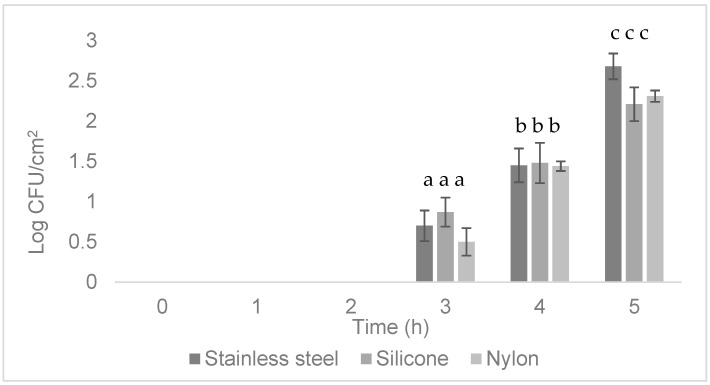 Figure 1
 Figure 2
 Figure 3
Peer Reviews
No public reviews on file for this paper yet. If you reviewed it on a platform where reviews are public (OpenReview, ICLR, NeurIPS, ICML), you can paste yours below so the community can read it here.
Videos
No videos yet. Explain this paper in a talk, walkthrough, or lecture? Add one.
Taxonomy
TopicsSalmonella and Campylobacter epidemiology · Biosensors and Analytical Detection · Identification and Quantification in Food