A Case Report of Inguinal Hernia Sac Lithiasis
Kiana Babaei, Ali Movahedi, Azam Gazerani, Navid Soroush

TL;DR
A 41-year-old man had a rare case of a stone found inside his inguinal hernia sac during surgery.
Contribution
This paper presents a rare clinical case of inguinal hernia sac lithiasis with calcium oxalate composition.
Findings
A stone measuring 2 cm in diameter was found inside the hernia sac during surgery.
The stone was identified as calcium oxalate through pathology analysis.
Abstract
We report a case of a stone in inguinal hernia sac. A 41-year-old male patient presented to Hakim Hospital in Neyshabur city, Iran, with complaints of pain and swelling in the right abdominal region. After initial evaluations, a diagnosis of right inguinal hernia was made, and the patient was scheduled for hernioplasty. He had no history of previous surgeries, hospital admissions, underlying diseases, or kidney and gallbladder stones. The surgery was performed. The hernia sac was exposed. Inside the hernia sac, a stone measuring approximately 2 cm in diameter, with a hard consistency and yellow color, was found. The stone was not adherent to the sac and was mobile. The hernia sac was opened, the stone was removed, and sent to the pathology lab. The patient was discharged 24 h later in good general condition. According to the pathology report, the components of the stone were identified…
Genes, proteins, chemicals, diseases, species, mutations and cell lines named across the full text — each resolved to its canonical identifier and authoritative record.
Click any figure to enlarge with its caption.
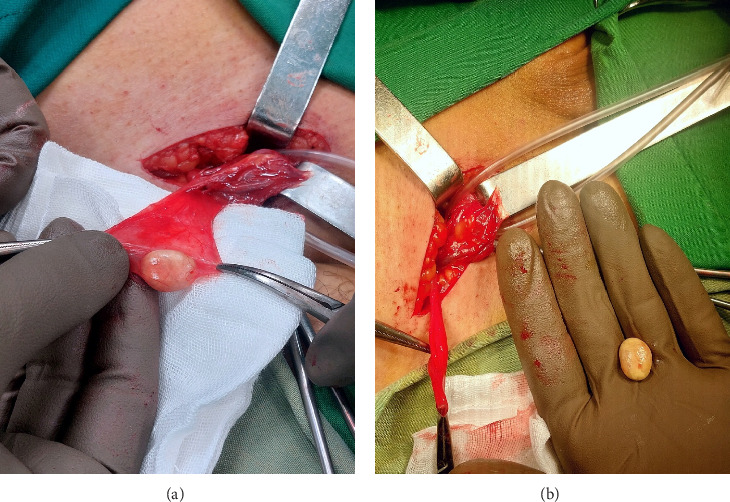 Figure 1
Peer Reviews
No public reviews on file for this paper yet. If you reviewed it on a platform where reviews are public (OpenReview, ICLR, NeurIPS, ICML), you can paste yours below so the community can read it here.
Videos
No videos yet. Explain this paper in a talk, walkthrough, or lecture? Add one.
Taxonomy
TopicsHernia repair and management · Omental and Epiploic Conditions · Intestinal and Peritoneal Adhesions