Eco-Friendly and Efficient Synthesis of 2-Hydroxy-3-Hydrazono-Chromones Through α,β-C(sp2)–H Bond Difunctionalization/Chromone Annulation Reaction of o-Hydroxyaryl Enaminones, Water, and Aryldiazonium Salts
Xiaohong Wang, Menglin Peng, Yijin Wang, Siyu Song, Ying Xu, Li Chen, Fuchao Yu

TL;DR
This paper presents a green and efficient method to synthesize 2-hydroxy-3-hydrazono-chromones using water and common reagents under mild conditions.
Contribution
The study introduces a novel difunctionalization/annulation strategy for chromone synthesis with broad substrate scope and functional group tolerance.
Findings
The method constructs 2,3-disubstituted chromones with moderate to excellent yields.
It enables gram-scale synthesis and is applicable to a wide range of substrates.
The approach is eco-friendly and uses readily available starting materials.
Abstract
A novel, eco-friendly, and efficient method for constructing 2,3-disubstituted chromone skeletons from readily available water, o-hydroxyaryl enaminones (o-HPEs), and aryldiazonium salts has been developed under mild reaction conditions. This α,β-C(sp2)–H bond difunctionalization/chromone annulation reaction strategy is achieved by building two C(sp3)–O bonds and a C(sp2)-N bond, which provides a practical pathway for the preparation of 2-hydroxy-3-hydrazono-chromones in moderate to excellent yields, enabling broad substrate scope and good functional group tolerance, as well as gram-scale synthesis. This protocol offers a valuable tool for synthesizing diverse functionalized chromones with potential applications in drug discovery and industrial synthesis.
Genes, proteins, chemicals, diseases, species, mutations and cell lines named across the full text — each resolved to its canonical identifier and authoritative record.
Click any figure to enlarge with its caption.
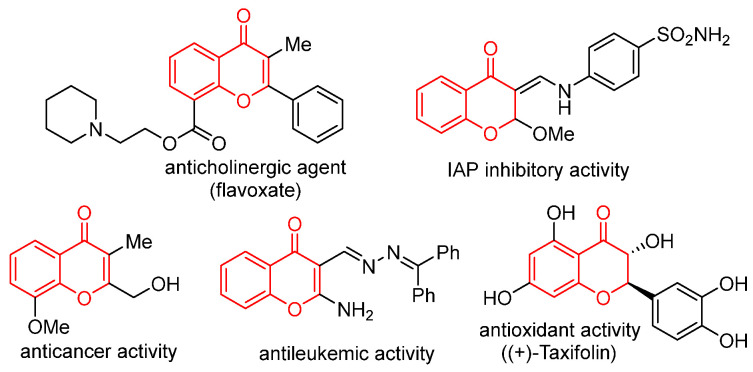 Figure 1
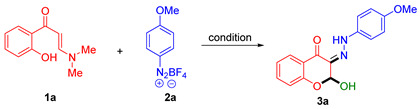 Figure 2
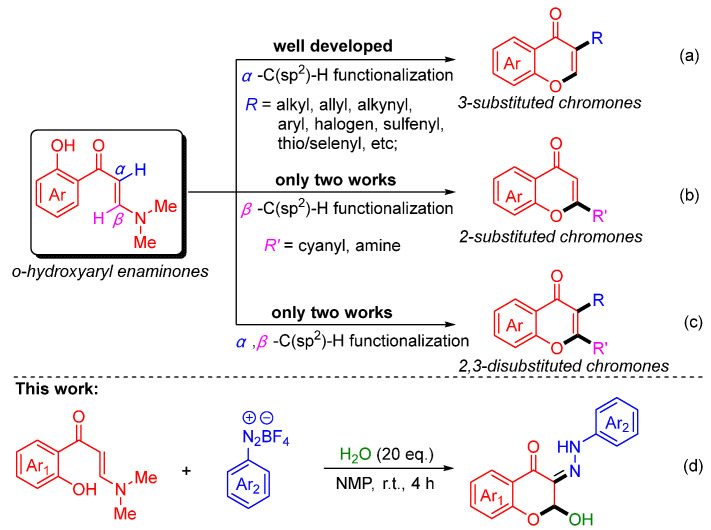 Figure 3
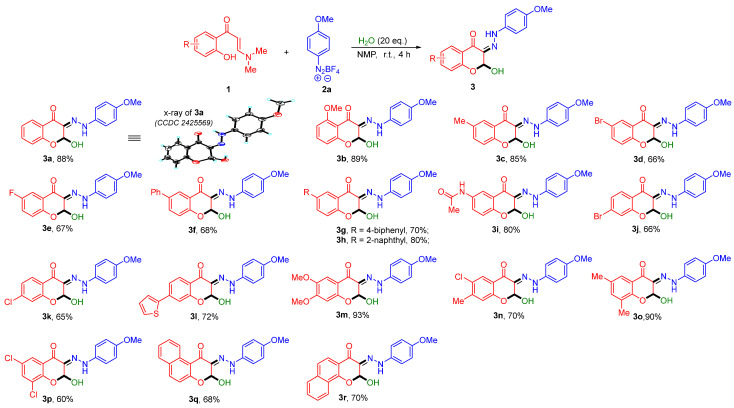 Figure 4
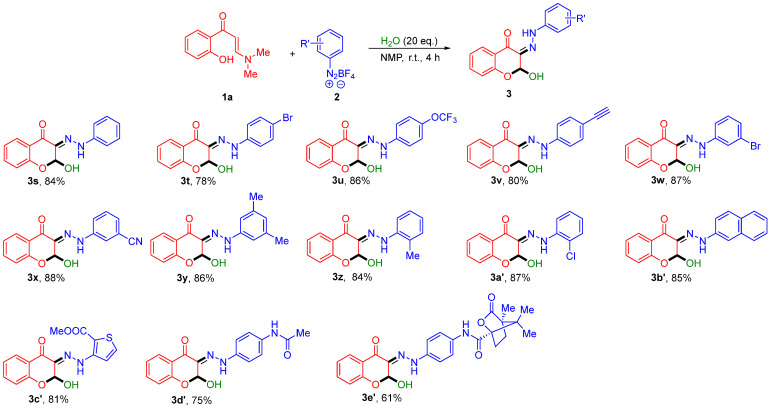 Figure 5
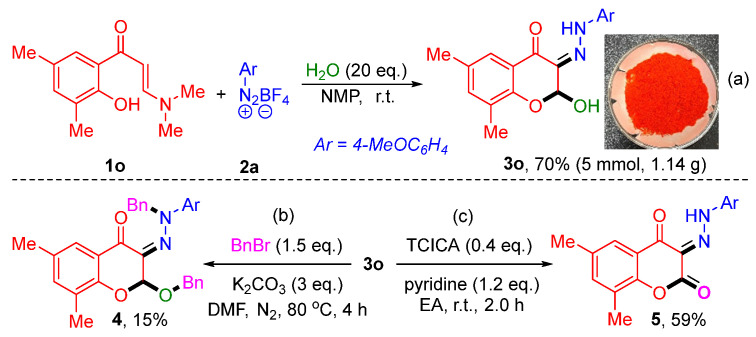 Figure 6
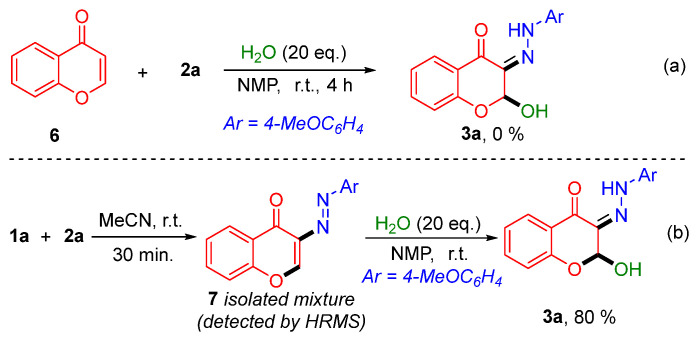 Figure 7
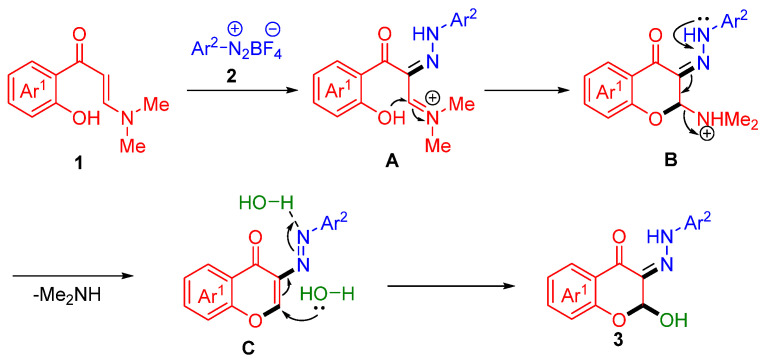 Figure 8
Peer Reviews
No public reviews on file for this paper yet. If you reviewed it on a platform where reviews are public (OpenReview, ICLR, NeurIPS, ICML), you can paste yours below so the community can read it here.
Videos
No videos yet. Explain this paper in a talk, walkthrough, or lecture? Add one.
Taxonomy
TopicsSynthesis of Organic Compounds · Multicomponent Synthesis of Heterocycles · Catalytic C–H Functionalization Methods