Application of Amplicon Metagenomics to Identify Fungal Pathogens in Formalin-Fixed Paraffin-Embedded Samples: Proof of Concept in Animals with Fungal Pathologies
David B. Needle, Guillaume Reboul, Patrick K. Mitchell, Derek Rothenheber, Nicholas J. Marra, Brittany D. Cronk, Neeti G. Patel, Laura B. Goodman

TL;DR
This study shows that amplicon metagenomics can identify fungal pathogens in preserved FFPE tissues, offering a new tool for diagnosis and research.
Contribution
The study demonstrates a proof of concept for using amplicon metagenomics in FFPE samples to identify fungal pathogens.
Findings
Amplicon metagenomics successfully identified fungal pathogens in 9 out of 11 FFPE samples.
The ITS1 and 28S D1 rRNA gene markers were effective for fungal identification in FFPE tissues.
The method is valuable for retrospective studies and polymicrobial community research with suboptimal DNA preservation.
Abstract
The identification of fungal pathogens in formalin-fixed paraffin-embedded (FFPE) tissues is an unmet need in human and animal medicine, and sequence-agnostic approaches are needed to identify emerging pathogens. Eleven FFPE biopsy specimens with etiologic diagnoses of fungal disease based on standard testing of paired fresh tissue samples were utilized here to evaluate metabarcoding approaches. The cases included tissues from three dogs, three cats, one box turtle, one goat, one common loon, and one gray tree frog. The diagnoses from the fresh tissues in these cases were Microsporum canis, Penicillium sp., Exophiala sp. (likely E. jeanselmei), Verticillium sp., Rhizopus sp., atypical Cryptococcus neoformans, Conidiobolus spp., Aspergillus fumigatus, Cryptococcus neoformans var grubii, Batrachochytrium dendrobatidis, Fusarium solani, Blastomyces dermatitidis, Coccidiodes immitis, and…
Genes, proteins, chemicals, diseases, species, mutations and cell lines named across the full text — each resolved to its canonical identifier and authoritative record.
Click any figure to enlarge with its caption.
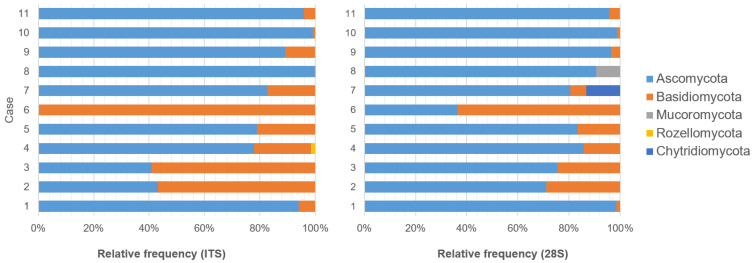 Figure 1
Peer Reviews
No public reviews on file for this paper yet. If you reviewed it on a platform where reviews are public (OpenReview, ICLR, NeurIPS, ICML), you can paste yours below so the community can read it here.
Videos
No videos yet. Explain this paper in a talk, walkthrough, or lecture? Add one.
Taxonomy
TopicsInfectious Diseases and Mycology · Fungal Infections and Studies · Plant Pathogens and Fungal Diseases