Comment on Wang et al. Simufilam Reverses Aberrant Receptor Interactions of Filamin A in Alzheimer’s Disease. Int. J. Mol. Sci. 2023, 24, 13927
Keith Fluegge, Kyle Fluegge

Abstract
Genes, proteins, chemicals, diseases, species, mutations and cell lines named across the full text — each resolved to its canonical identifier and authoritative record.
Click any figure to enlarge with its caption.
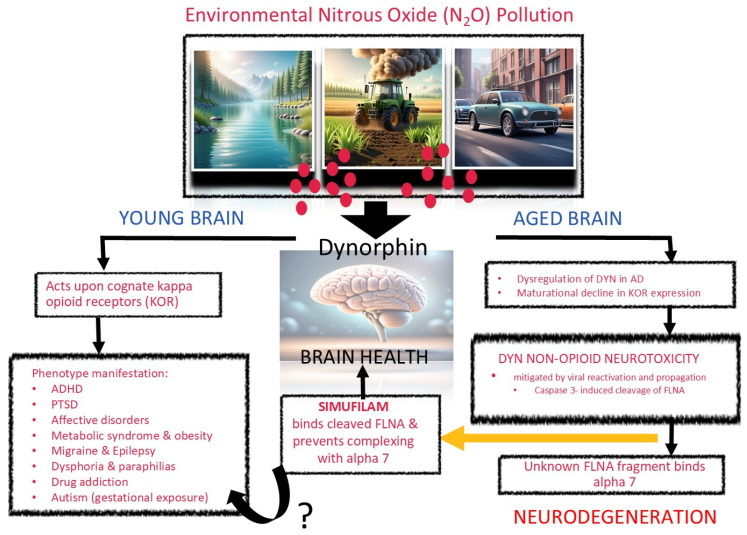 Figure 1
Peer Reviews
No public reviews on file for this paper yet. If you reviewed it on a platform where reviews are public (OpenReview, ICLR, NeurIPS, ICML), you can paste yours below so the community can read it here.
Videos
No videos yet. Explain this paper in a talk, walkthrough, or lecture? Add one.
Taxonomy
TopicsBiotin and Related Studies · Alzheimer's disease research and treatments · Advanced Fluorescence Microscopy Techniques
The authors have published their findings that simufilam, a small novel molecule suggested for clinical use in Alzheimer’s disease (AD), restores a deleterious conformation of filamin A (FLNA), which is a large intracellular scaffolding protein, as indicated by changes in isoelectric focusing points [1]. The isoelectric point (pI) is the pH at which a molecule carries no electrical charge. Changes in isoelectric focusing points can also indicate more than just phosphorylation or mechanical stress. Proteolytic cleavage and subsequent changes in protein length can also affect the balance of charges [2], and the authors briefly mention cleavage as a possible interaction in characterizing mutant FLNA. The co-immunoprecipitation experiments use FLNA antibody that is specific to various epitopes on the C or N-terminus. There is the possibility that these epitopes exist on both wild-type FLNA and fragmented protein segments. These experiments prove that FLNA has been altered, but whether this entails a conformational change is not certain.
This consideration is minimized, though, when the authors postulated in their discussion that amyloid beta1–42 (Aβ42) drives this potential altered conformation. If this hypothesis were correct, patients with moderate and/or severe dementia should see an observed clinical benefit from taking simufilam, owing to a greater amyloid burden as the disease progresses. Indeed, patient screening for clinical trials measuring simufilam’s effectiveness in AD involves assessing amyloid pathology. However, on Cassava Sciences’ website, the unpublished phase 2 clinical data thus far suggests that only mild AD cases experience a therapeutic benefit of simufilam [3], indicating that the hypothesis that Aβ42 drives a conformational change in FLNA, which simufilam reverses, is not correct. Rather, the clinical data thus far would suggest that mutant FLNA appears before any amyloid deposition and aggregation, and not after. This is a critical observation because the recent ReThink-ALZ phase 3 readout indicated that simufilam did not improve or even halt cognitive loss in AD. If there is a clinical benefit to simufilam, it may not be readily observable in already diagnosed AD populations with evident amyloid pathology.
We believe that our hypothesis aligns more closely with the ex vivo, in vitro, and clinical data on simufilam. That is, simufilam preserves brain health through binding a highly expressed caspase 3-dependent fragment of FLNA (“from 280 kDa to 170, 150, and 120 kDa major N-terminal and 135, 120, and 110 kDa major C-terminal fragments”) [4], one of which binds the α7 nicotininc acetylcholine receptor, uncouples nitric oxide (NO) metabolism, and generates oxidative stress which promotes Aβ42 generation through BACE1 activation. This critical binding, the beginning of an apoptotic cascade, permits aberrant Aβ42/α7 linkages, which may be instrumental to initiating or maintaining other aberrant linkages that the authors have described. Therefore, simufilam’s mechanism of action prevents Aβ42 through binding of this pathologic FLNA fragment and preventing its complexing with α7 and thereby disabling the formation of other aberrant Aβ42-induced linkages, keeping NO metabolism intact and neurodegeneration at bay [5,6] (See Figure 1).
This hypothesis challenges the current view of the authors that simufilam targets an Aβ42-induced altered FLNA conformation. We suggest here that the authors consider this alternative mechanism and seek clinical efficacy in premorbid conditions to AD to capture this early apoptotic signaling event that simufilam likely precludes (i.e., restoration of the α7). Those conditions could include, and perhaps principally, adult ADHD, a neurodevelopmental disorder often diagnosed in childhood that is characterized in part, neurologically, by tau accumulation in addition to the common and well-known behavioral traits of inattention and hyperactivity [5,6,7]. We have previously identified ADHD and AD as a continuum of brain degeneration occurring over the lifespan [5,6,7]. Simufilam could halt a lifespan of neurodegeneration at its initial stage (See Figure 1), and we hope the authors consider this mechanistic insight when reevaluating their phase 3 trials and any other future clinical pursuits for simufilam and its related diagnostic.
The reference list from the paper itself. Each links out to its DOI / PubMed record.
- 1Wang H.-Y. Cecon E. Dam J. Pei Z. Jockers R. Burns L.H. Simufilam reverses aberrant receptor interactions of filamin A in Alzheimer’s disease Int. J. Mol. Sci.2023241392710.3390/ijms 24181392737762230 PMC 10531384 · doi ↗ · pubmed ↗
- 2Kiraga J. Mackiewicz P. Mackiewicz D. Kowalczuk M. Biecek P. Polak N. Smolarczyk K. Dudek M.R. Cebrat S. The relationships between the isoelectric point and: Length of proteins, taxonomy and ecology of organisms BMC Genom.2007816310.1186/1471-2164-8-16317565672 PMC 1905920 · doi ↗ · pubmed ↗
- 3Cassava Sciences Cassava Sciences Announces Positive Top-Line Clinical Results in Phase 2 Study Evaluating Simufilam in Alzheimer’s Disease Available online: https://www.cassavasciences.com/news-releases/news-release-details/cassava-sciences-announces-positive-top-line-clinical-results(accessed on 27 December 2024)
- 4Umeda T. Kouchi Z. Kawahara H. Tomioka S. Sasagawa N. Maeda T. Limited proteolysis of filamin is catalyzed by caspase-3 in U 937 and Jurkat cells J. Biochem.200113053554210.1093/oxfordjournals.jbchem.a 00301611574073 · doi ↗ · pubmed ↗
- 5Fluegge K. A model of lipid dysregulation and altered nutrient status in Alzheimer’s disease Alzheimers Dement.2019513914510.1016/j.trci.2019.03.00231065583 PMC 6495090 · doi ↗ · pubmed ↗
- 6Fluegge K. Fluegge K. Antecedent ADHD, dementia, and metabolic dysregulation: A U.S. based cohort analysis Neurochem. Int.201811225525810.1016/j.neuint.2017.08.00528811268 · doi ↗ · pubmed ↗
- 7Fluegge K. Tau Protein Levels in ADHD Indian J. Clin. Biochem.20193423723910.1007/s 12291-018-0747-931093001 PMC 6486935 · doi ↗ · pubmed ↗
- 8Fluegge K. Fluegge K. Exposure to ambient PM 10 and nitrogen dioxide and ADHD risk: A reply to Min & Min (2017)Environ. Int.201710310911010.1016/j.envint.2017.02.01228259361 · doi ↗ · pubmed ↗