A Second Residual Tooth Occurring from One Tooth
Tatsuya Akitomo, Mariko Kametani, Yuko Iwamoto, Chieko Mitsuhata, Ryota Nomura

TL;DR
A 5-month-old child had a residual tooth that later regrew, highlighting the need for long-term dental follow-up in young patients.
Contribution
The paper presents a rare case of a second residual tooth occurring in the same region after initial extraction due to trauma.
Findings
A residual tooth was extracted from a 5-month-old child after trauma.
A second residual tooth was found in the same area one year later.
Long-term follow-up is crucial for managing residual teeth in young patients.
Abstract
In clinical pediatric dentistry, dental professionals may encounter some dental abnormalities. It may progress in various ways; therefore, long-term follow-up is essential. We describe the case of a 5-month-old male, and how the mandibular incisor was lost due to trauma. He was referred to our hospital two days later, but the calcified tissue was detected in the oral cavity, confirming the residual tooth. We extracted the tooth, and a regular dental checkup revealed another residual tooth in the same region one year later. A residual tooth is considered to be affected by the Hertwig’s epithelial sheath, and it may occur when the root is immature. It is important for dental professionals to share this information and to continue long-term follow-up when they encounter patients at young ages who have had such teeth extracted or lost due to trauma.
Genes, proteins, chemicals, diseases, species, mutations and cell lines named across the full text — each resolved to its canonical identifier and authoritative record.
Click any figure to enlarge with its caption.
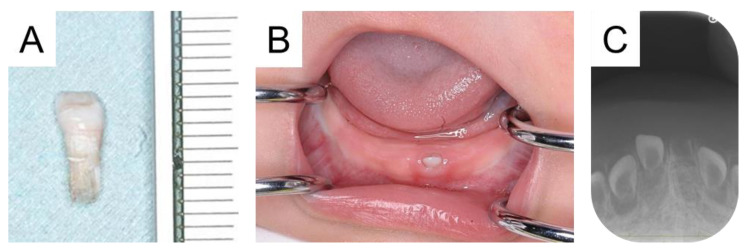 Figure 1
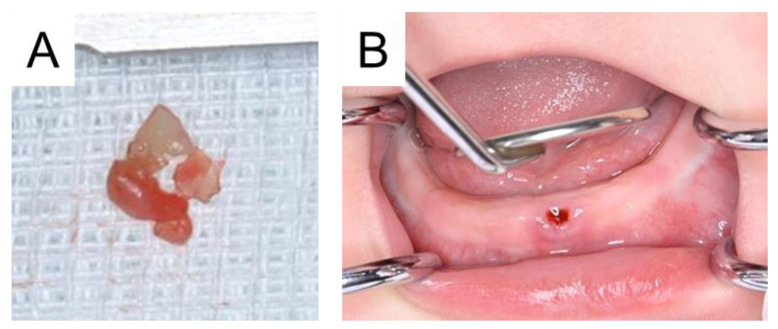 Figure 2
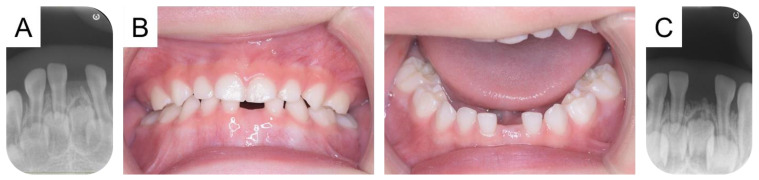 Figure 3
Peer Reviews
No public reviews on file for this paper yet. If you reviewed it on a platform where reviews are public (OpenReview, ICLR, NeurIPS, ICML), you can paste yours below so the community can read it here.
Videos
No videos yet. Explain this paper in a talk, walkthrough, or lecture? Add one.
Taxonomy
TopicsUrological Disorders and Treatments · Oral and Craniofacial Lesions · Dental Trauma and Treatments
The reference list from the paper itself. Each links out to its DOI / PubMed record.
- 1Tsubone H. Onishi T. Hayashibara T. Sobue S. Ooshima T. Clinico-pathological aspects of a residual natal tooth: A case report J. Oral Pathol. Med.20023123924110.1034/j.1600-0714.2002.310408.x 12076328 · doi ↗ · pubmed ↗
- 2Olszewska A. HanćA. The potential of trace elements mapping in child’s natal tooth by laser ablation-ICPMS method J. Environ. Health Sci. Eng.20211937938810.1007/s 40201-021-00611-234150242 PMC 8172758 · doi ↗ · pubmed ↗
- 3Leung A.K. Robson W.L. Natal teeth: A review J. Natl. Med. Assoc.20069822622816708508 PMC 2595049 · pubmed ↗
- 4Bhat V. Bhat V.S. Vadakkan J. Bhat S.S. Shetty S. Hegde S.K. Prosthodontic Management of Congenital Hypothyroidism with Anodontia: A Case Report Int. J. Clin. Pediatr. Dent.2021145865893482451910.5005/jp-journals-10005-1994 PMC 8585887 · doi ↗ · pubmed ↗
- 5Yamashita N. Mukai Y. Suzuki Y. Sasa R. Kodaka T. Higashi S. Radiographical and histological observations of newly formed root in the site of young permanent tooth displaced in trauma Jpn. J. Pediatr. Dent.198119546558(In Japanese)
- 6Akitomo T. Asao Y. Iwamoto Y. Kusaka S. Usuda M. Kametani M. Ando T. Sakamoto S. Mitsuhata C. Kajiya M. A Third Supernumerary Tooth Occurring in the Same Region: A Case Report Dent. J.2023114910.3390/dj 1102004936826194 PMC 9955779 · doi ↗ · pubmed ↗
- 7Mohammad Z. Bagalkotkar A. Mishra A. Veerala G. Customized hybrid bluegrass appliance: An innovative technique Int. J. Clin. Pediatr. Dent.20181114114510.5005/jp-journals-10005-150029991868 PMC 6034056 · doi ↗ · pubmed ↗
- 8Akitomo T. Kusaka S. Iwamoto Y. Usuda M. Kametani M. Asao Y. Nakano M. Tachikake M. Mitsuhata C. Nomura R. Five-Year Follow-Up of a Child with Non-Syndromic Oligodontia from before the Primary Dentition Stage: A Case Report Children 20231071710.3390/children 1004071737189966 PMC 10136868 · doi ↗ · pubmed ↗