Curiosity and Mind Wandering During Music Listening Are Negatively Correlated
Juan Felipe Pérez Ariza, Diana Omigie

TL;DR
The study shows that when people feel curious about music, they are less likely to have their minds wander.
Contribution
It demonstrates a negative correlation between curiosity and mind wandering during music listening.
Findings
Curiosity and mind wandering are negatively correlated during music listening.
Expertise and music's information dynamics influence mind wandering patterns.
Abstract
Curiosity, a crucial trigger of exploration and learning, has been described as the antithesis of mind wandering, a state of non-engagement with the external environment or a given task. Findings have confirmed that music’s structure influences levels of curiosity in listeners as they listen and, as such, suggests that this context could be useful in examining the relationship between curiosity and mind wandering. Here, participants were exposed to extended melodies twice, during which they carried out two counterbalanced tasks: one requiring them, whenever probed, to indicate whether they had been mind wandering at that moment and the other requiring them to indicate, when probed, how curious they were feeling about the music at that moment. Critically, participants were probed at the exact same moments in the music when completing the two tasks, allowing the relationship between…
Genes, proteins, chemicals, diseases, species, mutations and cell lines named across the full text — each resolved to its canonical identifier and authoritative record.
Click any figure to enlarge with its caption.
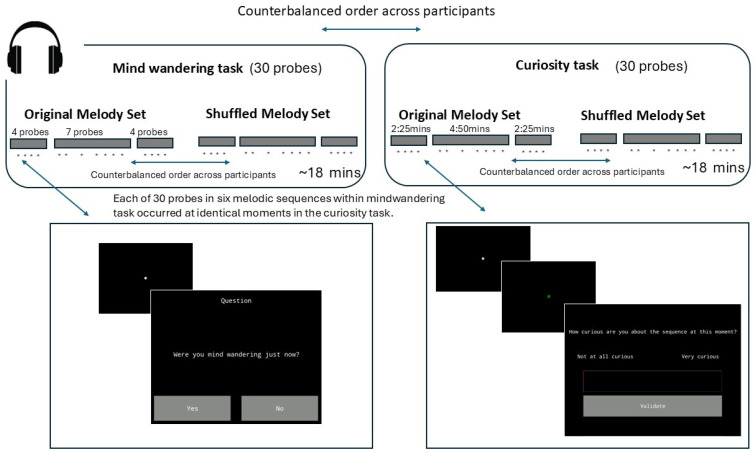 Figure 1
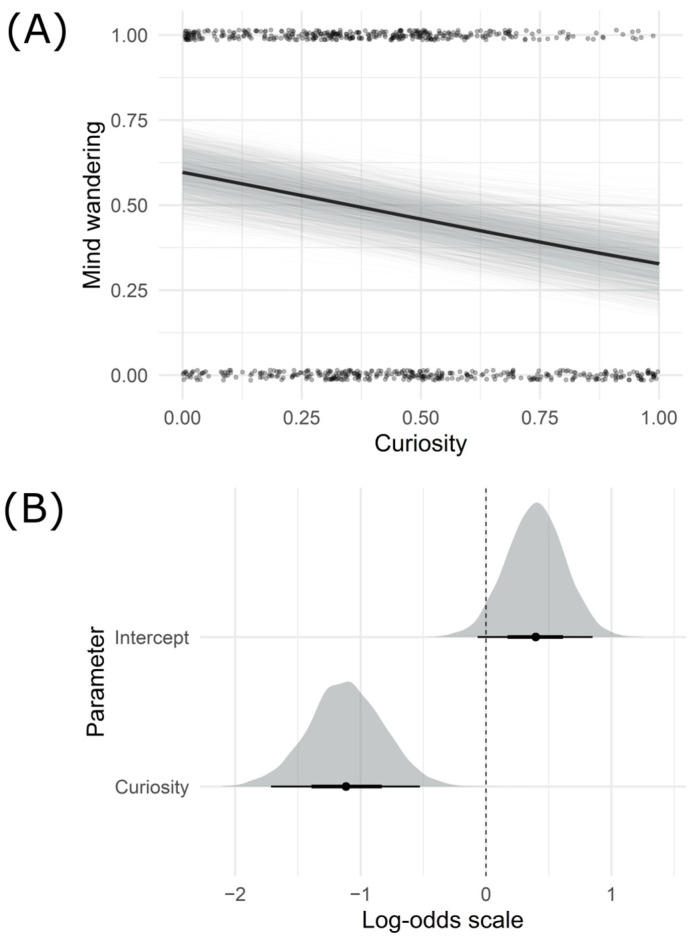 Figure 2
Peer Reviews
No public reviews on file for this paper yet. If you reviewed it on a platform where reviews are public (OpenReview, ICLR, NeurIPS, ICML), you can paste yours below so the community can read it here.
Videos
No videos yet. Explain this paper in a talk, walkthrough, or lecture? Add one.
Taxonomy
TopicsMind wandering and attention · Anxiety, Depression, Psychometrics, Treatment, Cognitive Processes · Perfectionism, Procrastination, Anxiety Studies