Antibacterial Effects of Synthetic Plantaricins Against Staphylococcus aureus
Seung-Eun Oh, Sojeong Heo, Gawon Lee, Jina Kim, Mi-Sun Kwak, Do-Won Jeong

TL;DR
This study shows that synthetic plantaricins can kill Staphylococcus aureus, a harmful bacteria, and could be used as natural antimicrobial agents.
Contribution
The study introduces synthetic plantaricin combinations and evaluates their antibacterial mechanisms and stability against S. aureus.
Findings
Synthetic plantaricin combinations showed minimal inhibitory concentrations between 1.4 and 1.8 μg/mL against S. aureus.
Raman spectra and electron microscopy confirmed cell lysis caused by the synthetic plantaricins.
Antibacterial activity was stable at temperatures below 40°C and pH 4–7, but decreased in the presence of proteases.
Abstract
Background/Objectives: Plantaricins without a signal sequence were synthesized based on bacteriocins, plantaricins A, E, F, J, and K, of Lactiplantibacillus plantarum KM2. The antibacterial activities of four combinations of synthetic plantaricins—spPlnA, E&F, E&J, and J&K—were identified against Staphylococcus aureus ATCC 12692. And in this experiment, we aimed to identify the antimicrobial mechanism of the synthesized plantaricin sample against S. aureus. Methods/Results: The minimal inhibitory concentrations for each combination were 1.4 μg/mL, 1.8 μg/mL, 1.6 μg/mL, and 1.6 μg/mL, respectively. Raman spectra changed after treating S. aureus ATCC 12692 with synthetic plantaricins. Furthermore, transmission electron microscopy results revealed that the four synthetic plantaricin combinations could induce the cell lysis of S. aureus ATCC 12692. Finally, the four synthetic plantaricin…
Genes, proteins, chemicals, diseases, species, mutations and cell lines named across the full text — each resolved to its canonical identifier and authoritative record.
Click any figure to enlarge with its caption.
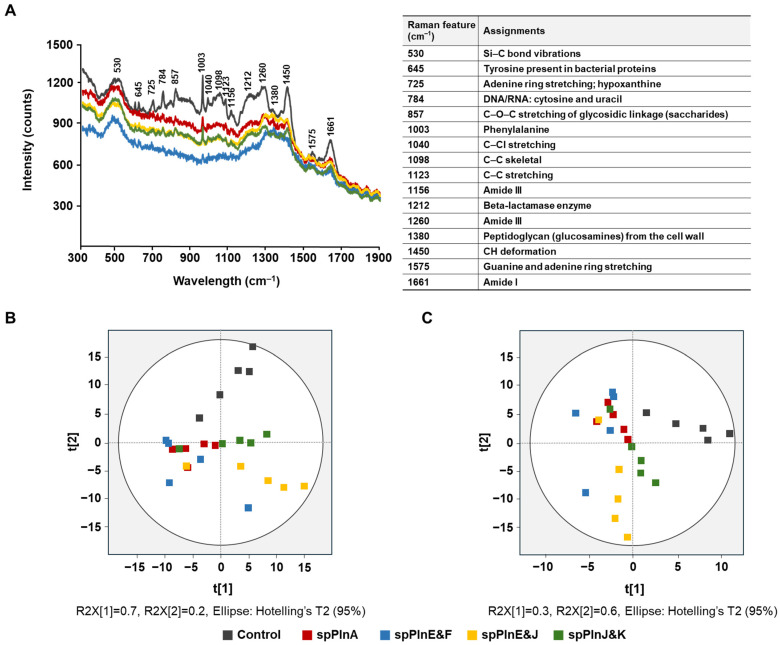 Figure 1
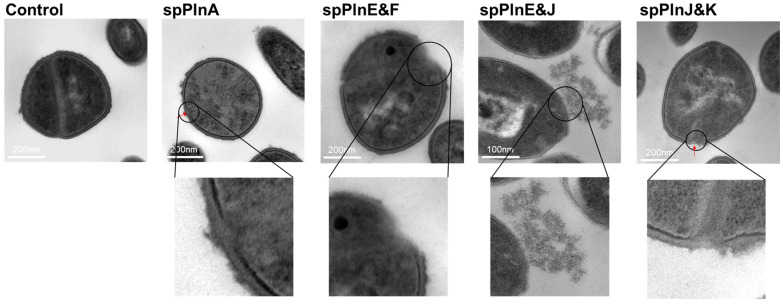 Figure 2
Peer Reviews
No public reviews on file for this paper yet. If you reviewed it on a platform where reviews are public (OpenReview, ICLR, NeurIPS, ICML), you can paste yours below so the community can read it here.
Videos
No videos yet. Explain this paper in a talk, walkthrough, or lecture? Add one.
Taxonomy
TopicsMicrobial Metabolism and Applications · Phytochemical Studies and Bioactivities · Medicinal Plants and Neuroprotection