Differences Between Patients With Multiple System Atrophy With Predominant Parkinsonism and Parkinson's Disease Based on fNIRS and Gait Analysis
Mengxi Gao, Heng Zhang, Aidi Shan, Yongsheng Yuan, Xingyue Cao, Lina Wang, Caiting Gan, Huimin Sun, Shiyi Ye, Chenghui Wan, Youyong Kong, Kezhong Zhang

TL;DR
This study compares gait and brain activity in MSA-P and Parkinson's disease patients during walking tasks to identify distinguishing features.
Contribution
The study identifies increased DLPFC activity and gait variability in MSA-P patients during dual-task walking as potential diagnostic markers.
Findings
MSA-P patients showed higher step length variability and DLPFC activity during dual-task walking compared to PD patients and healthy controls.
ΔHbO2 in the right DLPFC during dual-task walking had high specificity for distinguishing MSA-P patients.
A significant interaction effect was found in the right DLPFC between MSA-P and PD patients during dual-task walking.
Abstract
To investigate the differences in gait parameters and cortical activity during a single‐task walking (STW) and cognitive dual‐task walking (DTW) between multiple system atrophy with predominant parkinsonism (MSA‐P) and Parkinson's disease (PD). 24 MSA‐P patients, 20 PD patients, and 22 healthy controls (HCs) were enrolled. Gait parameters were collected using a portable inertial measurement unit system, and the relative change of oxyhemoglobin (ΔHbO2) in the bilateral frontal and sensorimotor cortex was obtained by functional near‐infrared spectroscopy during walking with and without cognitive tasks. MSA‐P patients had increased step length variability and higher ΔHbO2 in the right dorsolateral prefrontal cortex (DLPFC), relative to PD patients and HCs during the DTW condition. Meanwhile, MSA‐P patients exhibited higher step length variability and ΔHbO2 in the right DLPFC during DTW…
Genes, proteins, chemicals, diseases, species, mutations and cell lines named across the full text — each resolved to its canonical identifier and authoritative record.
Click any figure to enlarge with its caption.
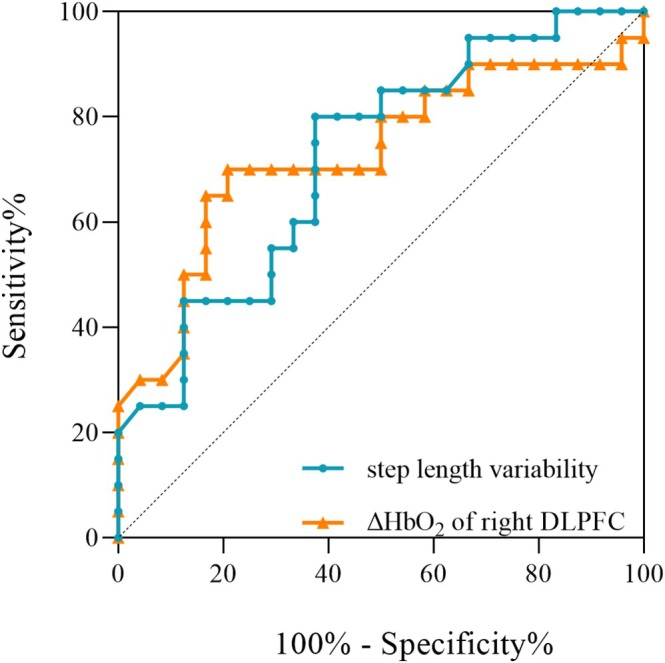 Figure 1
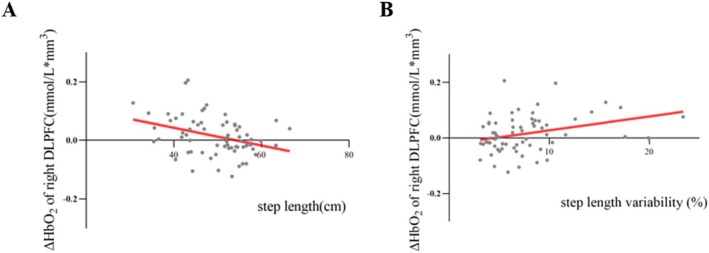 Figure 2
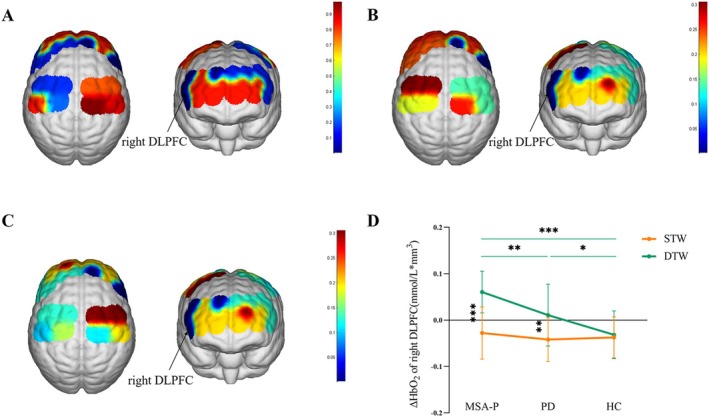 Figure 3
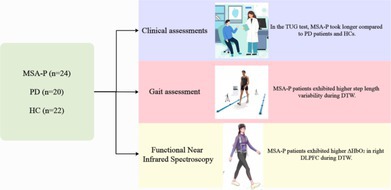 Figure 4
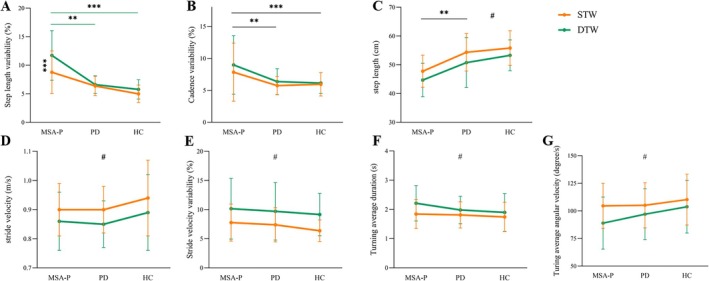 Figure 5
Peer Reviews
No public reviews on file for this paper yet. If you reviewed it on a platform where reviews are public (OpenReview, ICLR, NeurIPS, ICML), you can paste yours below so the community can read it here.
Videos
No videos yet. Explain this paper in a talk, walkthrough, or lecture? Add one.
Taxonomy
TopicsParkinson's Disease Mechanisms and Treatments · Balance, Gait, and Falls Prevention · Muscle activation and electromyography studies