Phylogenomic resolution of marine to freshwater dinoflagellate transitions
Mahara Mtawali, Elizabeth C Cooney, Jayd Adams, Joshua Jin, Corey C Holt, Patrick J Keeling

TL;DR
This study uses transcriptomes to uncover multiple transitions of dinoflagellates from marine to freshwater environments and explores their evolutionary relationships.
Contribution
The study provides a robust phylogenomic analysis resolving at least seven freshwater transitions in dinoflagellates using 30 freshwater transcriptomes.
Findings
At least seven independent transitions from marine to freshwater environments in dinoflagellates were resolved using phylogenomic analysis.
Environmental data mapping identified additional unsampled freshwater dinoflagellate lineages.
Durinskia species host cells are closely related, but their plastids likely originated from two distinct freshwater Nitzschia species.
Abstract
Dinoflagellates are an abundant and diverse group of protists that inhabit aquatic environments worldwide. They are characterized by numerous unique cellular and molecular traits, and have adapted to an unusually broad range of life strategies, including phototrophy, heterotrophy, parasitism, and all combinations of these. For most microbial groups, transitions from marine to freshwater environments are relatively rare, as changes in salinity are thought to lead to significant osmotic challenges that are difficult for the cell to overcome. Recent work has shown that dinoflagellates have overcome these challenges relatively often in evolutionary time, but because this is mostly based on single gene trees with low overall support, many of the relationships between freshwater and marine groups remain unresolved. Normally, phylogenomics could clarify such conclusions, but despite the recent…
Genes, proteins, chemicals, diseases, species, mutations and cell lines named across the full text — each resolved to its canonical identifier and authoritative record.
Click any figure to enlarge with its caption.
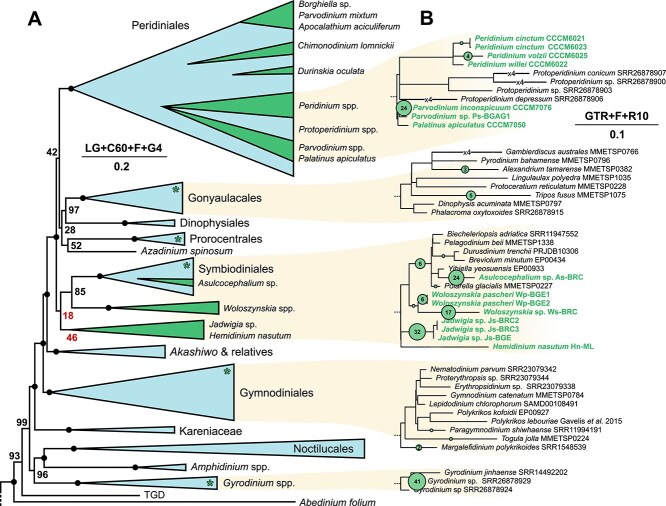 Figure 1
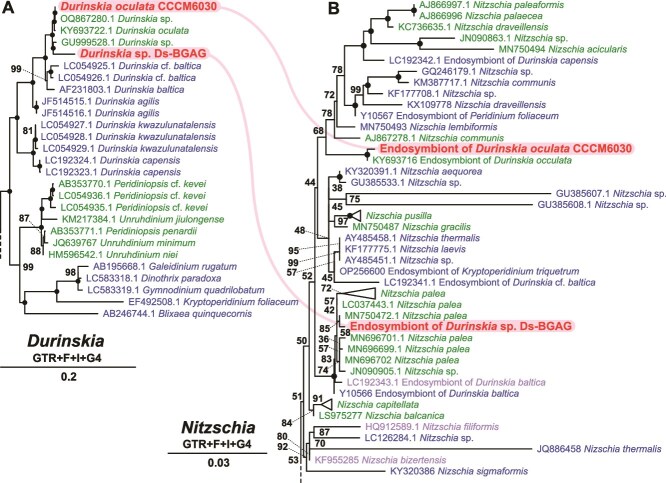 Figure 2
Peer Reviews
No public reviews on file for this paper yet. If you reviewed it on a platform where reviews are public (OpenReview, ICLR, NeurIPS, ICML), you can paste yours below so the community can read it here.
Videos
No videos yet. Explain this paper in a talk, walkthrough, or lecture? Add one.
Taxonomy
TopicsProtist diversity and phylogeny · Microbial Community Ecology and Physiology · Genomics and Phylogenetic Studies