Pre-existing parasympathetic dominance seems to cause persistent heart rate slowing after 6 months of fingolimod treatment in patients with multiple sclerosis
Max J. Hilz, Francesca Canavese, Carmen de Rojas-Leal, De-Hyung Lee, Ralf A. Linker, Ruihao Wang

TL;DR
Some patients with multiple sclerosis experience long-lasting heart rate slowing after starting fingolimod due to pre-existing strong parasympathetic nervous system activity.
Contribution
Identifies pre-existing parasympathetic dominance as a cause of prolonged heart rate slowing during fingolimod treatment.
Findings
11 patients showed prolonged HR slowing after fingolimod initiation due to inability to downregulate parasympathetic activity upon standing.
After 6 months, these 11 patients maintained more parasympathetic influence on HR compared to others.
Other patients showed reduced parasympathetic modulation and baroreflex sensitivity after 6 months of treatment.
Abstract
Vagomimetic fingolimod effects cause heart rate (HR) slowing upon treatment initiation but wear off with sphingosine-1-phosphate receptor downregulation. Yet, prolonged HR slowing may persist after months of fingolimod treatment. We evaluated whether cardiovascular autonomic modulation differs before and 6 months after fingolimod initiation between patients with RRMS with and without initially prolonged HR slowing upon fingolimod initiation. In 34 patients with RRMS, we monitored RR intervals (RRI) and blood pressure (BP), at rest and upon standing up before fingolimod initiation. Six hours and 6 months after fingolimod initiation, we repeated recordings at rest. At the three time points, we calculated autonomic parameters, including RRI standard deviation (RRI-SD), RRI-total-powers, RMSSD, RRI high-frequency [HF] powers, RRI and BP low-frequency (LF) powers, and baroreflex sensitivity…
Genes, proteins, chemicals, diseases, species, mutations and cell lines named across the full text — each resolved to its canonical identifier and authoritative record.
Click any figure to enlarge with its caption.
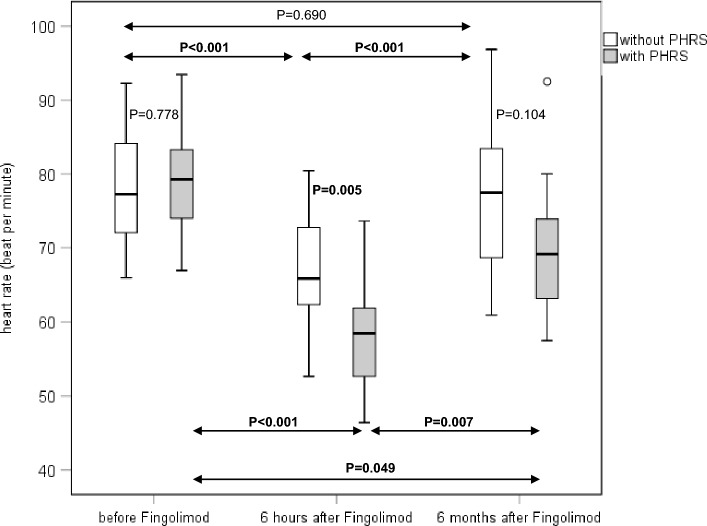 Figure 1
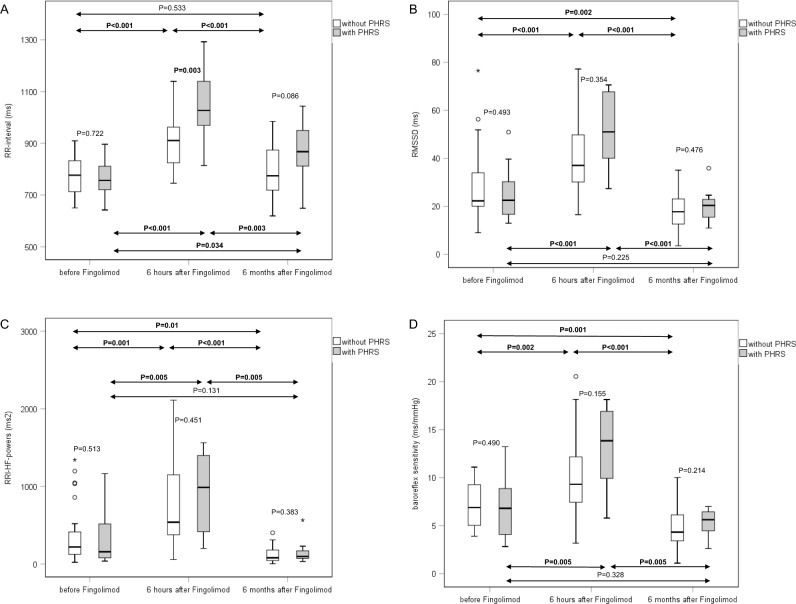 Figure 2
Peer Reviews
No public reviews on file for this paper yet. If you reviewed it on a platform where reviews are public (OpenReview, ICLR, NeurIPS, ICML), you can paste yours below so the community can read it here.
Videos
No videos yet. Explain this paper in a talk, walkthrough, or lecture? Add one.
Taxonomy
TopicsSphingolipid Metabolism and Signaling · Multiple Sclerosis Research Studies · Nonlinear Dynamics and Pattern Formation