Unravelling the small number bias: the role of pseudoneglect and frequency of use in random number generation
Serena Mingolo, Valter Prpic, Alberto Mariconda, Tiziano Agostini, Mauro Murgia

TL;DR
People tend to choose small numbers when asked to generate random numbers, and this bias is linked to how we mentally process numbers and how often we use small numbers in daily life.
Contribution
This study investigates whether pseudoneglect or frequency of use better explains the small number bias in random number generation.
Findings
Participants showed a small number bias when viewing an inverted clockface.
No bias was observed when viewing a regular clockface.
Both pseudoneglect and frequency of use contribute to the small number bias.
Abstract
When asked to produce random numbers individuals generate more small numbers than large ones, a phenomenon known as “Small Number Bias” (SNB; Loetscher & Brugger, 2007). This bias has been associated with a spatial preference known as “pseudoneglect,” where attention is biased towards the left side of the mental number line during numerical processing (Loetscher & Brugger, 2009). Another potential explanation for SNB is the higher frequency of use of small compared to large numbers in daily life (Dehaene & Mehler, 1992). This study aims to determine which of these two explanations better accounts for SNB. Participants were asked to generate random numbers from 1 to 12 while viewing either a regular or an inverted clockface. On a regular clockface smaller numbers are on the right, whereas on an inverted clockface they are on the left. Both theories predict SNB for the inverted clockface.…
Genes, proteins, chemicals, diseases, species, mutations and cell lines named across the full text — each resolved to its canonical identifier and authoritative record.
Click any figure to enlarge with its caption.
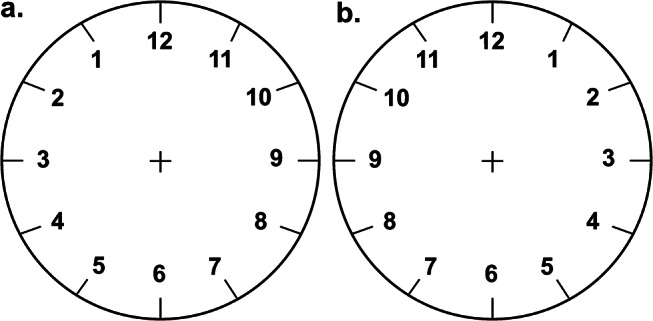 Figure 1
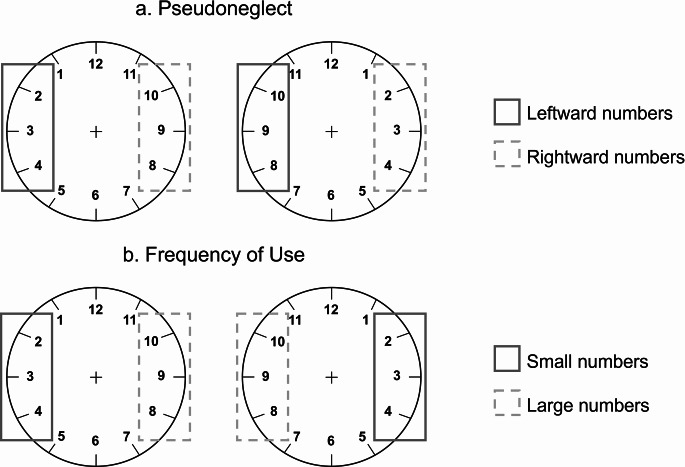 Figure 2
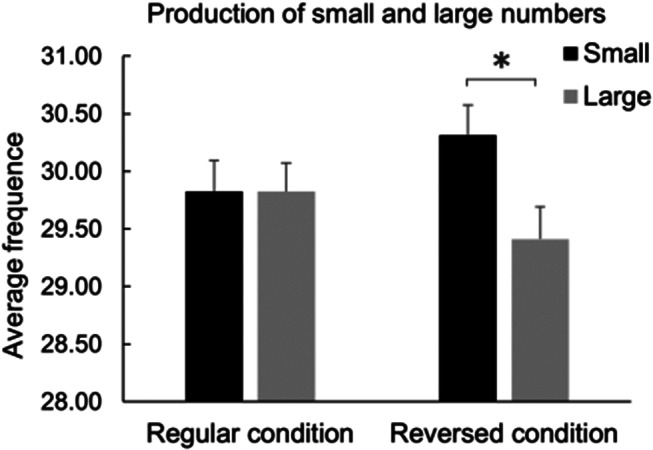 Figure 3
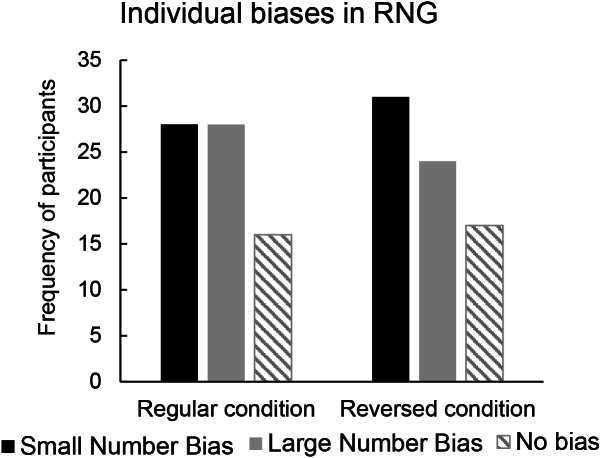 Figure 4
Peer Reviews
No public reviews on file for this paper yet. If you reviewed it on a platform where reviews are public (OpenReview, ICLR, NeurIPS, ICML), you can paste yours below so the community can read it here.
Videos
No videos yet. Explain this paper in a talk, walkthrough, or lecture? Add one.
Taxonomy
TopicsCognitive and developmental aspects of mathematical skills · Spatial Neglect and Hemispheric Dysfunction · Visual perception and processing mechanisms