Postural control of sway dynamics on an unstable surface reduces similarity in activation patterns of synergistic lower leg muscles
Lida Mademli, Maria-Elissavet Nikolaidou, Sebastian Bohm, Adamantios Arampatzis

TL;DR
This study shows that standing on an unstable surface increases the diversity of muscle activation patterns in the lower leg and thigh, which may help improve balance and stability.
Contribution
The study reveals that unstable surfaces reduce similarity in activation patterns of synergistic lower leg muscles compared to stable surfaces.
Findings
Triceps surae muscles showed lower activation pattern similarity than quadriceps muscles across all conditions.
Unstable surfaces reduced similarity in activation patterns for both muscle groups.
No interaction was found between muscle pair and surface condition in affecting similarity.
Abstract
Diversity of activation patterns within synergistic muscles can be important for stability control in challenging conditions. This study investigates the similarity of activation patterns within the triceps surae and quadriceps femoris muscles and the effects of unstable surface during a visually guided postural task. Eighteen healthy adults performed a visually guided anteroposterior tracking task on both stable and unstable surfaces. Electromyographic activity of triceps surae (gastrocnemius medialis, gastrocnemius lateralis, soleus) and quadriceps femoris (vastus medialis, vastus lateralis, rectus femoris) was recorded at 1,000 Hz. Cosine similarity (CS) between muscle pairs within each muscle group was calculated to assess the similarity of activation patterns of synergistic muscles for stable and unstable conditions. To compare the CS of the muscle pairs, a linear mixed model was…
Genes, proteins, chemicals, diseases, species, mutations and cell lines named across the full text — each resolved to its canonical identifier and authoritative record.
Click any figure to enlarge with its caption.
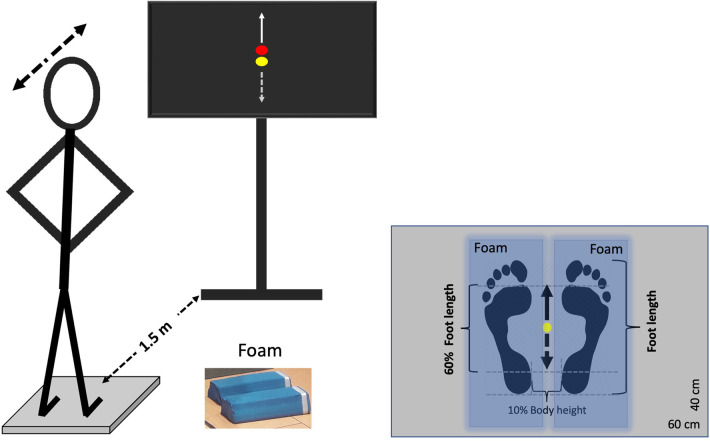 Figure 1
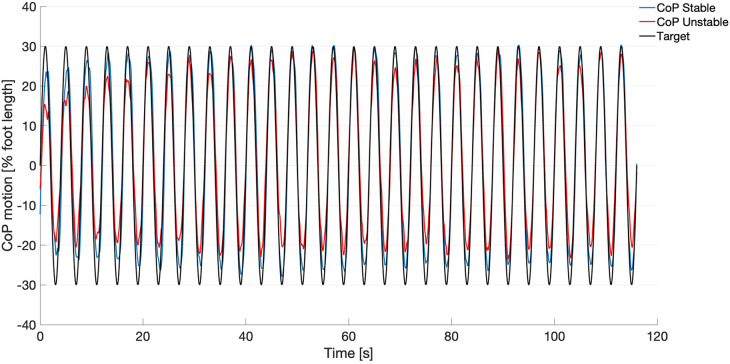 Figure 2
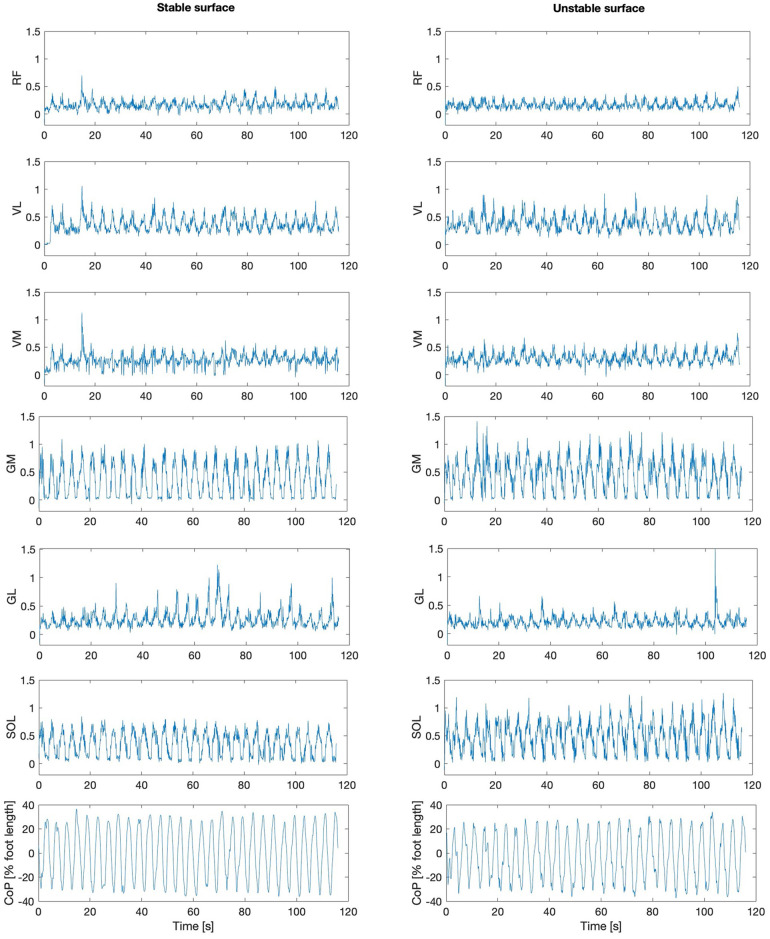 Figure 3
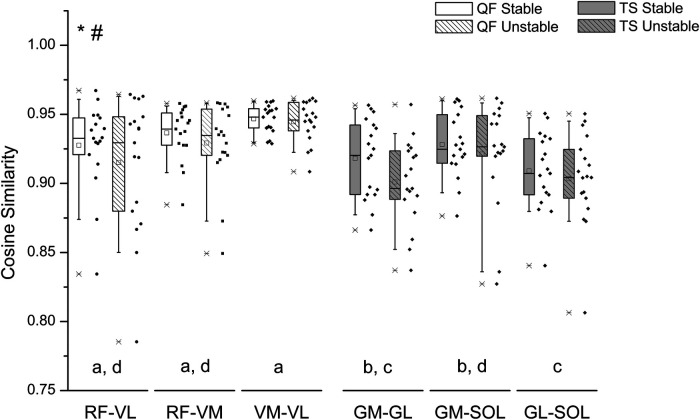 Figure 4
Peer Reviews
No public reviews on file for this paper yet. If you reviewed it on a platform where reviews are public (OpenReview, ICLR, NeurIPS, ICML), you can paste yours below so the community can read it here.
Videos
No videos yet. Explain this paper in a talk, walkthrough, or lecture? Add one.
Taxonomy
TopicsBalance, Gait, and Falls Prevention · Muscle activation and electromyography studies · Motor Control and Adaptation