Distinct and content-specific neural representations of self- and other-produced actions in joint piano performance
Natalie Kohler, Anna M. Czepiel, Örjan de Manzano, Giacomo Novembre, Peter E. Keller, Arno Villringer, Daniela Sammler

TL;DR
Expert pianists use distinct brain regions to represent their own and their partner's actions during joint performances, suggesting specialized neural mechanisms for coordination.
Contribution
The study reveals parallel, content-specific neural representations of self- and other-produced actions in joint music performance using fMRI and MVPA.
Findings
Left M1 showed higher classification accuracy for self-produced right-hand melodies.
Right PMC showed higher accuracy for other-produced left-hand basslines.
PMC representations remained precise even when unfamiliar with the partner's part.
Abstract
During ensemble performance, musicians predict their own and their partners’ action outcomes to smoothly coordinate in real time. The neural auditory-motor system is thought to contribute to these predictions by running internal forward models that simulate self- and other-produced actions slightly ahead of time. What remains elusive, however, is whether and how own and partner actions can be represented simultaneously and distinctively in the sensorimotor system, and whether these representations are content-specific. Here, we applied multivariate pattern analysis (MVPA) to functional magnetic resonance imaging (fMRI) data of duetting pianists to dissociate the neural representation of self- and other-produced actions during synchronous joint music performance. Expert pianists played familiar right-hand melodies in a 3 T MR-scanner, in duet with a partner who played the corresponding…
Genes, proteins, chemicals, diseases, species, mutations and cell lines named across the full text — each resolved to its canonical identifier and authoritative record.
Click any figure to enlarge with its caption.
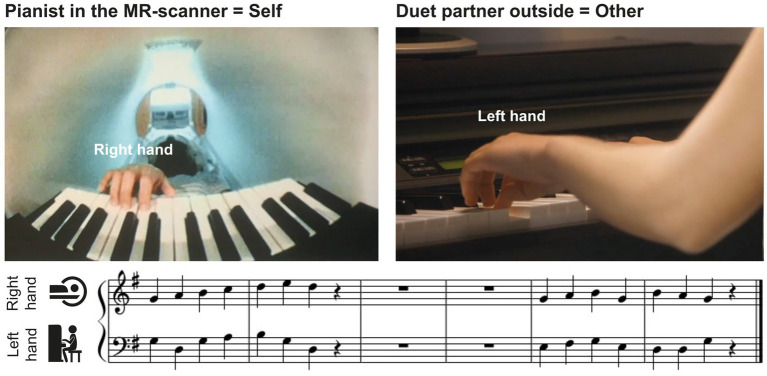 Figure 1
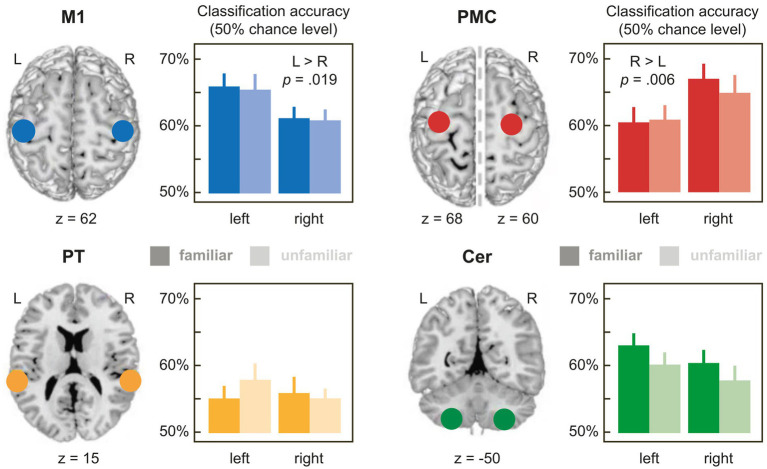 Figure 2
Peer Reviews
No public reviews on file for this paper yet. If you reviewed it on a platform where reviews are public (OpenReview, ICLR, NeurIPS, ICML), you can paste yours below so the community can read it here.
Videos
No videos yet. Explain this paper in a talk, walkthrough, or lecture? Add one.
Taxonomy
TopicsAction Observation and Synchronization · Neuroscience and Music Perception · Motor Control and Adaptation