Proprotein convertase subtilisin/kexin type 9: a promising marker of cardiovascular risk in post-menopausal diabetic women in primary prevention
Michelangelo Rottura, Maria Antonietta Barbieri, Carmine Siniscalchi, Pierpaolo Di Micco, Selene Francesca Anna Drago, Marianna Gigliotti De Fazio, Arrigo Francesco Giuseppe Cicero, Federica Fogacci, Giuseppe Armentaro, Angela Sciacqua, Vincenzo Arcoraci, Natasha Irrera

TL;DR
This study explores how PCSK9 levels relate to cardiovascular risk in post-menopausal diabetic women, finding a link with blood pressure and cholesterol markers.
Contribution
The study identifies ApoB and LDL as factors influencing PCSK9 levels and shows PCSK9's direct effect on pulse wave velocity in diabetic women.
Findings
Apolipoprotein B is an independent predictor of PCSK9 levels.
PCSK9 levels are inversely related to LDL cholesterol levels.
PCSK9 levels directly influence pulse wave velocity in post-menopausal diabetic women.
Abstract
Proprotein convertase subtilisin/kexin type 9 (PCSK9) increases circulating LDL levels and cardiovascular disease (CVD) risk; its levels may be related to the dysregulation of glycemic control and may be affected by estrogens. The aim of this study was to assess factors related to PCSK9 levels, and to evaluate the correlation between PCSK9 levels and CV parameters in post-menopausal diabetic women in primary prevention. Generalized linear models (GLM) were adopted to evaluate predictors of PCSK9 levels as well as factors related to CV outcomes, such as pulse wave velocity (PWV), pulse pressure (PP), and augmentation index (AI). A total of 135 post-menopausal diabetic women, with a median (Q1-Q3) serum PCSK9 levels of 370.3 (344.0–409.4) ng/ml were enrolled. Apolipoprotein B values resulted an independent predictor of PCSK9 levels (B = 1.023; p < 0.001). However, LDL values were…
Genes, proteins, chemicals, diseases, species, mutations and cell lines named across the full text — each resolved to its canonical identifier and authoritative record.
Click any figure to enlarge with its caption.
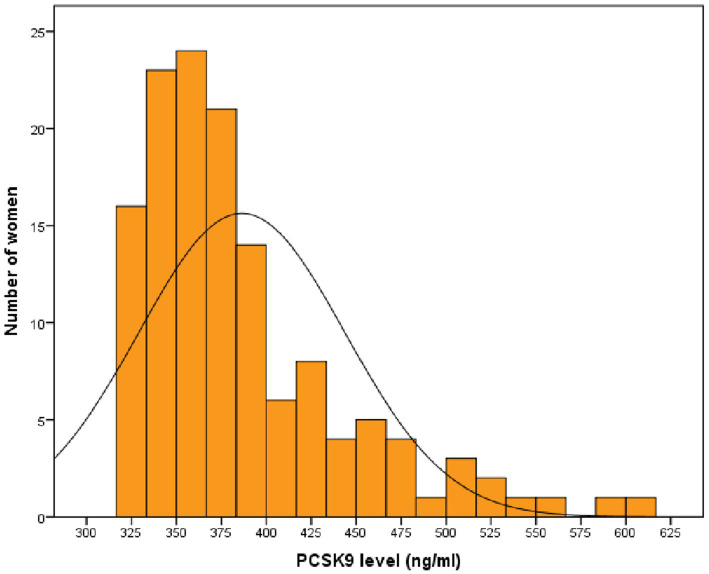 Figure 1
 Figure 2
 Figure 3
 Figure 4
Peer Reviews
No public reviews on file for this paper yet. If you reviewed it on a platform where reviews are public (OpenReview, ICLR, NeurIPS, ICML), you can paste yours below so the community can read it here.
Videos
No videos yet. Explain this paper in a talk, walkthrough, or lecture? Add one.
Taxonomy
TopicsLipoproteins and Cardiovascular Health · Vitamin K Research Studies · Diabetes, Cardiovascular Risks, and Lipoproteins