Identification and characterization of the elusive protein backbone of the immuno-dominant and species-specific Em2(G11) metacestode antigen of Echinococcus multilocularis
Philipp A. Kronenberg, Teivi Laurimäe, Michael Reinehr, Ansgar Deibel, Sina Hasler, Peter Gehrig, Achim Weber, Peter Deplazes, Ramon M. Eichenberger

TL;DR
Researchers identified the protein backbone of the Em2(G11) antigen from Echinococcus multilocularis, a key diagnostic marker for alveolar echinococcosis.
Contribution
The study identifies the protein backbone of the glycosylated Em2(G11) antigen and produces a monoclonal antibody specific to it.
Findings
The Em2(G11) antigen consists of 33 unique proteins, with EmuJ_001105600.1 being the most abundant.
A monoclonal antibody (mAbEm2rec) was developed and reacts specifically with the antigen after deglycosylation.
The native Em2(G11) antigen is more effective for antibody detection in human patients than the recombinant version.
Abstract
Alveolar echinococcosis (AE) caused by Echinococcus multilocularis, is a severe zoonotic disease in humans. One of the major metacestode antigens of E. multilocularis is the Em2 or Em2(G11) native purified antigen. The Em2 antigen is used for the serological and histopathological diagnosis of AE in humans and plays an important role in parasite–host interactions. As the Em2(G11) antigen is a mucin-type and glycosylated protein, the protein backbone has not been identified yet. We have targeted the protein backbone identification through mass spectrometry (LC-MS/MS) analysis of the Em2(G11) antigen. As a result, we evidenced that the Em2(G11) antigen consists of 33 unique protein candidates of which the most abundant was ‘’EmuJ_001105600.1’’. This protein (889 amino acids) had 427 predicted glycosylation sites. Amino acid composition comparison was in agreement with earlier studies and…
Genes, proteins, chemicals, diseases, species, mutations and cell lines named across the full text — each resolved to its canonical identifier and authoritative record.
Click any figure to enlarge with its caption.
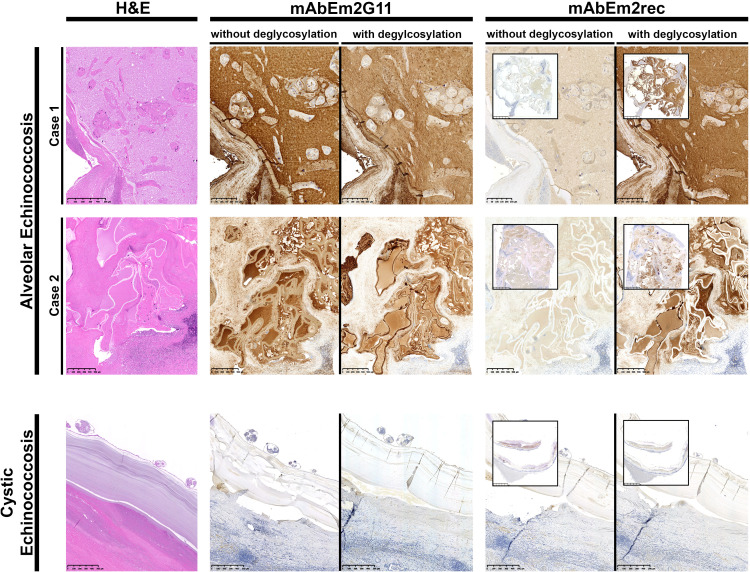 Figure 1
Peer Reviews
No public reviews on file for this paper yet. If you reviewed it on a platform where reviews are public (OpenReview, ICLR, NeurIPS, ICML), you can paste yours below so the community can read it here.
Videos
No videos yet. Explain this paper in a talk, walkthrough, or lecture? Add one.
Taxonomy
TopicsParasitic infections in humans and animals · Parasitic Infections and Diagnostics · Congenital Anomalies and Fetal Surgery