Active surveillance in patients with a complete clinical response after neoadjuvant chemoradiotherapy for esophageal- and gastroesophageal junction cancer
Tamara J. Huizer, Sjoerd M. Lagarde, Joost J.M.E. Nuyttens, Lindsey Oudijk, Manon C.W. Spaander, Roelf Valkema, Bianca Mostert, Bas P.L. Wijnhoven

TL;DR
This paper reviews whether watching patients closely instead of immediately performing surgery after cancer treatment is a safe option for some esophageal cancer patients.
Contribution
The paper evaluates the safety and effectiveness of active surveillance as an alternative to standard surgery after cancer treatment.
Findings
Active surveillance may be a viable option for patients with no residual disease after treatment.
Combining endoscopy, ultrasound, and PET-CT helps detect residual disease effectively.
The safety and survival rates of active surveillance compared to surgery remain unclear.
Abstract
Neoadjuvant chemoradiotherapy in patients with esophageal- and gastroesophageal junction cancer induces tumor regression. In approximately one fourth of patients, this leads to a pathological complete response in the resection specimen. Hence, active surveillance may be an alternative strategy in patients without residual disease after neoadjuvant chemoradiotherapy. Previous studies have shown that the combination of esophagogastroduodenoscopy with bite-on-bite biopsies, endoscopic ultrasound with fine needle aspiration of suspected lymph nodes, and a PET-CT-scan can be considered adequate for the detection of residual disease. So far, it has been unclear whether active surveillance with surgery as needed is a safe treatment option and leads to non-inferior overall survival compared to standard esophagectomy after neoadjuvant chemoradiotherapy. This review will discuss the current…
Genes, proteins, chemicals, diseases, species, mutations and cell lines named across the full text — each resolved to its canonical identifier and authoritative record.
Click any figure to enlarge with its caption.
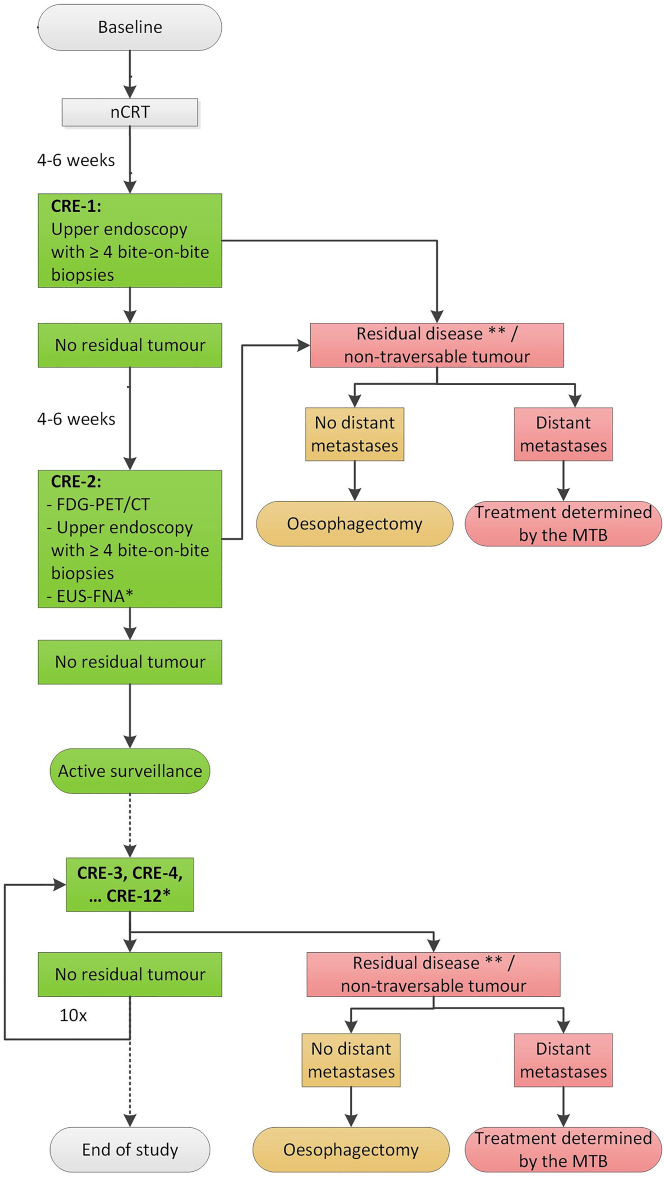 Figure 1
Peer Reviews
No public reviews on file for this paper yet. If you reviewed it on a platform where reviews are public (OpenReview, ICLR, NeurIPS, ICML), you can paste yours below so the community can read it here.
Videos
No videos yet. Explain this paper in a talk, walkthrough, or lecture? Add one.
Taxonomy
TopicsEsophageal Cancer Research and Treatment · Gastric Cancer Management and Outcomes · Esophageal and GI Pathology