Associations of maternal cyclin-dependent kinase 5 regulatory subunit-associated protein 1-like 1(CDKAL1) gene variants with adverse pregnancy outcome in Chinese women
Shuoying Yue, Meng Su, Zihao Zhang, Jing Li, Junhong Leng, Weiqin Li, Jin Liu, Tao Zhang, Yijuan Qiao, Zhijie Yu, Gang Hu, Jun Ma, Xilin Yang, Hui Wang

TL;DR
This study finds that certain genetic variants in the CDKAL1 gene in Chinese women are linked to higher risks of adverse pregnancy outcomes like low birth weight and macrosomia, even after accounting for gestational diabetes.
Contribution
The study identifies CDKAL1 gene variants as independent risk factors for adverse pregnancy outcomes in Chinese women, beyond the influence of gestational diabetes.
Findings
CDKAL1 genetic marker was associated with increased risk of adverse pregnancy outcome (OR: 2.51).
The marker was significantly linked to low birth weight (OR: 19.80) and macrosomia (OR: 2.40).
The association remained significant after adjusting for gestational diabetes mellitus.
Abstract
To test associations of cyclin-dependent kinase 5 regulatory subunit-associated protein 1-like 1 (CDKAL1) gene variants with the risk of adverse pregnancy outcome in Chinese women and whether the association was mediated by occurrence of gestational diabetes mellitus. We organized a 1:1 age-matched study nested within a prospective cohort of pregnant women (207 pairs) established in urban Tianjin. Adverse pregnancy outcome was defined as a composite outcome of preterm birth, low birth weight or macrosomia. Logistic regression analyses were used to estimate associations of CDKAL1 gene variants with adverse pregnancy outcome and its components. The CDKAL1 genetic marker was defined as encompassing any of the identified susceptibility variants for adverse pregnancy outcome. The CDKAL1 genetic marker was associated with the risk of adverse pregnancy outcome (OR: 2.51, 95%CI: 1.47, 4.28),…
Genes, proteins, chemicals, diseases, species, mutations and cell lines named across the full text — each resolved to its canonical identifier and authoritative record.
Click any figure to enlarge with its caption.
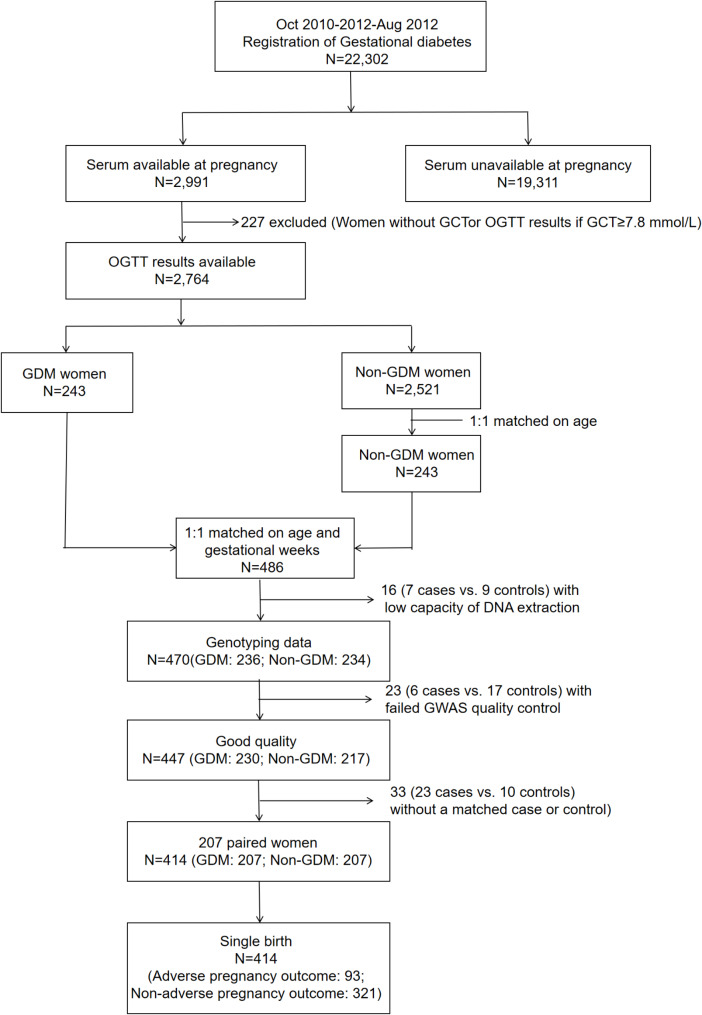 Figure 1
Peer Reviews
No public reviews on file for this paper yet. If you reviewed it on a platform where reviews are public (OpenReview, ICLR, NeurIPS, ICML), you can paste yours below so the community can read it here.
Videos
No videos yet. Explain this paper in a talk, walkthrough, or lecture? Add one.
Taxonomy
TopicsGestational Diabetes Research and Management · Birth, Development, and Health · Pregnancy and preeclampsia studies