The human milk endocannabinoidome is preserved by high hydrostatic pressure processing but altered by holder pasteurization
Lucie Marousez, Elizabeth Dumais, Léa Chantal Tran, Laure Dubernat, Marie De Lamballerie, Frédéric Gottrand, Delphine Ley, Nicolas Flamand, Vincenzo Di Marzo, Jean Lesage

TL;DR
This study compares how two milk processing methods affect endocannabinoid-like compounds in donor milk, finding that one method preserves them better than the other.
Contribution
The study introduces high hydrostatic pressure processing as a better alternative to pasteurization for preserving endocannabinoid mediators in donor milk.
Findings
High hydrostatic pressure processing preserves endocannabinoid-like mediator concentrations similar to raw donor milk.
Holder pasteurization significantly increases concentrations of four specific N-acyl-ethanolamines.
2-Monoacylglycerols and DHEA remain stable across all processing methods.
Abstract
The microbiological safety of donor milk (DM) is commonly ensured by holder pasteurization (HoP, 62.5°C for 30 min) in human milk banks despite its detrimental effects on several bioactive factors. We compared the concentration of twelve endocannabinoid (eCB)-like mediators in raw DM and in DM after holder pasteurization or high hydrostatic pressure processing (HHP, 350 MPa at 38°C), a non-thermal substitute for DM pasteurization. We measured five N-acyl-ethanolamines (NAEs) and seven 2-mono-acyl-glycerols (2-MAGs) in raw-DM, HHP-DM and HoP-DM using high-performance liquid chromatography coupled to tandem mass spectrometry (LC-MS/MS). HoP-DM and HHP-DM demonstrated comparable concentrations compared with raw DM of 2-MAGs as well as for N-docosapentaenoyl-ethanolamine (DHEA, an NAE). However, four other NAEs, including N-arachidonoyl-ethanolamine (AEA), N-palmitoyl-(PEA), N-oleoyl…
Genes, proteins, chemicals, diseases, species, mutations and cell lines named across the full text — each resolved to its canonical identifier and authoritative record.
Click any figure to enlarge with its caption.
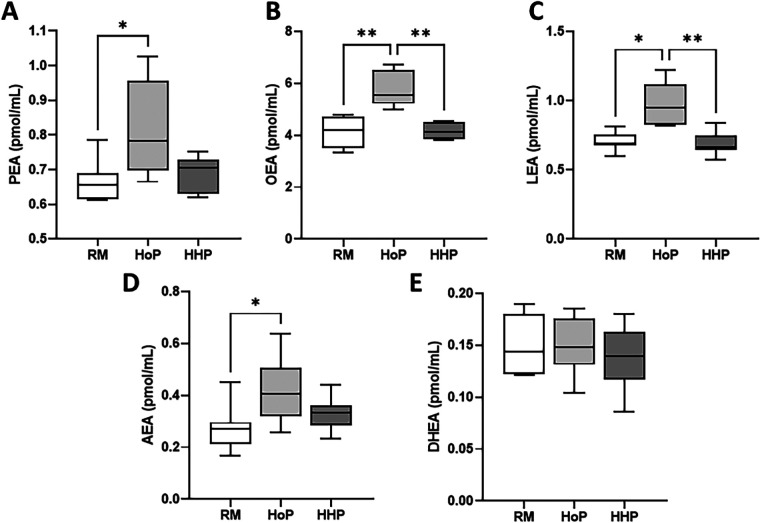 Figure 1
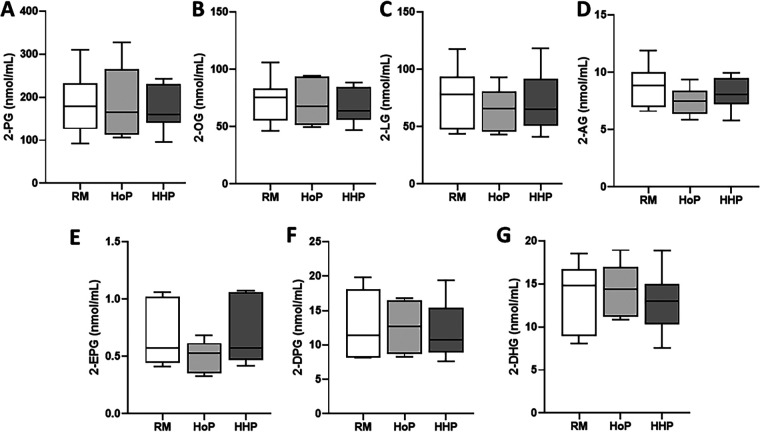 Figure 2
Peer Reviews
No public reviews on file for this paper yet. If you reviewed it on a platform where reviews are public (OpenReview, ICLR, NeurIPS, ICML), you can paste yours below so the community can read it here.
Videos
No videos yet. Explain this paper in a talk, walkthrough, or lecture? Add one.
Taxonomy
TopicsNeuroscience of respiration and sleep · Cannabis and Cannabinoid Research · Infant Health and Development