Correction and removal of expression of concern: Enhanced electrical and magnetic properties of (Co, Yb) co-doped ZnO memristor for neuromorphic computing
Noureddine Elboughdiri, Shahid Iqbal, Sherzod Abdullaev, Mohammed Aljohani, Akif Safeen, Khaled Althubeiti, Rajwali Khan

TL;DR
This paper corrects and removes an expression of concern for a study on a memristor material for neuromorphic computing.
Contribution
The paper addresses issues with a prior publication on (Co, Yb) co-doped ZnO memristor properties.
Findings
The original study's claims about enhanced electrical and magnetic properties are under scrutiny.
The correction and removal aim to maintain scientific integrity and accuracy in the field.
Abstract
Correction and removal of expression of concern for ‘Enhanced electrical and magnetic properties of (Co, Yb) co-doped ZnO memristor for neuromorphic computing’ by Noureddine Elboughdiri et al., RSC Adv., 2023, 13, 35993–36008, https://doi.org/10.1039/D3RA06853F.
Click any figure to enlarge with its caption.
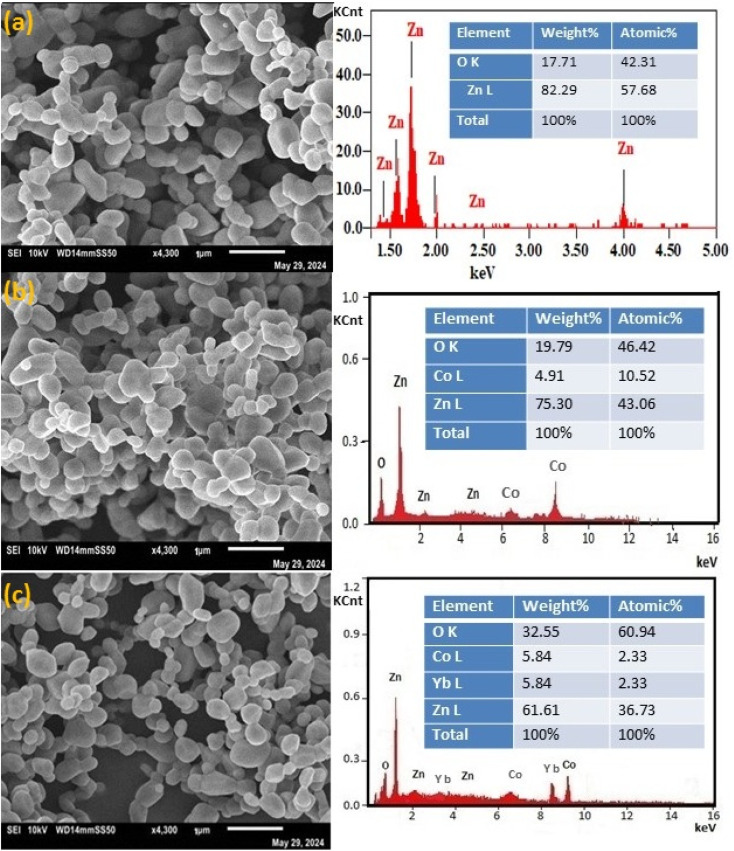 Figure 1
- —Taif University10.13039/501100006261
Peer Reviews
No public reviews on file for this paper yet. If you reviewed it on a platform where reviews are public (OpenReview, ICLR, NeurIPS, ICML), you can paste yours below so the community can read it here.
Videos
No videos yet. Explain this paper in a talk, walkthrough, or lecture? Add one.
Taxonomy
TopicsAdvanced Memory and Neural Computing · Machine Learning and ELM · Gas Sensing Nanomaterials and Sensors
The authors regret that due to an error in the data labels, the incorrect data was used for Fig. 4b.
The University of Lakki Marwat, Pakistan has investigated and confirmed the integrity and reliability of the EDX data associated with Fig. 4b and the new SEM data for Fig. 4, which are shown here.
The University of Lakki Marwat, Pakistan investigation found that as there is no SEM instrument at the institution the SEM analysis was outsourced to a collaborating institution. During this process, a communication error occurred between the graduate author and the SEM operator who collected the data for Fig. 4. This error resulted in the same data mistakenly being used for Fig. 4a and b of the original publication. The investigating committee were able to confirm that this overlap was caused by miscommunication between the graduate author and the SEM operator and was not due to deliberate misconduct. The original data for Fig. 4a and c are correct. New SEM data was collected from a separate collaborating institution and the investigating committee was able to verify the integrity and reliability of the new data.
This correction supersedes the information provided in the Expression of concern related to this article.
The Royal Society of Chemistry apologises for these errors and any consequent inconvenience to authors and readers.